


Most enterprise absence programs don't fail because of bad policy. They fail because nobody owns the operating model — the actual structure that determines who runs what, who pays for what, and who gets called when a leave case blows up at 4pm on a Friday.
You can have a polished policy library, a modern leave system, and a dozen well-meaning HR business partners, and still end up with three regions running intermittent leave three different ways, payroll finding out about approvals a week late, and finance unable to explain why absence spend climbed 18% year over year. That's not a policy gap. That's a structural one.
This piece is about structure. Specifically: how to choose between a centralized, embedded, or hybrid absence governance operating model, how to tie service levels to real costs so finance stops treating your program like a black hole, and how to run a governance cadence that doesn't collapse after the first quarter. You'll get org charts, RACI, SLA tiers, costing buckets, a funding checklist, and a 90/180/365 rhythm you can lift directly into a deck.
Why the operating model is what actually breaks
There's a pattern that shows up repeatedly in large orgs. Leadership approves a new absence strategy. It looks great on paper. Then reality hits the seams:
-
A region "customizes" the intake process because local leaders don't trust the central team.
-
Payroll builds its own shadow spreadsheet because handoffs from HR are unreliable.
-
A TPA change gets negotiated by benefits, but nobody tells the people running day-to-day adjudication.
-
Finance can't allocate absence cost to the right cost centers, so absence becomes an untraceable line item.
None of these are policy problems. Every one of them is an ownership problem. The operating model defines ownership — and when it's fuzzy, work leaks to whoever is closest and most stressed.
What tends to happen across large, multi-site employers is that the model drifts rather than gets designed. A company grows by acquisition, inherits three leave teams, half-merges them, and calls it a day. Nobody sits down and asks "who owns adjudication decisions, and where does that authority live?" So it gets answered by accident, differently in each region.
Designing the model deliberately means you stop answering that question by accident.
The three models, and how they actually behave
Before the decision criteria, it's worth being concrete about what each model is in practice — not the textbook version, the operational one.
Stop managing absences manually.
Absencely simplifies leave requests, approvals, and absence monitoring for your entire workforce.
- Automated leave tracking
- Manager approval workflows
- Compliance & reporting tools
No credit card required
Centralized
One central absence operations team owns intake, eligibility, adjudication coordination, payroll handoff, and reporting for the whole enterprise. Local HR and managers feed cases in and receive decisions back. The TPA relationship, escalation paths, and data standards all sit centrally.
Where it shines: consistency, auditability, and cost control. When one team runs everything, you get one process, one data definition, and one set of numbers finance can trust. Multi-jurisdiction compliance is easier to defend because interpretation lives in one place.
Where it strains: responsiveness and local nuance. A central team in one time zone serving plants across five countries will miss local context and feel slow to the front line. Managers complain that "corporate doesn't understand our floor."
Embedded
Absence specialists sit inside business units or regions. They report — solid or dotted — into local HR leadership. Each unit runs its own intake and adjudication with a light central policy layer for standards.
Where it shines: speed and context. The specialist knows the managers, knows the site, knows the union rep by name. Cases move fast and feel human.
Where it strains: consistency and cost visibility. Five embedded teams will develop five slightly different interpretations of the same policy. Finance gets five reporting formats. Audit gets a headache. And when volume dips in one unit, you can't easily flex that capacity elsewhere.
Hybrid
A central "center of excellence" owns standards, tooling, TPA governance, complex and high-risk case handling, and enterprise reporting. Embedded coordinators handle routine intake, manager support, and local relationships. Authority splits by case complexity and risk, not geography alone.
Where it shines: most large enterprises land here for good reason. You get central consistency on the things that must be consistent — compliance, data, cost, complex cases — and local speed on the things that benefit from proximity, like intake, manager coaching, and RTW conversations.
Where it strains: the handoff line. Hybrid lives or dies on a clean definition of what escalates to the center and what stays local. Get that boundary wrong and you get the worst of both — duplicated work and finger-pointing.
Decision criteria: picking the right model
Don't pick based on preference. Pick based on the shape of your organization.
| Factor | Lean Centralized | Lean Embedded | Lean Hybrid |
|---|---|---|---|
| Number of jurisdictions | Few, similar rules | Many, very different | Many, mixed complexity |
| Leave volume | Moderate, predictable | High, uneven by unit | High, enterprise-wide |
| Case complexity mix | Mostly routine | Mostly routine, local | Wide mix, some high-risk |
| Audit/litigation exposure | High | Low–moderate | High |
| Cost-allocation pressure from finance | Strong | Weak | Strong |
| M&A activity | Stable | Stable | Frequent integrations |
| Front-line responsiveness needs | Moderate | Critical | Critical for intake only |
| Data maturity | Low (needs central grip) | High already | Building |
A quick read: if compliance and cost control keep you up at night, lean centralized. If your business units are wildly different and speed to the floor is everything, lean embedded. If you're a large, complex, acquisitive enterprise — which most readers here are — you almost certainly want hybrid, and the real work is figuring out exactly where to draw the escalation line.
One gut check before choosing: look at your current absence program maturity. A structure your team can't operate yet will fail regardless of how well it's designed on paper. The four-stage absence program maturity model is a useful way to be honest about where you actually are versus where the org chart pretends you are.
Sample org charts
Text versions you can redraw in your deck.
Centralized VP, HR Operations └── Director, Absence Center of Operations ├── Intake & Eligibility Team (Tier 1) ├── Adjudication & Coordination Team (Tier 2) ├── Complex/Legal-Hold Case Team (Tier 3) ├── Payroll Interface & Reconciliation └── Reporting, Data & TPA Governance Local HR & Managers → feed cases in / receive decisions
Embedded CHRO ├── Region A HR Lead │ └── Absence Specialist(s) ├── Region B HR Lead │ └── Absence Specialist(s) └── Region C HR Lead └── Absence Specialist(s) Central Policy Lead (dotted line to all specialists — standards only)
Hybrid VP, HR Operations ├── Absence Center of Excellence (central) │ ├── Standards, Policy & Compliance │ ├── TPA & Vendor Governance │ ├── Tier 3 Complex/High-Risk Case Team │ ├── Enterprise Data & Reporting │ └── Payroll Coordination Standards └── Embedded Coordinators (in each BU/region) ├── Tier 1 Intake & Manager Support └── Tier 2 Routine Case Handling (Escalation line: Tier 2 → CoE Tier 3 by defined triggers)
The dotted-versus-solid reporting line on embedded coordinators is consistently the most argued detail in these conversations. Solid line to local HR for day-to-day operations, dotted line to the CoE for standards, quality, and escalation compliance. That keeps the local relationship intact while giving the center real teeth on consistency.
SLA tiers tied to costing
This is where most models get vague and finance loses patience. Service levels mean nothing until they're tied to what they cost to deliver.
| SLA Tier | Case type | Intake acknowledgment | Eligibility decision | Coordination touchpoint | Relative cost to serve |
|---|---|---|---|---|---|
| Tier 1 – Routine | Predictable, single-jurisdiction, standard leave | Same business day | 2 business days | Weekly | Low (mostly automated intake) |
| Tier 2 – Standard | Multi-step, STD/coordination, moderate complexity | 4 business hours | 3 business days | Every 3–5 days | Medium |
| Tier 3 – Complex/High-Risk | Intermittent, litigation-hold, cross-border, accommodation-heavy | 2 business hours | 5 business days + specialist review | Twice weekly, documented | High (specialist + legal time) |
The move that makes this finance-ready: attach a fully-loaded cost-to-serve estimate to each tier. Tier 1 might run a fraction of Tier 3 per case, because Tier 3 pulls in specialist adjudication, legal review, and heavier documentation. When you can say "we handled roughly 2,400 Tier 1 cases at around $40 each and about 180 Tier 3 cases at around $600 each," suddenly your staffing model and budget defend themselves.
Keep the measurement source honest — if you can't timestamp it in a system, you can't defend the SLA.
For the mechanics of pushing those costs back to the right owners, the absence cost-allocation and showback framework pairs directly with these tiers — the tier becomes your showback unit.
SLA template (drop-in)
Service: [Absence intake / eligibility / coordination] Tier: [1 / 2 / 3] Trigger: [event that starts the clock] Commitment: [response time] Owner: [role] Escalation if breached: [next role, within X hours] Measurement: [system timestamp source] Cost-to-serve bucket: [Tier cost reference] Review cadence: [monthly / quarterly]
RACI for the whole flow
The RACI is what stops the hybrid model from turning into a blame machine.
| Activity | Embedded Coordinator | CoE / Central Ops | Manager | Payroll | Legal | Finance |
|---|---|---|---|---|---|---|
| Case intake | R | C | R | I | — | — |
| Eligibility decision | C | A/R | I | I | C | — |
| Complex/legal-hold review | I | A/R | I | I | C | — |
| Payroll handoff | R | A | I | R | — | I |
| Cost allocation & showback | I | C | — | C | — | A/R |
| SLA monitoring | R | A | I | I | — | I |
| Policy & standards | C | A/R | I | I | C | I |
The two rows people fight over: eligibility decision and payroll handoff. In a hybrid model, eligibility authority should sit centrally for anything above routine — otherwise you end up with five interpretations of the same rule. Payroll handoff is where duplicate-payment risk hides, so someone in payroll must be explicitly Responsible, not vaguely "informed."
For the day-to-day manager-side mechanics that feed this RACI, the manager absence workflow playbook covers the intake and escalation triggers that make the coordinator's job manageable instead of purely reactive.
Sample costing buckets
When finance asks "what does absence governance cost," they don't want one number. They want buckets they can challenge and allocate. Structure your program budget like this:
-
People (run) central CoE headcount, embedded coordinators, adjudication specialists.
-
Vendor/TPA per-case adjudication fees, carrier admin, escalation and appeals handling.
-
Technology absence system licensing, integration and maintenance, reporting tooling.
-
Direct absence cost (pass-through) paid leave wages, STD/LTD bridge costs, temp coverage.
-
Compliance & legal legal-hold handling, audit prep, redaction and retention work.
-
Governance overhead reporting, cadence meetings, model validation.
The distinction that matters most to finance: separate cost to run the program — people, tech, vendor governance — from cost of the absences themselves — wages, coverage, bridge pay. Executives conflate these constantly, then blame the HR team for spend they don't control. Split them and the conversation gets considerably more rational.
Finance-ready funding checklist
Before you walk into the funding conversation, have answers to every one of these. If you can't answer one, expect that to be the exact question your CFO asks.
-
[ ] Chosen operating model and the decision criteria behind it
-
[ ] Current-state cost baseline, split into run vs. direct absence cost
-
[ ] Headcount plan mapped to SLA tiers and expected case volumes
-
[ ] Cost-to-serve per SLA tier, with volume assumptions
-
[ ] TPA/vendor cost structure and any renegotiation timeline
-
[ ] Technology and integration costs, one-time vs. recurring
-
[ ] Cost-allocation and showback method so BUs see their own spend
-
[ ] Compliance and legal exposure reduction, quantified where possible
-
[ ] 12-month savings hypothesis with sensitivity ranges, not single numbers
-
[ ] Risks if not funded — audit findings, duplicate payments, coverage gaps
-
[ ] Governance cadence and who reviews results with finance
-
[ ] Exit and rollback plan if the model underperforms in year one
That last one earns more credibility than any projection. Leaders trust people who show them the off-ramp.
The 90 / 180 / 365 governance cadence
A model without a cadence decays. People revert to old habits, SLAs quietly slip, and by month four nobody's looking.
[Governance Cadence Flow] Days 1–90: Stand Up & Stabilize → Ratify model + publish RACI → Lock SLA tiers + enable timestamped measurement → Establish baseline (volumes, cost-to-serve, breach rate) → Biweekly ops reviews focused on handoffs → Fix top 3 broken handoffs first Days 91–180: Tune & Prove → Monthly governance reviews (SLA + cost trends) → Finance joins to validate cost buckets → Recalibrate escalation-line triggers → Quarterly compliance spot-check → Publish one-page leadership scorecard Days 181–365: Govern & Optimize → Full-year review: baseline vs. actuals → Reassess model fit vs. org changes → Renegotiate TPA terms with real data → Refresh funding case with actuals → Run embedded coordinator standards re-alignment
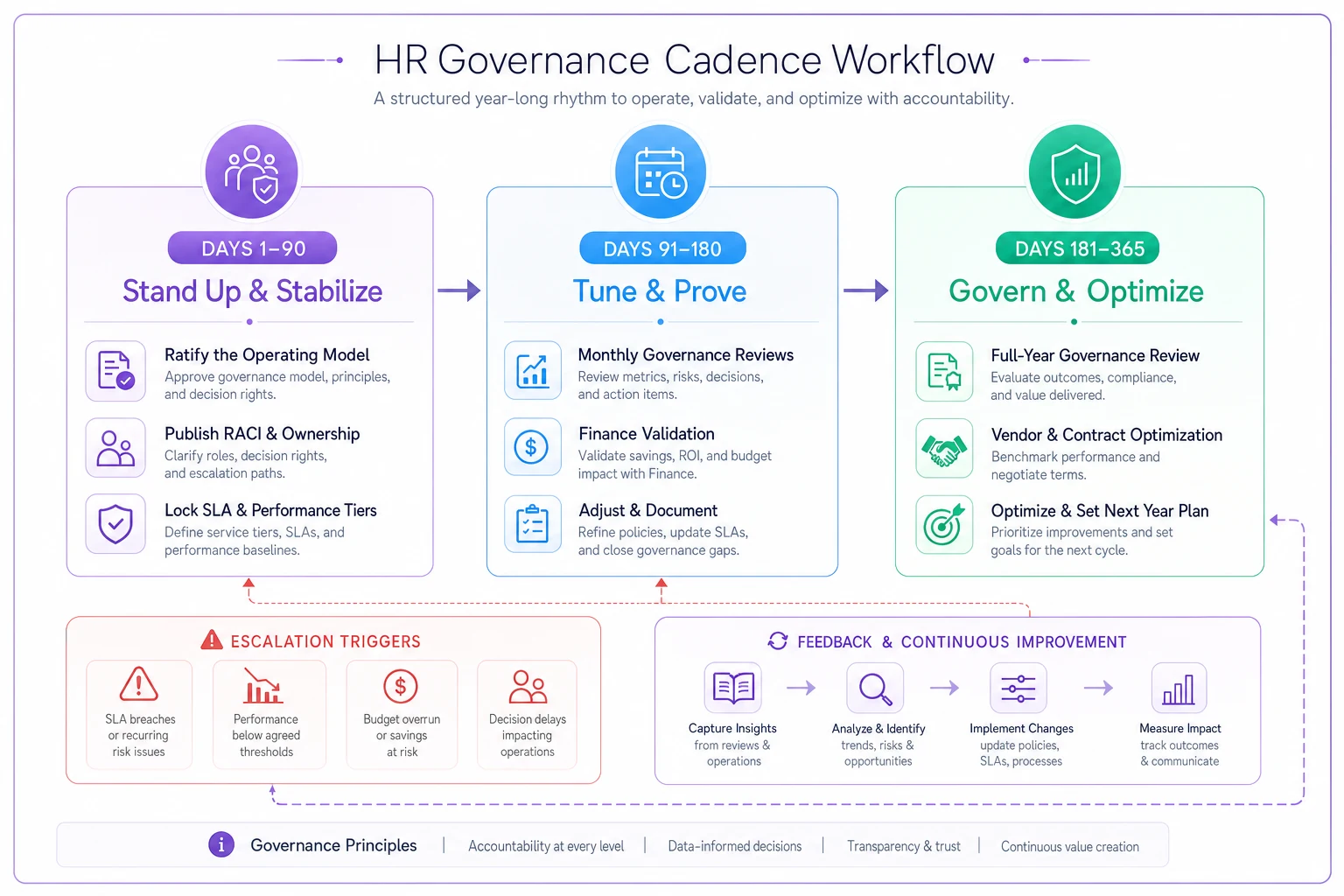
Use this as a simple visual in your deck to show phase-based activities and escalation feedback.
First 90 days — stand up and stabilize
-
Ratify the operating model and publish the RACI to every stakeholder group.
-
Lock the SLA tiers and turn on measurement — no SLA counts until it's timestamped in a system.
-
Run a baseline
current case volumes by tier, current cost-to-serve, current breach rate.
-
Hold biweekly operational reviews focused on handoffs and escalation-line disputes — the hybrid pain point.
-
Fix the top three broken handoffs before touching anything else.
Through 180 days — tune and prove
-
Move to monthly governance reviews with SLA performance and cost-to-serve trends.
-
Bring finance into the review to validate cost buckets and showback accuracy.
-
Review escalation-line accuracy
how many Tier 2 cases should have gone to Tier 3, and vice versa? Recalibrate the trigger.
-
Run your first quarterly compliance and audit spot-check under the new model.
-
Publish a one-page scorecard to leadership.
By 365 days — govern and optimize
-
Full-year review
cost baseline vs. actuals, SLA attainment, audit results, breach patterns.
-
Reassess the model itself — did the org grow or acquire in a way that shifts you between models?
-
Renegotiate TPA and vendor terms armed with a year of tier-level performance data.
-
Set next-year targets and refresh the funding case with real numbers replacing hypotheses.
-
Rotate any embedded coordinators who've drifted from standards through a re-alignment sprint.
That last step matters more than it sounds. Embedded teams drift — not out of malice, just proximity and habit. An annual standards refresh keeps the hybrid model from quietly turning back into an uncoordinated embedded one.
When each model is a bad idea
Centralized is a bad idea when your business units are so operationally different that one process genuinely can't serve them, or when front-line responsiveness is a safety or union issue and a distant team creates real risk. Forcing centralization in those environments breeds shadow processes.
Embedded is a bad idea when you have serious audit or litigation exposure and can't afford five interpretations of the same rule, or when finance is demanding clean cost allocation you simply can't produce from fragmented teams.
Hybrid is a bad idea when you don't yet have the discipline to maintain a clean escalation line. If your team can't consistently define and honor "this stays local, this goes central," hybrid becomes duplicated effort with a fancier org chart. In that case, start centralized, get your data and standards solid, then decentralize the routine work later.
A real scenario
A manufacturer with around 6,000 employees across a dozen sites in three countries inherited three separate leave teams through acquisitions. Each ran intake its own way. Payroll kept a private spreadsheet to catch handoff errors. Finance couldn't allocate absence cost to individual plants, so it sat as one enterprise line item that grew every year with no clear explanation.
They moved to a hybrid model over roughly nine months. The central CoE took standards, TPA governance, Tier 3 cases, and enterprise reporting. Embedded coordinators kept intake and manager support at each site. They defined a hard escalation line — intermittent, cross-border, and any legal-hold case went central automatically.
The results weren't dramatic, but they were real. Payroll retired the shadow spreadsheet within two quarters because handoffs had become reliable. Duplicate-payment incidents dropped noticeably once payroll had one Responsible owner in the RACI instead of "whoever noticed." And for the first time, finance could see per-plant absence cost — which changed the whole tone of budget conversations. Plants started owning their own numbers.
Run-cost went up slightly — you're funding a real CoE — but direct absence cost and error-driven leakage came down enough that the net conversation with finance was straightforward.
The lesson wasn't "hybrid is best." It was that any deliberate model beats an accidental one. The drift was the problem. The design was the fix.
Getting your team to actually adopt it
Structure on paper doesn't change behavior. The rollout does. Coordinators need to know the new escalation triggers cold, managers need to know who they call now, and payroll needs the handoff to be boring and predictable. Rolling out a new operating model without a change plan is how you end up with a great design nobody follows — the change-management blueprint for absence rollouts walks through the RACI, training sprints, and adoption KPIs that keep a new model from quietly reverting in month three.
The operating model isn't a document you file. It's the answer to "who owns this decision" — asked hundreds of times a week across your enterprise. Design that answer deliberately, tie it to cost, hold it with a cadence, and the rest of your absence program finally has something solid to stand on.
The operating model isn't a document you file. It's the answer to "who owns this decision" — asked hundreds of times a week across your enterprise. Design that answer deliberately, tie it to cost, hold it with a cadence, and the rest of your absence program finally has something solid to stand on.
Ready to optimize your workforce absence management?
Join 2,000+ HR teams using Absencely to reduce administrative burden, improve compliance, and boost employee satisfaction.