

Most HR teams don't have an absence problem. They have an absence program stuck at a stage they haven't named yet. The reason last week's payroll had three leave-related corrections, the reason your forecast keeps missing by 4–6 heads every quarter, the reason your best manager spends Friday afternoons chasing return dates — those aren't separate fires. They're symptoms of a program that hasn't caught up to the size of the company.
That's the frustrating part. You keep fixing individual things, and the same class of problem shows up somewhere else. A cleaner intermittent-leave log doesn't help if payroll still can't see it in time. A better manager checklist doesn't matter if the data feeding your forecast is defined three different ways across three sites.
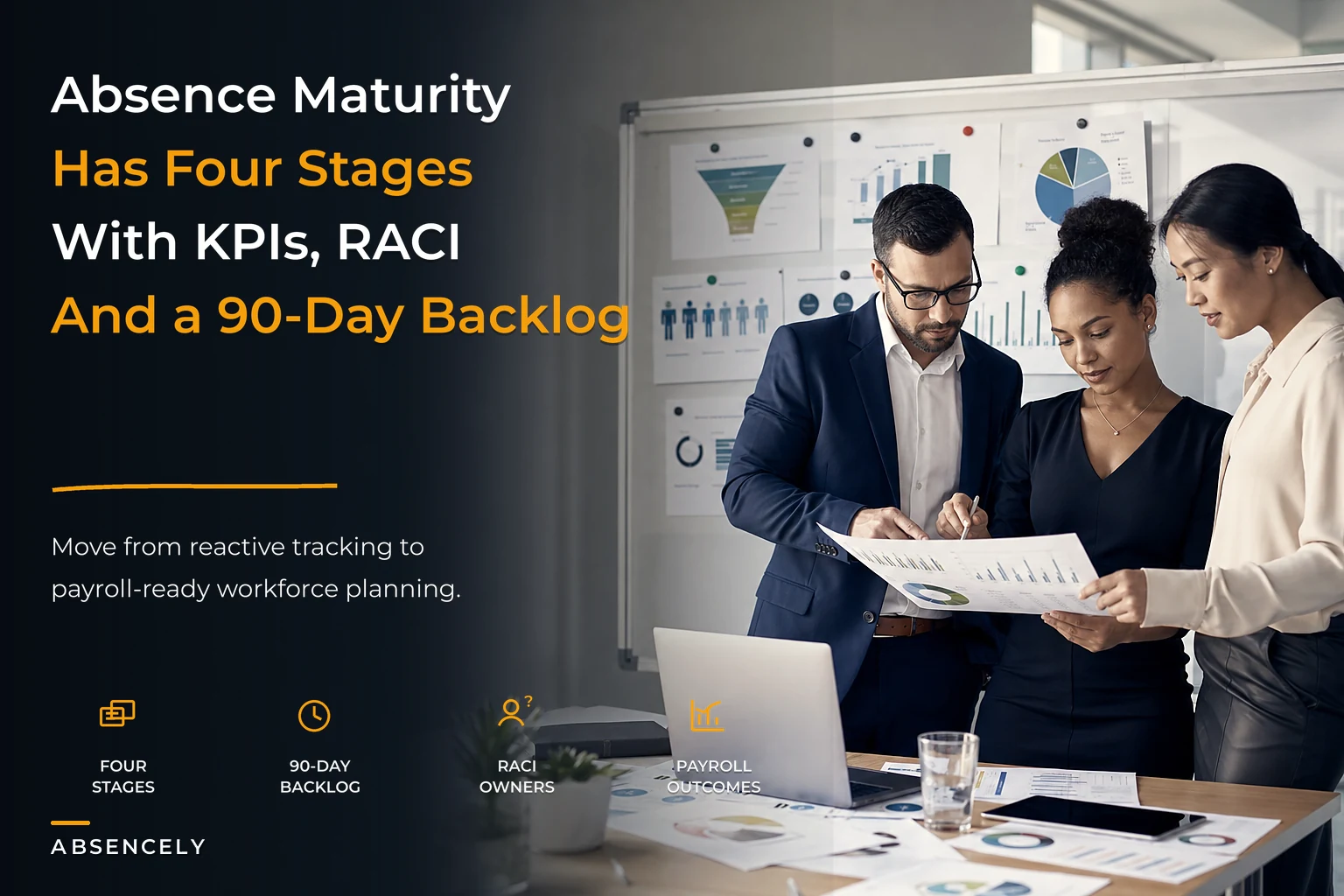
The absence program maturity model below is a way to stop treating these as isolated incidents. Four stages, each with its own failure signature, its own KPIs worth tracking, and its own RACI reality. At the end there's a 90-day backlog template so you can pick the right next move instead of the loudest one.
Why absence programs get stuck (and it's rarely the policy)
Almost nobody says this out loud: absence maturity has very little to do with how good your leave policy is. Companies with beautifully written policies still run chaotic programs, because the policy is a document and the program is a system of handoffs.
What stalls a program is coordination debt. Every time a piece of absence information moves — employee to manager, manager to HR, HR to payroll, payroll to finance for forecasting — there's a chance for it to arrive late, arrive wrong, or not arrive at all. At small scale, people paper over those gaps with memory and hallway conversations. "Oh yeah, Dana's out till the 14th, I told payroll." That works at 40 employees. It quietly breaks somewhere around 150–200, and by 400 it's generating real money in overpayments and forecast misses.
So the maturity of your program is really the maturity of those handoffs. The stages below are defined by how information flows, not by how many perks you offer.
One pattern worth noting: the companies that move up stages fastest are usually the ones that got burned by a single expensive mistake — a five-figure overpayment cluster, a failed audit, a forecast so wrong it triggered a hiring freeze. Pain buys attention. The trick is to move before that happens.
The four stages
Here's the model at a glance. Find the row that sounds most like your Tuesday.
Stop managing absences manually.
Absencely simplifies leave requests, approvals, and absence monitoring for your entire workforce.
- Automated leave tracking
- Manager approval workflows
- Compliance & reporting tools
No credit card required
| Stage | What it feels like | Data reality | Payroll link | Forecasting reality |
|---|---|---|---|---|
| 1. Reactive | Absences handled as they happen; email + spreadsheets | Records live in inboxes and one person's head | Manual entry, frequent corrections | No real forecast; "we'll deal with it" |
| 2. Standardized | Defined process, consistent forms, one owner per step | Central log exists but still manually maintained | Scheduled handoff, fewer surprises | Backward-looking averages |
| 3. Coordinated | Roles clear, SLAs enforced, systems talk to each other | Single source of truth, defined record fields | Near-real-time sync, exceptions routed | Rolling forecast tied to actual absence rates |
| 4. Optimized | Program is predictive; absence data drives staffing decisions | Governed, audited, forecast-grade | Automated with exception governance | Scenario-based, feeds headcount planning |
Most mid-sized companies I'd put at a solid Stage 2 that thinks it's at Stage 3. That gap — believing your handoffs are coordinated when they're really just standardized — is where the expensive surprises live.
Stage 1 — Reactive
The whole program lives in individual competence. A manager knows their people are out because those people texted them. HR finds out when it matters for pay. There's no shared record anyone trusts, so every question like "how many sick days has this team taken this quarter?" becomes a small research project.
Failure points are obvious once you look: a manager goes on vacation and their team's absences go dark, someone gets paid for leave they'd exhausted, and nobody can answer a basic FMLA eligibility question without digging through email. The cost isn't dramatic yet — it's death by a thousand small corrections.
Stage 2 — Standardized
Now there's a process. A form, a shared tracker, an owner for each step. This is a genuine leap, and a lot of companies plateau here for years because it feels under control.
But standardized isn't the same as connected. The central log exists, yet someone still has to type absence data into payroll by hand. Managers follow the process when they remember to. The forecast, if there is one, is basically last year's average with a fudge factor. The classic Stage 2 tell: your data is clean but always a few days stale, so payroll is accurate eventually rather than on time.
Stage 3 — Coordinated
This is where handoffs get real teeth. Roles are unambiguous, SLAs are enforced — not just documented — and systems actually pass information to each other instead of relying on someone to re-key it. Payroll sees leave status close to real-time. Exceptions get routed to a named person with a deadline, not dropped into a general inbox.
Getting to Stage 3 usually requires two things most companies underinvest in: agreed record definitions and enforced ownership. If "leave start date" means different things to a manager and to payroll, no amount of system integration saves you. This is exactly the groundwork covered in fixing absence data governance before it breaks forecasting — the record definitions and ownership matrix are the load-bearing wall for this whole stage.
Stage 4 — Optimized
At Stage 4, absence data isn't just accurate — it's predictive. You know your intermittent-leave patterns well enough to staff around them. Your forecast runs scenarios ("if flu season looks like last year, we're short 3 in fulfillment by week two"). Payroll automation handles the predictable cases and only surfaces true exceptions for human judgment.
Very few small and mid-sized companies genuinely operate here across the board, and honestly, not all of them should. Stage 4 has real overhead. The point of naming it isn't to guilt anyone into it — it's to give you a direction so Stage 3 improvements are built with Stage 4 in mind.
Stage-specific KPIs (measure the right thing for where you are)
A mistake I see constantly: teams import Stage 4 metrics into a Stage 1 program and then feel like failures. If you're reactive, tracking "forecast accuracy" is meaningless — you don't have a forecast. Track the thing that actually moves you up.
Stage 1 → track completeness and timeliness
-
% of absences captured in a shared record within 24 hours (target
get this above 80% before anything else)
-
Number of payroll corrections per cycle traced to absence data
-
% of managers using the intake process at all
Stage 2 → track consistency and lag
-
Data lag
average days between absence occurring and it hitting payroll-ready status
-
% of absence records with all required fields complete
-
Rework rate
corrections per 100 absence entries
Stage 3 → track SLA adherence and flow
-
% of handoffs meeting their SLA (manager→HR, HR→payroll)
-
Exception resolution time (median hours to route and close)
-
% of payroll runs with zero absence-related corrections
Stage 4 → track prediction and outcomes
-
Forecast variance vs. actual absence-driven staffing gaps
-
% of predictable leaves handled without manual touch
-
Cost-per-absence trend and overpayment rate
Notice the KPIs change what they're measuring as you climb — from "did we even capture it" to "did we predict it." If you're pulling together the top-line version of these for leadership, the structure in the executive absence scorecard shows how to compress stage KPIs into something a CFO will actually read.
One warning on KPIs: don't track more than four per stage. The whole reason Stage 1 companies stay stuck is that everyone's overloaded. A dashboard with 18 metrics is a Stage 1 dashboard no matter how sophisticated it looks.
Role-level RACI — who owns what actually changes by stage
Most maturity models skip this part: the RACI shifts as you mature. The same task has a different owner at Stage 2 than at Stage 4, and confusion about this is where a lot of "we tried to level up and it fell apart" stories come from.
Take a single recurring task — capturing a new absence and getting it payroll-ready:
| Role | Stage 1–2 | Stage 3 | Stage 4 |
|---|---|---|---|
| Employee | Responsible (reports it) | Responsible | Responsible |
| Manager | Accountable | Responsible | Informed |
| HR Ops | Consulted | Accountable | Consulted |
| Payroll | Informed | Consulted | Accountable (via automation) |
| System | — | Responsible (sync) | Responsible (handles predictable) |
At Stage 1–2, the manager is accountable for making sure absence data gets where it needs to go, which is exactly why it breaks when they're busy or out. As you mature, that accountability moves off the individual manager and onto HR Ops and then onto the system, with the manager stepping back to an informed role for routine cases. That's the whole point of maturing — removing single points of human failure, not adding process for its own sake.
If your managers are drowning, it's usually because your RACI is stuck at Stage 2 while your headcount says Stage 3. Rebalancing that is most of the battle. The manager absence workflow playbook has the SLA and escalation detail for what "manager as Responsible with clear triggers" looks like in practice at Stage 3.
A real scenario: a regional services company stuck between stages
A regional facilities-services company — around 380 employees across six sites — is a good example of the Stage 2-thinking-it's-3 trap.
On paper they had a process: a leave request form, a shared tracker, an HR coordinator who owned it. But each site manager maintained their own version of "who's out," and payroll pulled from the central tracker that lagged the sites by 3–5 days. The result was roughly 6–9 payroll corrections a month, a couple of them overpayments that took a full cycle to claw back. Their quarterly staffing forecast was missing by 5–7 heads consistently, because it was built on absence averages that didn't reflect what was actually happening on the ground.
Nothing here was catastrophic. That's why it persisted. The monthly cost of corrections and the buffer-staffing they carried to cover forecast misses was somewhere in the low thousands — annoying, not alarming, so it never got prioritized.
What moved them was a stage diagnosis, not a big platform purchase. They:
-
Agreed on shared record definitions so "leave start" and "expected return" meant one thing across all six sites.
-
Named a single owner for the manager→HR handoff with a 24-hour SLA.
-
Connected the site trackers to one source of truth so payroll stopped pulling stale data.
-
Started tracking data lag as their headline KPI.
Within about two quarters, data lag dropped from 3–5 days to under one, monthly corrections fell to one or two, and the forecast tightened to within 2–3 heads. Nothing exotic — they just stopped operating a Stage 3 headcount with a Stage 2 data flow.
The 90-day quarterly improvement backlog
Maturity doesn't move in a straight sprint. It moves in quarters, one bottleneck at a time. The backlog below is tied to payroll and forecasting outcomes, because those are the two places absence maturity actually pays for itself.
Fill this out each quarter. Pick 3–5 items max — the temptation to do everything is exactly what keeps programs stuck.
Days 1–30 — Diagnose and stabilize the worst leak
-
Run a stage diagnosis (which stage are you actually in, per the table above)
-
Pick your single most expensive handoff failure (usually manager→HR or HR→payroll)
-
Instrument one KPI you don't currently measure — most commonly data lag or corrections per cycle
-
Agree record definitions for the 4–5 fields your forecast and payroll both depend on
Days 31–60 — Rewire one handoff
-
Assign a named owner and SLA to the chosen handoff
-
Kill the parallel spreadsheet, if there is one (shadow trackers are a Stage 2 signature)
-
Route exceptions to a person with a deadline, not a shared inbox
-
Backfill the RACI shift for the affected task so no one's guessing who's accountable
Days 61–90 — Prove the payroll/forecast impact
-
Measure the KPI you instrumented on day 1 against baseline
-
Reconcile a payroll cycle specifically for absence-driven corrections and count them
-
Update the forecast using the now-fresher absence data and compare variance to last quarter
-
Pick next quarter's single bottleneck
A quick checklist to know a quarter actually worked, versus just felt busy:
-
- [ ] Did data lag or correction count measurably drop?
-
- [ ] Did at least one manual re-keying step disappear?
-
- [ ] Is there a named owner where there used to be ambiguity?
-
- [ ] Did your forecast variance improve, even slightly?
-
- [ ] Could you answer a basic "who's out and why" question in under a minute?
If you can't check at least three, you did work but didn't mature. That distinction matters, because motion feels like progress and it usually isn't.
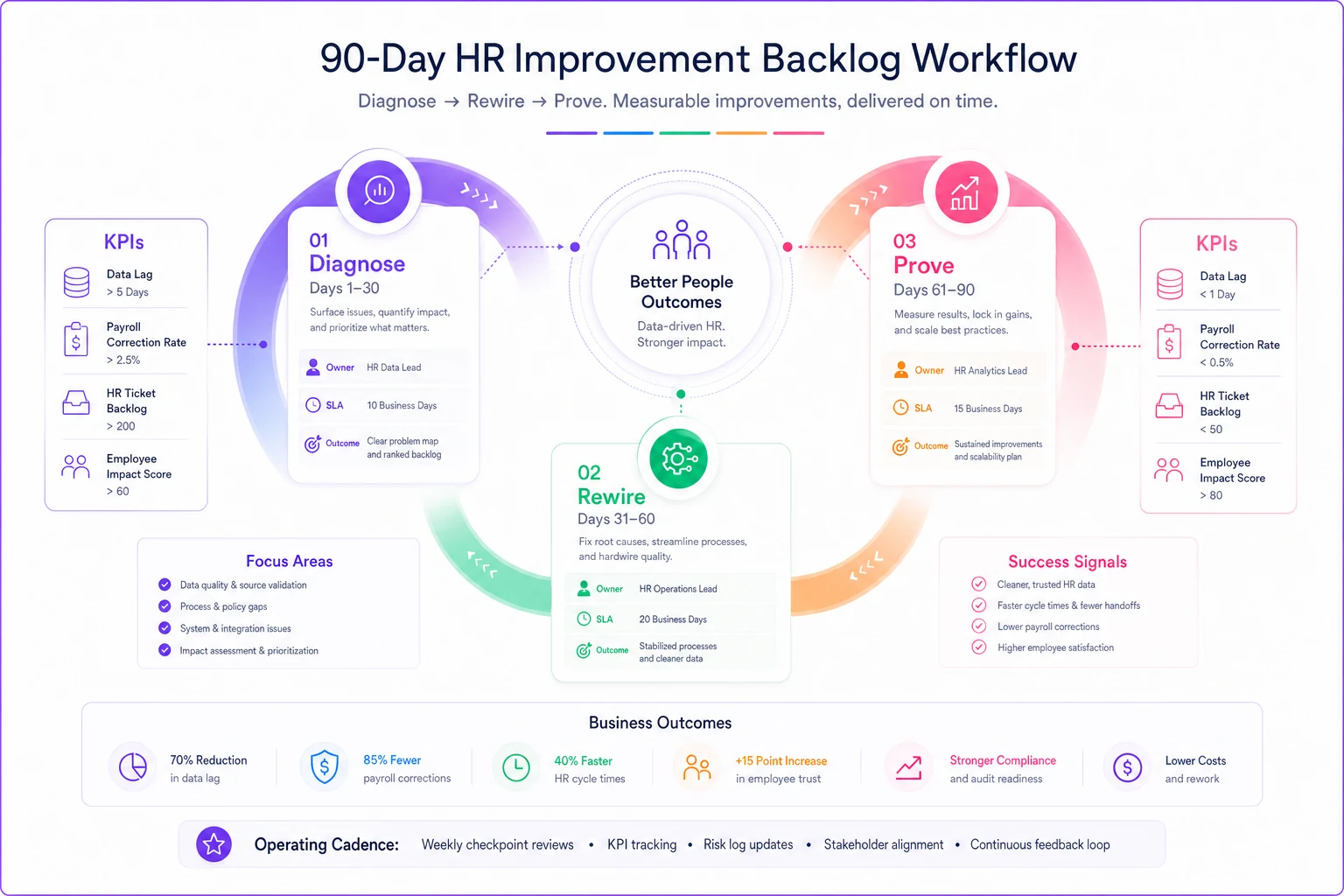
A simple visual of the 90-day backlog workflow.
Where systems and automation fit (and where they don't)
A fair question at this point: where does software actually help versus where is it lipstick on a broken process?
Automation is worth almost nothing at Stage 1. If your records are scattered and undefined, connecting a system just moves the mess faster. This is the classic mistake: a company buys an absence platform to fix a Stage 1 coordination problem and ends up at Stage 2 with a more expensive spreadsheet. The tooling assumes handoffs that don't exist yet.
Where AI-assisted operational platforms genuinely earn their keep is the Stage 2→3 and 3→4 transitions. Once your record definitions are agreed and your handoffs are named, that's the point where letting the system carry the routine flow — syncing leave status to payroll, routing exceptions to the right person with a deadline, flagging the absence patterns your forecast should react to — removes the human single-points-of-failure that stall growing companies. The value isn't the software being clever; it's the software reliably doing the boring handoffs that people forget when they're busy or out sick themselves.
Sequencing matters. Define, then standardize, then automate. Companies that automate before they define spend a year fighting their own tools. Companies that define first find the automation almost anticlimactic — it just does what the process already said.
Who should *not* chase Stage 4
Not every company needs to be at the top of this model, and pretending otherwise wastes budget.
Under roughly 75 employees with predictable, low-volume absence, a well-run Stage 2 is genuinely fine. The overhead of full coordination and prediction won't pay for itself. Your energy is better spent on clean definitions and one reliable owner.
If your absence volume is low but your risk is high — heavily regulated, cross-border, litigation-sensitive — you may need Stage 3 governance even at small headcount, because the cost of a single mishandled case dwarfs the process overhead.
And if you're growing fast — say you'll double headcount in 18 months — build for the stage you'll be at, not the one you're in. The company that stays Stage 2 while doubling is the one generating five-figure overpayment clusters by next fiscal year, then scrambling to retrofit governance under pressure. Maturing on your own schedule is always cheaper than maturing during a crisis.
Bringing it together
The reason the absence program maturity model is useful isn't that it's a neat framework — it's that it reframes recurring absence headaches as stage-appropriate problems with stage-appropriate fixes. The payroll corrections, the forecast misses, the overloaded managers: those aren't random. They're what a given stage produces, and they resolve when you move the handoffs up a level, not when you patch the symptom.
So the next time you're staring at a payroll exception or a forecast that missed by six heads, don't ask "how do we fix this one?" Ask "what stage is this a symptom of, and what's the single handoff I'd have to fix to make this class of problem stop happening?" Pick that. Run it as a 90-day backlog item tied to a payroll or forecasting number. Then pick the next one.
That's the whole game — one bottleneck per quarter, always measured against money, always moving accountability off individuals and onto the system. Do that four quarters in a row and you'll look up to find your program somewhere it's never been: quietly, reliably boring.
Ready to optimize your workforce absence management?
Join 2,000+ HR teams using Absencely to reduce administrative burden, improve compliance, and boost employee satisfaction.