

Most HR teams sitting on absence data have the opposite problem of what they think they have. They assume they need more signals. What they actually need is a way to decide which signals deserve action, which deserve a second look, and which are just statistical noise dressed up as a warning.
The gap shows up the moment a manager asks a simple question: "This person's absence pattern changed — what do I actually do about it?" If your answer depends on who's asking, what mood the manager is in, or whether legal happens to be in the room, you don't have a decisioning framework. You have a guessing habit with dashboards attached.
This piece is about building the connective tissue between absence analytics and retention outcomes — the policy-to-practice layer that most organizations skip. Not the scoring model itself, not the intervention programs, but the part in the middle where a signal becomes a defensible decision you'd be comfortable explaining to an employee, a regulator, or a judge.
The real failure isn't bad data — it's undocumented judgment
Organizations tend to invest heavily at both ends of the pipeline. They build a decent risk score on one end. They build intervention playbooks on the other. Then they connect the two with... a meeting. A Slack thread. Someone's gut.
That middle layer is where defensibility collapses. When you can't reconstruct why a specific person received a retention offer while another didn't, every decision becomes legally fragile. Disparate impact claims don't require proof of intent — they require a pattern you can't explain. And "our model flagged them" is not an explanation. It's the beginning of a discovery request.
-
A signal fires, but nobody validated whether the underlying data was even clean (duplicate leave records, misclassified intermittent days, a payroll sync lag).
-
The signal gets mapped to an action inconsistently — one manager coaches, another escalates to a retention conversation, a third does nothing.
-
No artifact survives the decision. Six months later, during an audit or a dispute, there's no record of the reasoning, the inputs, or the safeguards.
If you've already built an absence-driven risk model with a scoring rubric and triage playbooks, this framework is the governance layer that makes those scores actionable without becoming a liability.
Step one: validate the signal before anyone acts on it
Signal validation is the step everyone skips because it's boring and because the dashboard already looks confident. But acting on an unvalidated signal is how you end up coaching someone for an absence pattern that was actually a data entry error in payroll.
Stop managing absences manually.
Absencely simplifies leave requests, approvals, and absence monitoring for your entire workforce.
- Automated leave tracking
- Manager approval workflows
- Compliance & reporting tools
No credit card required
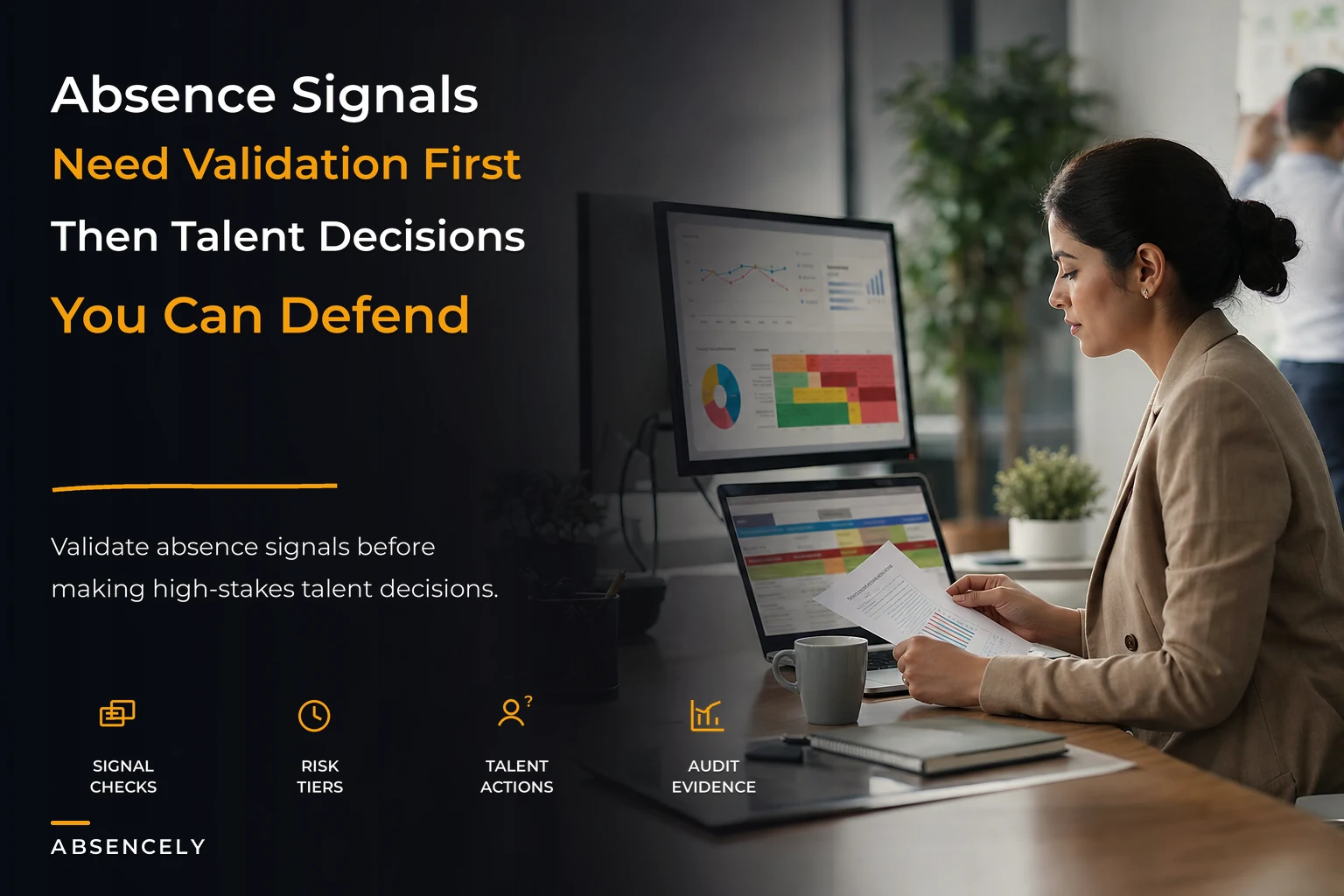
A signal isn't ready for a talent decision until it clears a few checks — think of it as a pre-flight checklist before anything human-facing happens.
Sample signal validation checklist
-
Data completeness — Are all leave types represented? Intermittent FMLA days are notorious for being partially logged. If 30% of a person's absence is unclassified, the signal is unreliable.
-
Source reconciliation — Does the HRIS record match payroll and the TPA feed? A mismatch of more than a day or two usually means a sync problem, not a behavior change.
-
Timing lag check — Is the data current enough to act on? A signal built on data that's three weeks stale may already be resolved.
-
Protected-category scrub — Is any portion of the absence tied to a protected leave (medical, disability accommodation, caregiving)? If yes, the decision path changes entirely and legal guardrails apply.
-
Volume threshold — Is the pattern statistically meaningful, or is it one bad month? A single spike is a conversation, not a trend.
-
Peer context — Is this person an outlier relative to their team and role, or did the whole team spike (which points to a workload or burnout issue, not an individual one)?
Check payroll and HRIS reconciliation first—sync issues are a frequent source of false signals.
That last point matters more than people expect. A lot of "individual risk signals" are actually team-level signals in disguise. If five people on a nine-person team all show rising unplanned absence in the same quarter, the problem isn't five retention risks — it's one manager or one broken process.
The validation step is also where governance of the underlying model belongs. If your signals come from a predictive model, the validation and bias controls for predictive absence models need to run upstream of this checklist, so you're not validating individual cases on top of a model that's already skewed.
Step two: map validated signals to risk tiers — and tie each tier to a specific action
A validated signal still doesn't tell you what to do. That's the job of a risk-tier map. The entire point of tiering is to remove discretion from the type of response while leaving room for human judgment inside the response itself.
The mistake that shows up most often: tiers that describe severity but don't prescribe action. "High risk" means nothing if two managers interpret it differently. Each tier must link to a bounded set of permitted actions — and crucially, actions that are off-limits at that tier.
Tiered action matrix
| Tier | Signal profile (post-validation) | Permitted talent actions | Explicitly NOT permitted | Approval required |
|---|---|---|---|---|
| Tier 1 — Watch | Mild deviation, single period, no protected-leave overlap | Manager notes context; informal check-in | Formal coaching record, retention offer, succession flag | None |
| Tier 2 — Engage | Sustained pattern, 2+ periods, peer-outlier confirmed | Structured 1:1, workload review, coaching plan | Compensation changes, PIP, succession decisions | Manager + HRBP |
| Tier 3 — Intervene | Strong pattern, retention-risk indicators, voluntary disclosure of dissatisfaction | Retention conversation, flexible-arrangement offer, role adjustment | Any action referencing protected leave as a factor | HRBP + comp/legal review |
| Tier 4 — Critical role exposure | High-criticality role + sustained signal | Succession activation, knowledge-transfer plan, targeted retention package | Unilateral manager action | HR leadership + legal |
Protected-leave overlap shuts down specific actions at every tier. That's deliberate. If a signal's severity is being driven by legally protected absence, you cannot let that absence become the basis for a talent action — even a positive one like a retention offer — without inviting the argument that you're treating protected leave as a performance input.
The actions in Tiers 2 and 3 should connect to programs you've already built. A Tier 2 coaching path often feeds directly into a tiered intervention program with triggers and EAP integration, rather than inventing a parallel process. And when a signal overlaps with someone returning from leave, the action should route through your return-to-work scripts and phased reintegration plans instead of a generic retention conversation — because the context is legally and operationally different.
The privacy and legal guardrails that make this defensible
This is the part that separates a real framework from a dashboard with ambitions. Every tier and every action has to operate inside a set of non-negotiable guardrails.
-
Purpose limitation. Absence data collected for benefits administration shouldn't silently become the engine for talent decisions without a documented, communicated purpose. If you're using it for retention, say so in policy.
-
Protected-category firewall. Protected leave data (medical, disability, caregiving, pregnancy-related) must be partitioned so it never flows into the signal that drives a talent action. The signal should be built on attendance reliability categories that explicitly exclude protected absence.
-
Access scoping. A line manager should see "this person is Tier 2, recommended action: structured 1:1." They should not see the underlying medical reason behind an absence. Decisioning and diagnosis are different access levels.
-
Decision transparency. If you'd be uncomfortable showing an employee the reasoning behind their tier, that reasoning doesn't belong in the model.
-
Human-in-the-loop requirement. No automated signal should trigger a talent action without a documented human decision. The system can recommend; a person decides and owns it.
The firewall point is where most well-intentioned programs quietly go wrong. Teams build a "risk score," feel good about it, and never audit what's inside it. If protected absence is quietly inflating someone's score, your whole tiering system is now sitting on a legal fault line.
The audit artifacts you must generate — automatically, not heroically
A decision is only defensible if you can reconstruct it later without relying on anyone's memory. Every tier-2-and-above action needs to leave a trail, and that trail needs to be generated as part of the workflow — not assembled frantically when a dispute lands.
Required audit artifacts per decision
-
Signal snapshot — the exact data inputs at the moment of the decision, including which absences were excluded as protected.
-
Validation record — confirmation the signal cleared the validation checklist, with the clearer's name and timestamp.
-
Tier assignment rationale — why this signal landed in this tier, in plain language.
-
Action taken + decision-maker — what was done, by whom, and under what approval.
-
Guardrail confirmation — explicit confirmation that protected-category data did not influence the action.
-
Outcome follow-up — what happened afterward, logged at a defined interval.
Audit-ready documentation template (one decision)
DECISION ID: DATE: EMPLOYEE REF (pseudonymized): ROLE CRITICALITY: Low / Med / High SIGNAL SUMMARY: ___ DATA SOURCES RECONCILED: HRIS [ ] Payroll [ ] TPA [ ] PROTECTED ABSENCE EXCLUDED FROM SIGNAL: Yes [ ] / Not applicable [ ] VALIDATION CLEARED BY: DATE: ASSIGNED TIER: 1 / 2 / 3 / 4 TIER RATIONALE: ___ ACTION TAKEN: DECISION-MAKER: APPROVER(S): GUARDRAIL CONFIRMATION (protected data not used): FOLLOW-UP DATE: OUTCOME:
The value of forcing this format isn't bureaucratic. The artifact itself prevents bad decisions. A manager who has to write down why protected leave was excluded tends to actually exclude it. The documentation acts as a control, not just a record.
Embedding the workflow into HRIS and people processes
A framework that lives in a PDF dies in a quarter. The only version that survives is the one wired into the systems people already use. Here's the operational sequence that tends to hold up.
-
Configure the signal layer to exclude protected absence at the source. Don't filter it downstream — keep it out of the attendance-reliability category entirely. This is a data-contract decision, not a reporting toggle.
-
Add validation as a required gate. Before a signal surfaces to a manager, it passes the validation checklist automatically where possible (completeness, reconciliation, lag) and flags anything needing human review.
-
Surface tiers, not raw scores, to managers. The manager-facing view shows the tier and the permitted action menu — scoped to what they're allowed to do at that tier.
-
Enforce approvals in the workflow. Tier 3 and 4 actions can't be marked complete without the required approver signing off in the system.
-
Auto-generate the audit artifact. The decision record populates from the workflow itself. The human fills in rationale and outcome; the system handles inputs, timestamps, and confirmations.
-
Schedule the follow-up. The outcome field triggers a reminder, so decisions don't vanish into "we talked to them once."
Here's a quick visual of that operational sequence.
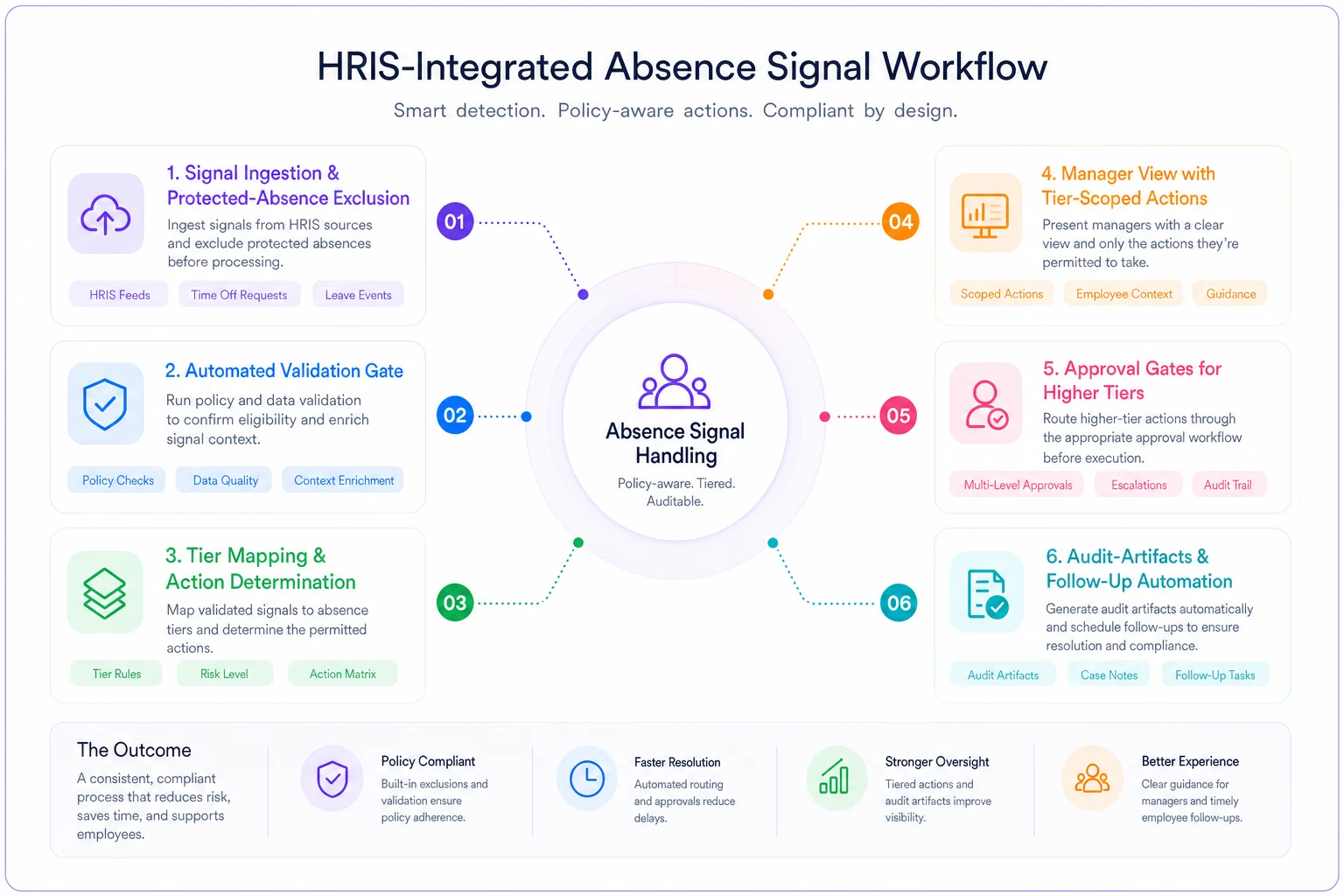
This is where workflow platforms with built-in audit logging actually earn their keep — not because they make the decision, but because they make the defensible path the easy path. When validation gating, tier-scoped actions, and artifact generation are embedded in the system, compliance stops depending on whether a busy HRBP remembered the process on a Thursday afternoon. The control lives in the workflow instead of in someone's discipline.
A realistic scenario
A regional healthcare support services company — around 240 employees, heavy on hard-to-replace clinical coordinators — had an absence dashboard and a retention problem, but no bridge between them. Managers acted on signals inconsistently. In one case, a coordinator got pulled into a "performance" conversation over absences that were later found to be documented intermittent medical leave. That near-miss triggered the rebuild.
They introduced the validation gate and the tier-action matrix. In the first full quarter, something unexpected happened: roughly 40% of the signals that used to trigger manager action got caught at validation — either data reconciliation issues or protected-absence overlap that should never have surfaced as a talent signal in the first place. Managers were, in effect, acting on noise close to half the time.
Of the signals that did clear validation, the Tier 3 retention conversations led to a handful of flexible-schedule arrangements and two role adjustments. Voluntary turnover among the flagged-and-engaged group dropped noticeably over the following two quarters — not dramatic, but a clear improvement. Just as important: when an unrelated complaint later prompted a records review, the documentation held up without anyone scrambling.
The lesson wasn't that the model got smarter. The model didn't change at all. The decisioning layer changed — and that's what made the same data both safer and more useful.
When this framework makes sense — and when it doesn't
When it's worth building: You have multiple managers acting on absence data, you operate in jurisdictions with meaningful leave protections, or you're already using absence signals to influence retention in any informal way. If retention decisions are being made off this data today, you need the defensibility layer whether you've formalized it or not.
When it's overkill: A small, single-manager team where one person makes every call and can genuinely explain each decision. At that scale, a lightweight log beats a full tier matrix. Don't build governance heavier than your organization.
Who should not do this yet: Teams whose underlying absence data is still a mess. If your HRIS, payroll, and TPA records don't reconcile, a tiering framework just formalizes decisions built on bad inputs. Fix the data contracts first — a tidy decision process on top of unreliable data is more dangerous than no process, because it looks defensible while being hollow.
The thing to remember
The organizations that get in trouble here aren't the ones with weak analytics. They're the ones who can't explain the distance between a signal and an action. Strong analytics with no decisioning layer is actually more dangerous than weak analytics, because it produces confident, well-documented decisions that nobody validated and nobody can defend.
Turning absence analytics into retention outcomes isn't primarily a modeling exercise. It's a decisioning discipline: validate before you act, map signals to bounded actions, keep protected data firewalled, and leave an artifact behind for every call you make. Build that middle layer properly and your absence data stops being a liability you're hoping no one examines — and becomes something you'd actually be comfortable defending out loud.
Ready to optimize your workforce absence management?
Join 2,000+ HR teams using Absencely to reduce administrative burden, improve compliance, and boost employee satisfaction.