

Most retention risk lists are garbage because they're built backwards. Someone in HR pulls a report of "high performers," adds a gut-feel column called "flight risk," and hands it to managers who already suspected half the names on it. Nobody knows why one person scored higher than another, so nobody acts differently.
The absence signal is the one everyone ignores until it's too late. By the time a good employee is quietly job hunting, their attendance pattern has usually already shifted — a Friday here, a stretched-out Monday there, a sudden spike in unplanned single days. Performance data alone won't catch it. Absence data alone won't either. It's the combination that tells you who to call this week versus who to leave alone.
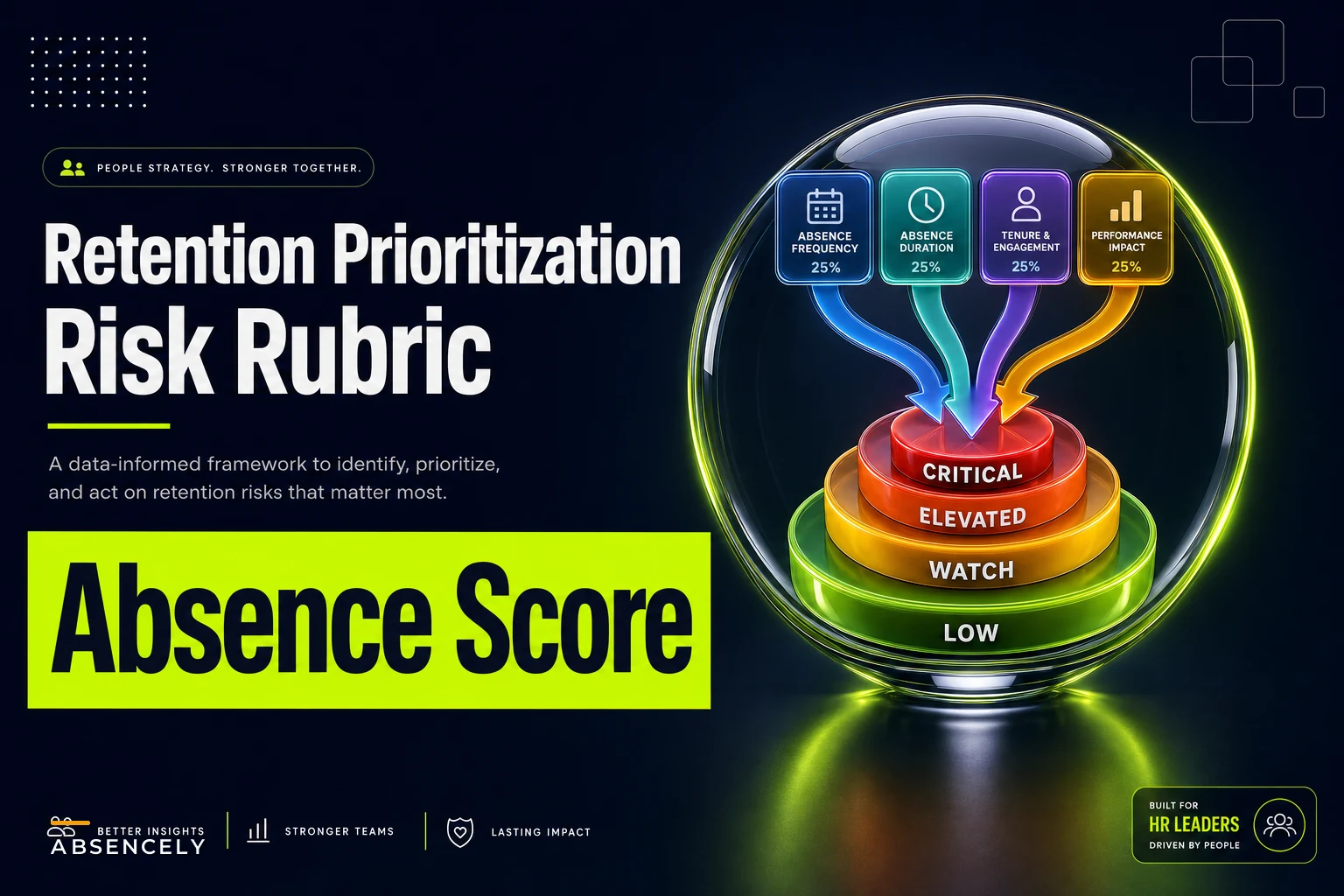
This piece is about building an absence retention risk model you can actually defend — a scoring rubric with weights, a sampling method so you're not drowning in false positives, and triage playbooks mapped to risk tiers so managers know exactly what to do when someone lands in the red.
Why absence + performance beats either one alone
Performance ratings lag. They're set quarterly or annually, they're political, and a manager who likes someone will round up. Absence data updates weekly and doesn't have an ego.
Disengagement usually shows up in attendance before it shows up in output. A senior person who's mentally checked out still clears their core tasks for a while — they just stop showing up for the optional stuff, start taking the Fridays they're owed, and drift into more unplanned single-day absences. Output stays flat for a quarter or two, then falls off a cliff. If you're only watching performance, you catch it at the cliff.
But absence alone is noisy. Someone with a new baby, a sick parent, or a chronic condition will light up every absence threshold you set, and they may be your most loyal employee. That's why you need both axes. High absence + declining performance + high role value is a different animal than high absence + stable performance + a documented family situation.
Across a lot of small and mid-size teams, the people who actually resign "out of nowhere" almost always had a two-signal shift that nobody connected: a soft dip in discretionary effort and a change in absence texture. Not volume — texture. The type and timing of absences changing.
The scoring rubric
Keep the rubric to four inputs. More than that and managers stop trusting it because they can't reason about it.
Stop managing absences manually.
Absencely simplifies leave requests, approvals, and absence monitoring for your entire workforce.
- Automated leave tracking
- Manager approval workflows
- Compliance & reporting tools
No credit card required
Score each employee 0–4 on each dimension, then apply weights.
| Dimension | What you're measuring | 0 (low signal) | 4 (high signal) | Weight |
|---|---|---|---|---|
| Absence texture shift | Change in type/timing of absences vs. their own 6-month baseline | No change | Clear shift to unplanned, single-day, Fri/Mon clustering | 30% |
| Absence volume trend | Trailing 90-day unplanned days vs. prior 90 | Flat or down | Up sharply, no documented reason | 15% |
| Performance trajectory | Direction, not absolute level | Stable/improving | Declining or newly "meets" after "exceeds" | 30% |
| Role value / replaceability | Cost and time to backfill | Easy to replace | Critical, long ramp, single point of knowledge | 25% |
A simple visual of the scoring workflow can help communicate how inputs feed into a composite score and tiers.
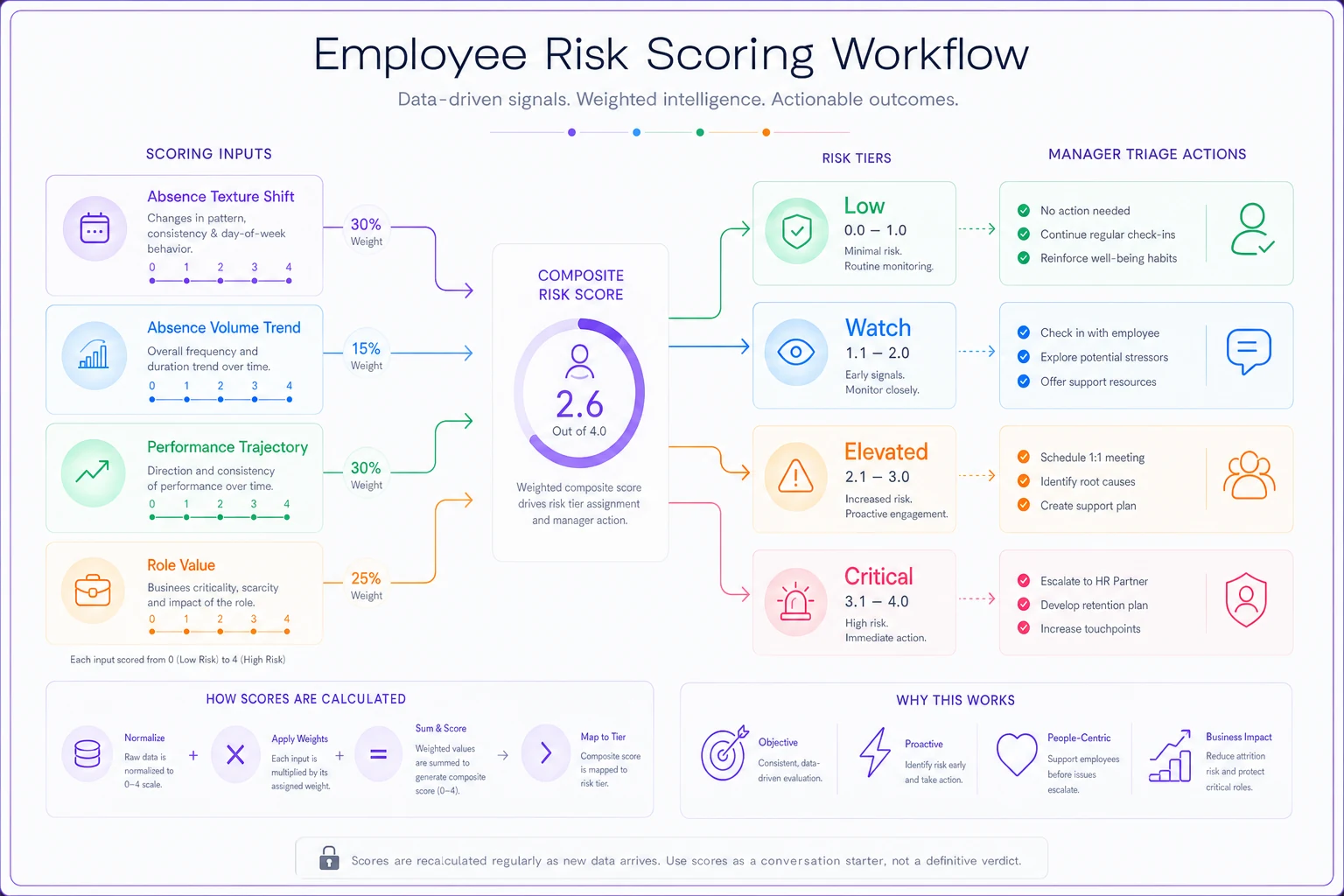
Multiply, sum, and you get a 0–4 composite. Bucket it into tiers:
-
0.0–1.4 — Low. No action.
-
1.5–2.4 — Watch.
-
2.5–3.2 — Elevated.
-
3.3–4.0 — Critical.
Two things about this table people usually get wrong.
First, texture is weighted higher than volume. That's deliberate. Someone taking more planned time off is often fine — they're using PTO because they're comfortable. The dangerous signal is the shape changing: planned becoming unplanned, spread-out becoming clustered. Volume gets a smaller weight because raw absence count over-flags people with legitimate ongoing situations.
Second, performance is trajectory, not level. A steady B-player who's always been a B-player isn't a retention emergency. A former A-player sliding to B is. Scoring the direction instead of the grade keeps you from wasting energy on people who are stable and fine.
Why these weights (and when to change them)
The weighting rationale matters because someone will eventually ask you to justify it in a room full of skeptical managers.
The 30/15/30/25 split assumes a business where backfilling roles is genuinely painful — most small and mid-size teams. If you're in a high-turnover, easy-to-replace environment (seasonal retail, entry-level call center), drop role value to 10–15% and push the absence weights up, because there you care more about disruption this month than long-term retention.
Absence gets 45% combined and performance only 30% because of timing. Absence is the leading indicator; performance is the lagging one. Weight performance too heavily and your model tells you what you already know instead of what's coming.
One adjustment worth pushing back on: don't let anyone talk you into adding tenure as a heavy input. Long tenure feels like it should predict loyalty, but in practice long-tenured people who start showing absence texture shifts are often the highest flight risk — they've stayed long enough to feel underpaid and know exactly what they're worth elsewhere. Tenure as a small tiebreaker, fine. As a core weighted input, it muddies the signal.
Sampling methodology (so you don't drown)
You cannot run playbooks on your entire headcount. The point of sampling is to spend limited manager-time where it actually changes outcomes.
Don't score everyone every week. Do this instead:
-
Baseline pass, once a quarter. Score the full population. This resets everyone's absence baseline and catches slow drifters.
-
Trigger-based sampling, weekly. Between quarterly passes, only re-score people who cross an absence trigger — a new unplanned single day, a second Friday/Monday in a rolling month, or a manager-flagged concern. This keeps the weekly working list small.
-
Stratify by role value first. Within your Elevated and Critical tiers, sort by role value before anyone touches the list. You want your best conversations happening with your hardest-to-replace people first.
-
Cap the active list. Give each manager no more than 5–7 active cases at a time. Past that, quality of the retention conversation collapses and it becomes a checkbox exercise.
Give each manager no more than 5–7 active cases at a time to preserve conversation quality.
The mistake that keeps coming up: HR scores the whole company monthly, generates a list of 80 "at-risk" names, and managers glaze over. Forty names in, everyone stops reading. A tight, triggered, capped list gets acted on. A comprehensive one gets ignored.
A quick note on false positives. Before anyone lands on a playbook, run the list past a human who knows the documented context — parental leave, an approved intermittent-leave arrangement, a bereavement. Those people will score high and shouldn't be triaged as flight risks. If you're already tracking absence texture for team health, a lot of that context overlaps with the signals covered in detecting team burnout from absence patterns, so pull from the same data rather than building a parallel view.
Triage playbooks mapped to risk tiers
Tiers are useless without a specific action attached to each. Here's what actually happens at each level.
Watch (1.5–2.4) — Manager awareness only
-
No formal conversation.
-
Manager notes the person for the next 1
1 and pays attention to whether the absence texture keeps shifting.
-
Re-score at next trigger. That's it. Don't over-intervene here — poking someone who's fine reads as surveillance.
Elevated (2.5–3.2) — Structured check-in within two weeks
-
Manager has a normal, non-alarming 1
1 that includes a genuine "how are things going, anything getting in your way" beat.
-
Look for the reason behind the absence shift — workload, a commute change, a personal situation, a broken relationship with a teammate.
-
Document what you learn in a neutral field (not "flight risk," which is legally and culturally toxic — use "engagement follow-up").
-
If a concrete fixable issue surfaces (comp, scope, schedule), open the fix and set a 30-day recheck.
Critical (3.3–4.0) — Retention action within one week
-
This is a real conversation, usually with the manager and sometimes with HR aware in the background.
-
Go in assuming this person is 60–90 days from a resignation letter, because they often are.
-
Put concrete levers on the table where you can
comp review, scope change, project change, flexibility. Vague reassurance does nothing at this tier.
-
Simultaneously start the quiet backfill-readiness work — knowledge documentation, cross-training — so a resignation isn't a five-alarm fire. Not giving up; just being realistic about it.
What separates a working model from a spreadsheet nobody uses is that every tier has a response SLA. Elevated = two weeks. Critical = one week. Without a clock, cases sit.
A short real scenario
A regional professional-services firm, roughly 140 employees, kept getting blindsided by senior-analyst resignations — the exact people who took eighteen months to fully ramp. Exit interviews were useless; everyone said "new opportunity."
When they went back and looked at attendance in the three months before each resignation, the pattern was almost embarrassingly consistent: unplanned single days roughly doubling, clustering near weekends, while their last performance rating still said "exceeds." Pure performance monitoring caught none of it.
They built a version of the rubric above, ran it trigger-based, and capped manager caseloads. Over the next couple of quarters they flagged a handful of Critical cases early. Not all were saveable — a few were already mentally gone — but they retained around half of the ones they'd historically have lost cold, and for the rest they had knowledge handoffs done before the resignation instead of scrambling after. The saved-ramp cost alone more than justified the effort. Nothing dramatic in the numbers month to month; the win was that "out of nowhere" resignations mostly stopped being out of nowhere.
When this model makes sense — and when it doesn't
When it's worth building:
-
Roles with long ramp times and real backfill cost.
-
Teams where you've already been surprised by resignations you feel you should have seen coming.
-
Organizations with clean-enough absence data to distinguish planned from unplanned and see timing.
When it's a bad idea:
-
High-churn, easy-to-replace roles where the economics of retention conversations don't pencil out.
-
Cultures where managers will weaponize the list or treat it as a discipline tool. A retention model used punitively becomes a resignation accelerator.
-
Situations where your absence data is so messy you can't trust the texture signal. Fix the data first — a model built on unreliable inputs produces confident garbage.
Who should not run this: any team that can't commit to the human context-check step. Skip it and you'll triage new parents and people on approved intermittent leave as flight risks, and word gets around fast that HR is watching sick days to build a hit list. That destroys trust faster than any resignation.
Rolling it out without wrecking trust
A few operational guardrails that keep this from backfiring:
-
Never call the tier "flight risk" in any field an employee could ever see. Use engagement language.
-
Keep the composite score internal to HR and the direct manager. It's not a scorecard you share upward by name — roll it up as counts by tier when you report to leadership, similar to how you'd present other retention signals on an executive absence scorecard.
-
Audit the false-positive rate quarterly. If more than a third of your Critical cases turn out to have benign documented reasons, your absence weights are too aggressive — dial texture and volume down.
-
Close the loop. When a case is resolved (retained, or context explained), record the outcome. Over a year that outcome history tells you whether your weights are calibrated or whether you're just generating anxiety.
The whole point of an absence retention risk model isn't to predict resignations perfectly — nothing does. It's to get you talking to the right people while there's still time to change their mind, instead of finding out at the exit interview that the signals were sitting in your attendance data the whole time.
The whole point of an absence retention risk model isn't to predict resignations perfectly — nothing does. It's to get you talking to the right people while there's still time to change their mind, instead of finding out at the exit interview that the signals were sitting in your attendance data the whole time.
Ready to optimize your workforce absence management?
Join 2,000+ HR teams using Absencely to reduce administrative burden, improve compliance, and boost employee satisfaction.