

Once you start scoring employees for absence risk — flagging burnout, predicting no-shows, forecasting coverage gaps — you've crossed a line. You're no longer just reporting on what happened. You're making predictions that trigger interventions, staffing decisions, and sometimes uncomfortable conversations. And the moment a model influences how a person gets treated at work, the questions shift from "is this accurate?" to "can we defend this?"
That's the gap most HR teams walk into blind. They stand up a predictive absence model, wire it to alerts, and celebrate the dashboard. Six months later, a manager acts on a flag that turns out to be biased against employees with disabilities, or a model quietly drifts until it's flagging the wrong people entirely — and nobody notices because there was never a validation cadence in place to catch it.
Governance isn't the boring paperwork layer bolted on afterward. It's the system that decides whether your predictions stay trustworthy as your workforce, policies, and data change. Here's how the whole thing fits together — and where it usually breaks.
Why absence models drift faster than most teams expect
Absence data is unusually unstable compared to the kinds of data most predictive models are trained on. Seasonality, policy changes, a new PTO rollover rule, a flu wave, a reorg that moves a couple hundred people into a new manager's org — each of these shifts the underlying patterns the model learned from.
What makes it worse: the interventions your model triggers change the very behavior it's predicting. If your burnout model flags a team and you rotate their schedules, absence patterns for that team change. The model was right, you acted, and now the historical relationship it learned is partly broken. This is called feedback contamination, and absence programs run into it constantly because the whole point is to intervene.
-
- Data drift — the inputs change. A payroll migration renames leave codes, or a new time-tracking tool starts logging partial-day absences differently, and suddenly the model is fed columns that don't mean what they used to.
-
- Concept drift — the relationship between inputs and outcomes changes. Post-pandemic, "three unplanned absences in a month" stopped predicting turnover the way it used to because remote work reshuffled everything.
-
- Population drift — who you're scoring changes. You acquire a company, add a contingent workforce, or expand into a new region with different leave entitlements.
The teams that get burned are the ones who validated once at launch and treated that as done. A model is only as trustworthy as its last check.
Validation metrics that actually mean something for absence
Accuracy is a trap for absence models. If 8% of employees are high-risk in a given quarter, a model that predicts "nobody is high-risk" is 92% accurate and completely useless. You need metrics tuned to the fact that the interesting cases are rare and the cost of mistakes is uneven.
Stop managing absences manually.
Absencely simplifies leave requests, approvals, and absence monitoring for your entire workforce.
- Automated leave tracking
- Manager approval workflows
- Compliance & reporting tools
No credit card required
The table below is a practical set of thresholds to anchor on. These aren't universal laws — they're starting points you calibrate to your own base rates and tolerance for error.
| Metric | What it tells you | Reasonable starting threshold | When to escalate |
|---|---|---|---|
| Precision (of high-risk flags) | Of the people flagged, how many were genuinely at risk | ≥ 0.65 | Drops below 0.55 — you're flooding managers with false alarms |
| Recall (on true high-risk) | Of the people who were at risk, how many you caught | ≥ 0.70 | Drops below 0.60 — you're missing real cases |
| AUC / ranking quality | How well the model separates risk overall | ≥ 0.75 | Falls below 0.70 across two consecutive checks |
| Calibration error | Whether "70% risk" actually means ~70% | Within ±10% by decile | Any decile off by more than 15% |
| Alert-to-action rate | Share of alerts a human actually acted on | Track trend, no fixed target | A sustained drop signals alert fatigue or eroding trust |
The one people skip is calibration, and it's arguably the one that matters most for fair treatment. A model can rank people correctly but still tell you someone is "high risk" when their real probability is modest. Managers read those scores literally. If your 80% flags only materialize half the time, you're pushing people into interventions they don't need — and that's exactly the kind of thing that surfaces in a complaint.
That alert-to-action rate deserves its own attention. When managers stop acting on flags, the model has already lost credibility — the metrics might still look fine on paper while the program is dying on the floor.
Fairness detection: recipes, not vibes
Bias in absence models isn't hypothetical. Absence correlates with pregnancy, chronic illness, disability, caregiving load, and age — every one of which maps to a protected characteristic. If your model treats frequent intermittent leave as a risk signal without care, you can end up with something that systematically penalizes people for exercising legally protected rights. That's not a technical bug. That's litigation.
You can't fix what you don't measure, so fairness has to be a scheduled check with defined thresholds, not a one-time "we looked at it and it seemed fine."
-
1. Define the protected groups you'll test — and get legal to sign off on the list. Typically this includes gender, age bands, disability status where you lawfully hold it, and any proxies you're worried about (like leave-of-absence history).
-
2. Pick your fairness lens. The two most defensible for absence work are demographic parity gap (are flag rates similar across groups?) and equal opportunity gap (among people who genuinely were high-risk, are catch rates similar across groups?). For absence, equal opportunity usually matters more — you don't want to miss real risk in one group while catching it in another.
-
3. Set thresholds. A common rule of thumb borrowed from employment law is the four-fifths rule: if a protected group's positive-flag rate is below 80% of the highest group's rate, that's worth investigating. Some teams tighten this to a 10-point gap for internal comfort.
-
4. Check for proxy leakage. Even if you exclude protected fields, features like part-time status, specific leave codes, or tenure can smuggle bias in. Run the model with and without suspect features and see if fairness metrics move.
-
5. Document every check. Date, dataset snapshot, metrics, thresholds, who reviewed it, decision. This is the artifact compliance will ask for later.
One pattern worth naming: teams often find their model isn't unfair in aggregate but is unfair in a specific slice — say, employees over 55 in one division. Aggregate fairness metrics hide these pockets. Slice your checks by the intersections that actually exist in your org, not just top-line categories.
Human-in-the-loop escalation playbooks
No absence model should ever auto-execute a consequential action against a person. The prediction informs a human; the human decides. But "a human reviews it" is meaningless without a defined path for which human, when, and with what authority.
Think of escalation in tiers based on the stakes of the action the alert would trigger:
-
- Tier 1 — informational. Low-stakes nudges
"this team's absence is trending up, consider checking in." Manager reviews, no formal record required. Fast, high-volume, low risk.
-
- Tier 2 — intervention-triggering. A flag that would lead to a wellness conversation, schedule change, or referral. Requires the manager to confirm the flag makes sense against what they actually know about the situation, with a one-line note on the decision.
-
- Tier 3 — consequential or ambiguous. Anything touching leave protections, accommodation, or performance. These route to HR before any action, full stop. The model's output is one input among several, and HR documents the human reasoning independently of the score.
The failure mode here is subtle: over time, managers start rubber-stamping Tier 2 confirmations to clear their queue. The whole point of human review collapses into a click. You catch this by tracking how often the human overrides the model. If override rates fall near zero, either your model is perfect (it isn't) or your humans have stopped genuinely reviewing. A healthy program sees meaningful, ongoing disagreement between model and human.
Escalation also needs a break-glass path — a way for an employee or manager to contest a flag and have it reviewed outside the automated flow. When someone says "this is wrong and it's affecting how I'm treated," you need a documented process, not an awkward improvised conversation.
Below is a simplified view of how a flag moves through the escalation flow before it ever reaches a decision point:
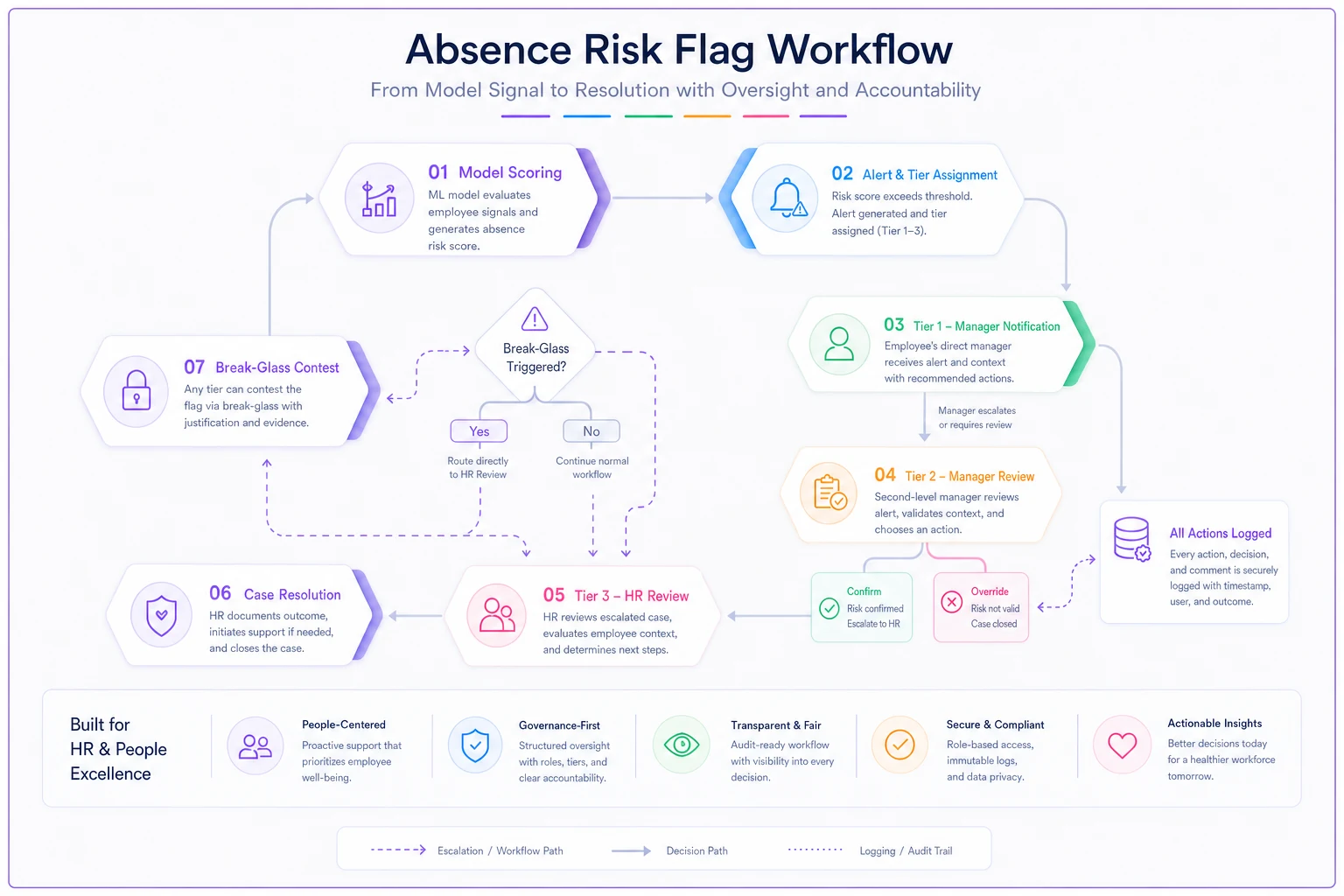
[Model scores employee] ↓ [Alert generated + tier assigned] ↓ [Tier 1] → Manager notified → No formal record required ↓ [Tier 2] → Manager reviews → Confirms or overrides → One-line note logged ↓ [Tier 3] → Routes to HR → Independent human review → Decision documented ↓ [Break-glass path] → Employee or manager contests → Reviewed outside automated flow → Resolution logged
Performance SLAs the business can hold you to
A governance framework without SLAs is a suggestion. If you're running predictive alerts, the people relying on them need commitments about freshness, reliability, and response — and you need commitments back from them about acting on what the system surfaces.
A reasonable SLA set for a predictive absence program:
-
- Model validation cadence — full revalidation quarterly at minimum, plus a triggered revalidation after any major data or policy change.
-
- Drift monitoring — automated checks run at least weekly; drift beyond threshold triggers a review within a set number of business days.
-
- Data freshness — scores refresh on a defined schedule (usually weekly for absence patterns), and any pipeline that's more than a set number of days stale gets flagged and suppressed rather than shown as current.
-
- Alert response — Tier 2 and 3 alerts acknowledged within a defined window (say, 3 business days) so nothing sits unreviewed.
-
- Fairness review — scheduled at least quarterly and documented, regardless of whether anything looks off.
Suppress stale scores rather than display them as current.
Getting these SLAs to hold depends heavily on the underlying data being clean and well-defined in the first place. If your leave codes, absence categories, and record ownership are ambiguous, no amount of model governance saves you — the work of fixing absence data governance before it breaks forecasting is the prerequisite that makes everything above achievable.
Audit logs and reporting artifacts legal will actually accept
When something goes sideways — a complaint, an audit, a discovery request — "the model said so" is not a defense. What protects you is a paper trail showing you built the model responsibly, monitored it, caught problems, and kept a human in the loop for consequential decisions.
Legal and compliance don't want your model architecture. They want evidence of a controlled, reviewable process. That means every meaningful event leaves a record.
-
- Score events — who was scored, when, on what data snapshot, with what model version. Retain enough to reconstruct any past prediction.
-
- Model version history — every retraining or change, with the date, what changed, who approved it, and the validation results that justified releasing it.
-
- Validation records — each validation run's metrics against thresholds, pass/fail, and reviewer.
-
- Fairness review records — the process above, run and documented on schedule.
-
- Human decisions — for Tier 2/3, the alert, the human's decision, whether they overrode the model, and their stated reasoning.
-
- Contests and break-glass events — any time someone challenged a flag and how it was resolved.
A reporting artifact that compliance tends to accept is a quarterly model governance summary: model versions in production, validation results, drift findings, fairness metrics with thresholds, override rates, open issues, and sign-off from a named owner. One or two pages, dated, archived. When an auditor asks "how do you know this system is fair and accurate?", you hand them the last four of these and the underlying logs. That's the difference between a defensible program and a liability.
The connection to your broader documentation discipline matters here. The same rigor you apply to individual leave cases and record definitions should extend to how the model treats those records — it's one continuous chain of custody from raw absence data through to the prediction and the human decision.
A real scenario: where governance earned its keep
A regional healthcare services company — roughly 900 employees across clinical and administrative roles — rolled out an absence-risk model to help flag likely coverage gaps and burnout. The first two quarters went well. Managers acted on flags, coverage improved, everyone was happy.
Then they migrated their scheduling system. The new platform logged partial-shift absences and on-call callouts in a way the old one hadn't. Nobody connected that to the model. Over about six weeks, precision on the high-risk flags quietly slid from around 0.68 to the low 0.50s. Managers started getting flagged on people who were fine, and their alert-to-action rate — which the team happened to be tracking — dropped noticeably.
Because they had a weekly drift check and were watching that action rate, the pattern surfaced before it became a real problem. Investigation traced it to the changed absence coding. They retrained on the corrected data, revalidated, and precision recovered into the mid-0.60s within a couple of weeks. Total disruption: a few weeks of degraded flags caught early, versus what could have been months of managers slowly losing trust and acting on bad predictions.
The point isn't the metric recovery. It's that the governance layer — drift monitoring, a tracked action rate, and a defined response process — turned what could have been a silent failure into a caught-and-fixed incident with a documented trail.
When predictive absence models make sense — and when they don't
Not every organization should be running one of these. Governance is what makes them safe, and governance has a cost.
This makes sense when you have enough scale that manual review can't keep up, reasonably clean and well-defined absence data, and the organizational maturity to actually run validation and fairness checks on a schedule. If you can commit to the SLAs above, prediction can meaningfully sharpen how you allocate attention and coverage. Pairing it with a sound approach to turning absence data into staffing outcomes is where the value compounds.
This is a bad idea when your absence data is messy or inconsistently coded, when you don't have the resources to monitor the model after launch, or when the flags would feed directly into performance or disciplinary decisions. A model that influences discipline based on absence is a legal minefield, and governance doesn't fully de-risk it.
Who should not do this at all: small organizations where a manager already knows every employee's situation personally. The model adds risk and overhead without adding insight a human doesn't already have. And any team tempted to skip the human-in-the-loop layer to "save time" — if you're going to automate consequences, you've fundamentally misunderstood what the model is for.
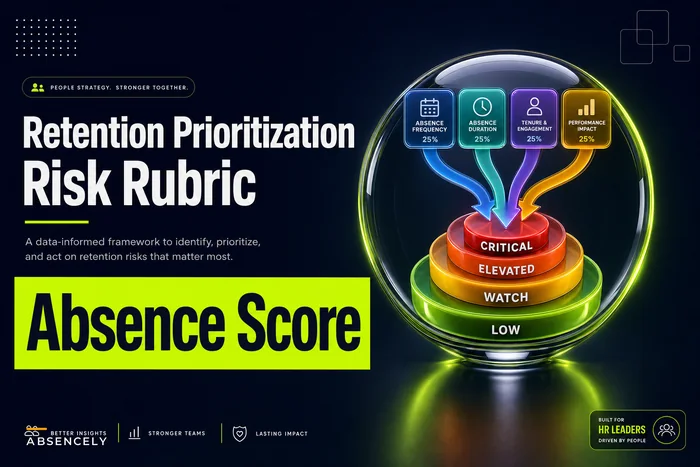
If the goal is understanding retention risk rather than triggering automated actions, a more transparent, human-scored approach like the one in this absence-driven risk model with a scoring rubric is often the better starting point — it's easier to explain, easier to govern, and easier to defend.
Pulling it together
Predictive absence model governance isn't one control — it's a connected system. Validation tells you the model still works. Drift monitoring tells you when reality has moved. Fairness checks tell you who might be getting hurt. Escalation keeps a human accountable for consequences. SLAs make the whole thing dependable. Audit logs turn all of it into something you can defend when someone asks hard questions.
Skip any one layer and the others weaken. A perfectly validated model with no fairness check can still be discriminatory. A great escalation playbook means nothing if scores are silently drifting. The programs that hold up over time treat these as a single fabric — where a change in the data flows through to a revalidation, which flows through to a fairness review, which gets logged, which a human can act on.
The model is the easy part. Keeping it accurate, fair, and defensible as your workforce and rules keep shifting underneath it — that's the system worth building.
Ready to optimize your workforce absence management?
Join 2,000+ HR teams using Absencely to reduce administrative burden, improve compliance, and boost employee satisfaction.