

The moment someone comes back from a long leave — surgery, a mental health absence, a serious family situation — there's a short window where you either build trust or quietly signal that they're now a problem to be managed. Most managers blow it without realizing. They open with "So, how are you feeling?" in a tone that sounds warm but forces the employee to either overshare medical details or deflect awkwardly. Then they pivot straight into "here's what's changed while you were out," which lands like a warning.
Neither of those is illegal. Both are just bad reintegration.
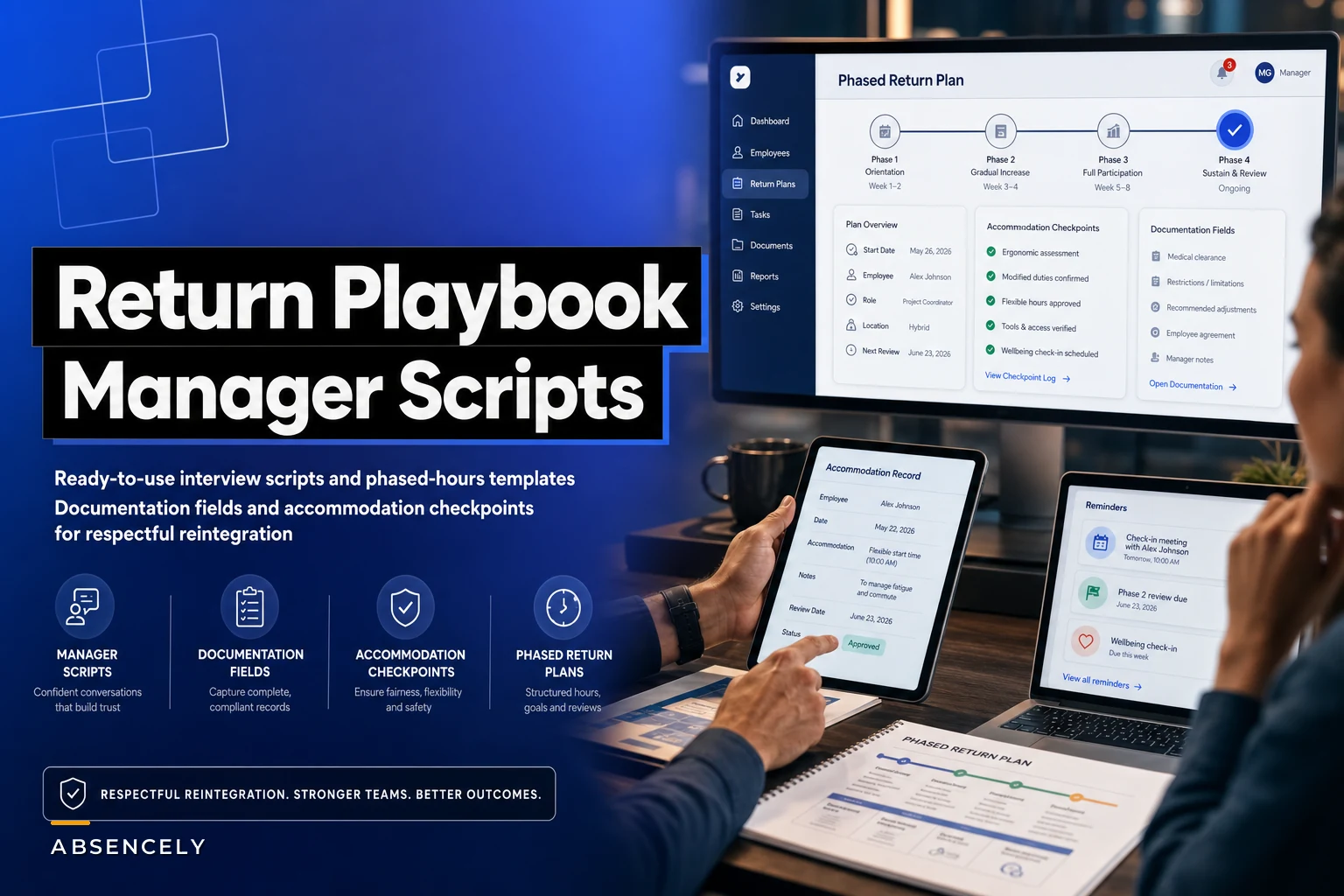
This post is about the return-to-work interview itself and the reintegration plan that follows it — the actual words, the documentation fields you should be filling in, and the accommodation checkpoints that keep the whole thing consistent across managers. Not a policy overview. The scripts.
Why the first return-to-work meeting goes sideways
Managers freeze in these conversations for a predictable reason: they're trying to be human and legally careful at the same time, and those two instincts pull in opposite directions. So they either over-index on empathy and start asking about the employee's diagnosis — which you're not supposed to do — or they over-index on caution and read from a stiff HR script that makes the person feel like they're being processed.
The other failure mode is inconsistency. One manager on the floor runs a warm, thoughtful reentry. Another manager two departments over skips the formal meeting entirely — the person just shows up and starts working. When someone eventually files a complaint, the gap between how two returning employees were treated becomes the whole case.
What tends to happen across small and mid-sized teams is that the return-to-work conversation is almost never scripted, even in companies that script everything else — onboarding, exit interviews, performance reviews. The reentry gets left to improvisation, and improvisation under legal pressure produces bad results.
The interview script: what to actually say
The script below is built around a simple principle. You talk about work capacity and logistics, never about medical condition. The employee can volunteer anything they want; you never dig.
Stop managing absences manually.
Absencely simplifies leave requests, approvals, and absence monitoring for your entire workforce.
- Automated leave tracking
- Manager approval workflows
- Compliance & reporting tools
No credit card required
Opening (set the frame):
> "Glad to have you back. This meeting is just to figure out how to make your first few weeks smooth. I'm not going to ask you anything about your medical situation — that's yours. I only need to understand what you can and can't do at work right now, and what would help."
The capacity questions (the core of it):
> "Based on what your provider cleared you for, are there any specific tasks or activities you should avoid right now?" > "Is there anything about your schedule — start times, breaks, total hours — that we should adjust at first?" > "Is there any equipment, workspace change, or support that would make things easier?"
None of those ask why. They ask what. If the person says "I can't lift more than fifteen pounds for six weeks," you write down the restriction and the duration. You don't ask about the injury.
The phasing question:
> "I'd rather ramp you back up than throw everything at you day one. Would it help to start at reduced hours or a lighter load for the first couple of weeks and step up from there?"
The close (name the checkpoint):
> "Let's plan to check in again in two weeks to see how it's going and whether we should adjust anything. If something isn't working before then, come find me — we can change it."
A few things to strike from your vocabulary
-
"What exactly happened?" — none of your business, legally and otherwise.
-
"Are you sure you're ready?" — puts the burden of proof back on them.
-
"We really needed you here." — turns their absence into guilt.
-
"Let me know if you can't handle it." — sets them up to underreport problems.
That last line matters more than people think. Reintegration plans fail when they're set once and never revisited. Naming the checkpoint out loud makes it real.
Phased hours and duties: templates that don't fall apart
The most common mistake in phased return isn't being too aggressive — it's being vague. "Ease back in" is not a plan. It gives the employee no idea what's expected and gives the manager nothing to measure. Then week three arrives, nobody knows if the ramp is working, and the plan silently dissolves into "just do your normal job."
Here's a phased template that holds up. Adjust the durations to the situation, but keep the specificity.
| Phase | Duration | Hours | Duties | Checkpoint |
|---|---|---|---|---|
| Phase 1 | Week 1–2 | ~50–60% of normal (e.g. 20–24 hrs) | Core tasks only, no on-call, no travel | End of week 2 |
| Phase 2 | Week 3–4 | ~75% (e.g. 30 hrs) | Add secondary duties, still no lifting/overtime restrictions lifted only if cleared | End of week 4 |
| Phase 3 | Week 5–6 | Full hours | Full duties minus any permanent restriction | End of week 6 |
| Steady state | Week 7+ | Normal | Normal or documented ongoing accommodation | Standing monthly if accommodation is permanent |
Two things people get wrong with this. First, they treat the percentages as fixed instead of adjusting to what the provider actually cleared. If the medical note says four hours a day for the first month, your Phase 1 doesn't magically become 60% because the template said so. Second, they forget that some restrictions are permanent, not phased. A phased plan ramps up temporary limitations. A permanent lifting restriction never ramps — it becomes a standing accommodation, documented separately.
A realistic example
A regional plumbing and HVAC company — around 40 field techs — had a senior tech return after shoulder surgery. His clearance said no overhead work and nothing over ten pounds for eight weeks. The branch manager's instinct was to bench him entirely until he was "100%," which would've meant roughly two months of a fully-paid senior tech doing nothing, or worse, sitting at home on partial pay getting resentful.
Instead they phased him: first two weeks he rode along on jobs handling diagnostics, customer walkthroughs, and quoting — no wrenching. Weeks three through six he took over all the light service calls and mentored a junior tech on the heavy ones. By week eight he was cleared and back to full load. They kept a productive senior person engaged the whole time, the junior tech got real coaching, and nobody was guessing at what "better" meant because the phases were written down with dates.
The cost difference was real but not dramatic — a few thousand dollars in recovered productivity over the eight weeks versus benching him. The bigger win was retention. Senior field techs are brutal to replace, and this one felt like the company actually handled his recovery well.
Documentation fields you actually need
This is where consistency lives or dies. If every manager documents reentry differently — or not at all — you have no defensible record and no way to spot patterns across the org. Keep the fields tight. Enough to be defensible, not so many that managers start skipping it.
Fill these for every return-to-work case:
-
Employee name and role
-
Return date
-
Leave type (do NOT record diagnosis — record the leave category only)
-
Work restrictions (the what, taken from the provider's clearance — e.g. "no lifting over 15 lbs, 6 weeks")
-
Restriction source and date (e.g. "provider note dated 3/14")
-
Restriction end date or "ongoing"
-
Phased plan summary (which template phase, hours, duties)
-
Accommodations provided (equipment, schedule, workspace)
-
Checkpoint dates scheduled
-
Checkpoint outcomes (updated each check-in)
-
Manager and HR sign-off
Capture the restriction source and date verbatim to avoid disputes later.
Hard rule: the documentation records functional limitations and accommodations, never medical condition. If a manager writes "returning after depression" in the file, that's a liability. "Returning from approved medical leave, provider-cleared with schedule accommodation" is what belongs there.
This is the same discipline that makes leave files defensible in general — the folder-structure and field standards in audit-ready leave documentation apply cleanly to reentry records too. If your leave files are already organized that way, reentry documentation slots into the same structure without much extra effort.
The accommodation checkpoints
Reasonable accommodation isn't a one-time yes/no. It's a running obligation, and the checkpoints are where you either meet it or quietly drop the ball. Here's the sequence that keeps you honest.
-
At the return meeting — capture stated restrictions and any accommodation request. Confirm what you can provide immediately.
-
Before day one — verify the accommodation is physically in place. If someone needs a modified workstation and it's not there when they walk in, you've undercut the whole thing on the first morning.
-
End of Phase 1 — is the current accommodation working? Too much? Not enough? Does the phased ramp need to slow down?
-
At each phase transition — confirm the next phase is medically appropriate before you increase hours or duties. Don't auto-advance because the calendar says so.
-
When a restriction is due to expire — check whether the provider actually cleared full duty or extended the restriction. Never assume expiry equals clearance.
-
For permanent accommodations — set a standing review, monthly or quarterly, so it doesn't get forgotten when a new manager inherits the team.
The checkpoint people skip most often is number five. A restriction has an end date, the date passes, and everyone assumes the person is fully cleared — including the person, sometimes. Then they reinjure, and the paper trail shows the company pushed them back to full duty with no updated clearance. That's the expensive one.
When a formal phased plan makes sense — and when it doesn't
It makes sense when:
-
The leave was long enough that skills or stamina genuinely need ramping — surgery, extended illness, serious mental health leave.
-
There are medical restrictions with a defined timeline.
-
The role is physical or high-stakes enough that easing in reduces reinjury or error risk.
It's overkill when:
-
The absence was short and there are no restrictions. A two-day bereavement leave doesn't need a phased ramp and a documentation packet — it needs a decent manager saying "welcome back, take it easy today."
-
Forcing a formal plan on someone who's fully cleared and ready to go can feel like you're treating them as fragile, or worse, building a paper case against them.
One failure mode worth naming: managers who love process for its own sake. Reintegration can get so proceduralized that returning employees feel surveilled rather than supported. The goal is consistency and respect, not a bureaucratic gauntlet. Match the formality to the situation.
Keeping it consistent across managers
The scripts and templates only work if every manager runs them roughly the same way. In practice that breaks down because managers are busy, checkpoints live in someone's head or a random calendar reminder, and nobody's tracking whether the two-week check-in actually happened.
This is the same coordination gap that shows up across absence handling generally — the difference between a policy that exists and a policy that actually runs. The manager absence workflow playbook covers the SLA and escalation side of this, and reentry checkpoints fit the same logic: a checkpoint with no owner and no due date is a checkpoint that won't happen.
If you're using any kind of workflow or HR platform, the practical move is to make the return-to-work plan a tracked item — restriction end dates trigger a reminder, phase transitions prompt the manager to confirm before advancing, and checkpoint outcomes get logged in the same place. That's not about automating the human conversation; the conversation stays human. It's about making sure the follow-up doesn't fall through the cracks when the manager is slammed and the two-week mark quietly slides to week five.
Here's a simple visual of that flow in context.
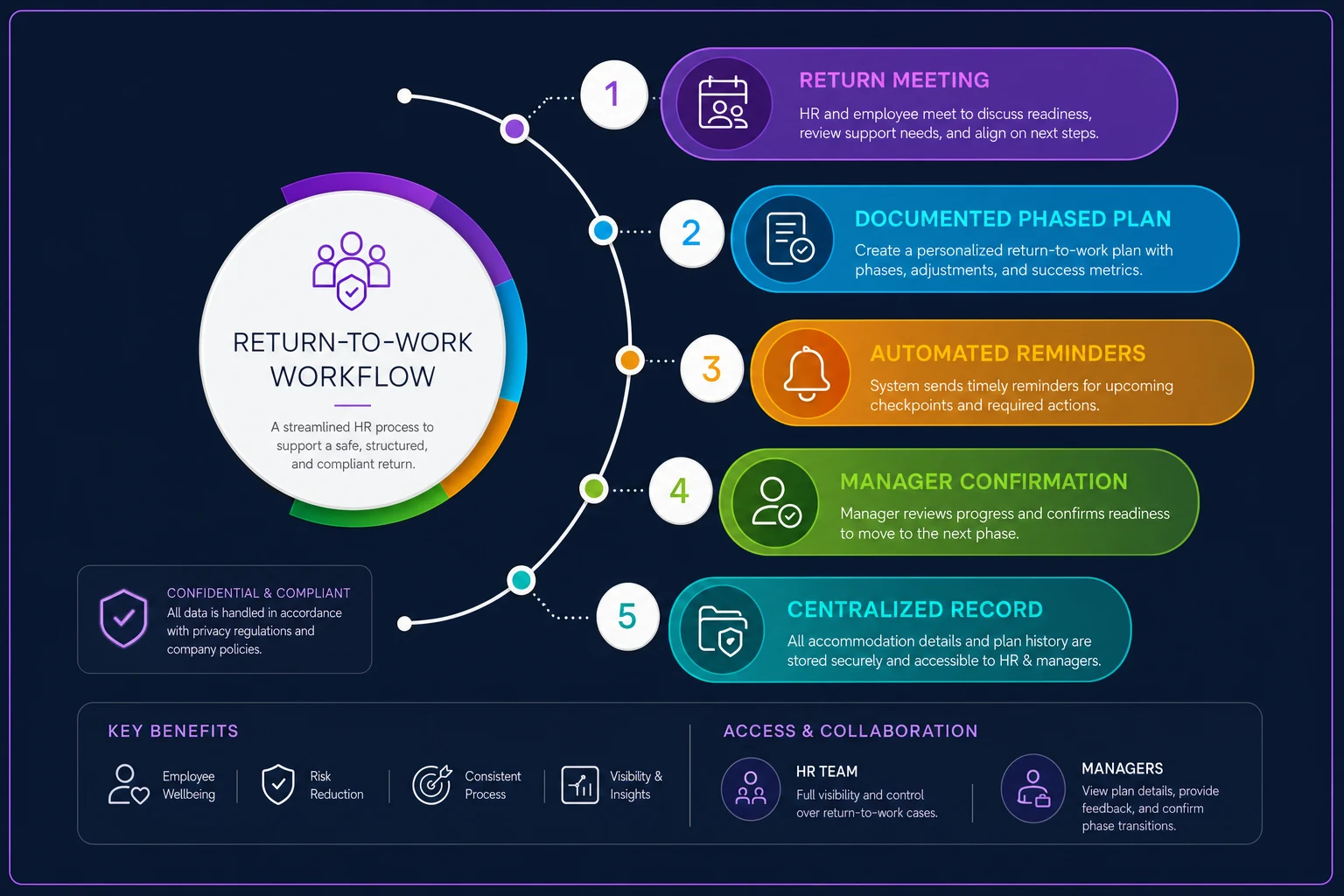
The visibility problem is just as real as the coordination problem. When absence handling and reentry are tracked in separate places — or not tracked at all — the manager who inherits a team has no idea what accommodations are in place, which phase someone is in, or when the next check-in is due. Centralizing that in a shared platform, even a basic one, removes a lot of the dropped-ball risk without adding much overhead for whoever is running the day-to-day.
A short reality check on tone
The best reintegrations aren't the ones with the most detailed plans. They're the ones where the manager treats the plan as a floor, not a ceiling — where the script is a starting point and the manager actually listens when the employee says "honestly, I'm ready for more" or "this is harder than I expected."
The documentation and checkpoints protect you legally and keep things consistent. But the person coming back can tell the difference between a manager running a process and a manager who actually wants them to succeed. Get both. Run the script so you don't fumble the first ninety seconds. Fill the fields so you're defensible. Hit the checkpoints so nobody gets pushed back to full duty before they're cleared. And then, inside all that structure, actually pay attention to the human in front of you. That's the part no template covers, and it's usually the part that determines whether someone comes back and stays.
The documentation and checkpoints protect you legally and keep things consistent. But the person coming back can tell the difference between a manager running a process and a manager who actually wants them to succeed. Get both. Run the script so you don't fumble the first ninety seconds. Fill the fields so you're defensible. Hit the checkpoints so nobody gets pushed back to full duty before they're cleared. And then, inside all that structure, actually pay attention to the human in front of you. That's the part no template covers, and it's usually the part that determines whether someone comes back and stays.
Ready to optimize your workforce absence management?
Join 2,000+ HR teams using Absencely to reduce administrative burden, improve compliance, and boost employee satisfaction.