


Most absence system failures don't happen during the RFP. They happen eighteen months later, when the vendor you fought to onboard is quietly underperforming, your SLA credits are rounding errors, and nobody owns the decision to renew, renegotiate, or walk away. The contract auto-renews because the alternative — re-running procurement — feels worse than the pain you're already living with.
That's the trap. Vendor governance for absence systems isn't an event, it's a lifecycle. And the reason so many HR and ops teams get burned is that they treat procurement, onboarding, SLA management, and renewal as four separate projects run by four different people who never compare notes. The procurement lead picks the vendor. The implementation lead onboards them. The ops team lives with the fallout. Finance signs the renewal based on a spreadsheet that has nothing to do with whether the system actually works.
This article walks through how the full lifecycle connects — and where it breaks when the handoffs are sloppy. The goal is a governance model where your scorecard KPIs mechanically drive your contract levers, so renewal stops being a gut call and becomes a decision you can actually defend.
Why vendor lifecycle governance breaks across the handoffs
The core structural problem is that an absence system touches too many teams for any single owner to see the whole picture. Payroll cares about accuracy and timing. HR cares about compliance and employee experience. IT cares about integration stability. Finance cares about cost. Each group experiences the vendor differently, and none of them has a complete view of whether the relationship is actually healthy.
The pain shows up in a predictable sequence. Procurement optimizes for price and feature checklists. Onboarding runs late and someone eats scope that was never priced. Then the system limps along — "good enough" — while small failures accumulate: a payroll feed that breaks every third pay cycle, adjudication SLAs that slip during volume spikes, a support queue that quietly degrades from 4-hour response to 2-day response.
None of those individually triggers a crisis. That's the whole problem. Governance that only reacts to crises never catches the drip. And because nobody formally scored the vendor along the way, when renewal lands there's no evidence base to push back with. You're negotiating from feelings, and the vendor knows it.
The fix isn't more meetings. It's tying each lifecycle stage to the next with artifacts that carry forward — so the scoring you do during procurement becomes the baseline you measure against at renewal, and the SLA misses you logged in month seven become the leverage you use in month twenty-two.
Stage one: procurement that sets up the rest of the lifecycle
Most procurement for absence systems is run as a one-time comparison, which is exactly why it fails to protect the later stages. A scoring model built only to pick a winner is useless the moment the contract is signed. The scoring model you build during procurement should be the same model you re-run every quarter afterward.
Stop managing absences manually.
Absencely simplifies leave requests, approvals, and absence monitoring for your entire workforce.
- Automated leave tracking
- Manager approval workflows
- Compliance & reporting tools
No credit card required
That reframing changes what you measure. Instead of scoring "does the vendor have feature X," you score things that stay measurable over time: integration reliability, adjudication accuracy, support responsiveness, configuration flexibility, and how cleanly the vendor exports your data if you ever need to leave. Each of those becomes a living KPI, not a checkbox that gets marked "yes" and forgotten.
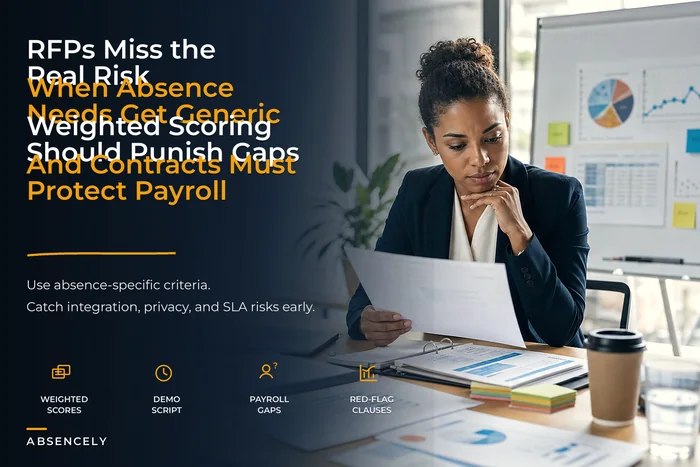
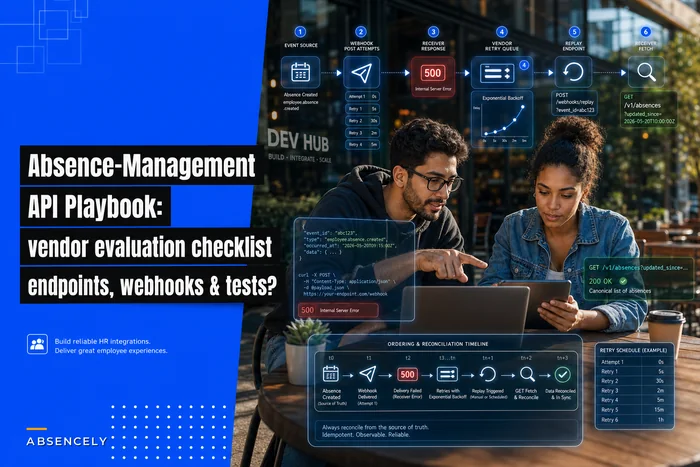
A lot of teams also under-weight the integration and data layers during selection because they're harder to evaluate than a slick demo. That's a mistake that compounds. If you want a deeper breakdown of the scoring and red-flag pitfalls, the walk-through on avoiding costly RFP mistakes for absence systems covers the evaluation scoring and payroll-risk traps in detail, and the absence-management API playbook for vendor evaluation gives you the concrete endpoints and test scenarios to validate before you sign anything.
Here's a vendor-scoring frame that carries across the lifecycle:
| Scoring dimension | Weight | Procurement signal | Ongoing KPI equivalent |
|---|---|---|---|
| Integration reliability | 25% | Passes payroll/HRIS test cases | Feed success rate, break frequency |
| Adjudication accuracy | 20% | Sample case accuracy in pilot | Error rate, rework volume |
| Support & responsiveness | 15% | Documented SLA tiers | Actual response/resolution times |
| Configuration flexibility | 15% | Self-service config demo | Change request turnaround |
| Data portability | 10% | Export format, exit terms | Export test pass/fail |
| Compliance coverage | 10% | Jurisdiction mapping | Audit findings, policy gaps |
| Commercials | 5% | Total cost of ownership | Cost per employee trend |
The weights matter less than the principle: every dimension you score at selection needs a measurable equivalent you can track after go-live. If you can't measure it operationally, don't let it drive the decision now.
Stage two: onboarding, where unpriced scope quietly destroys the economics
Onboarding is the stage where the deal you negotiated gets silently renegotiated in the vendor's favor. The pattern is familiar: implementation starts, a few things weren't quite in scope, your team absorbs them to keep the timeline, and three months later you've paid for a system that does less than you thought while your internal team quietly covered the gap.
This usually happens because the statement of work and the professional services scope were written vaguely. "Standard integration" means one thing to you and another to the vendor. "Data migration included" turns out to cover the happy path but not your five years of messy historical leave records. Every ambiguity becomes a change order or an unfunded internal project.
A good PS-scoping template forces specificity before the clock starts. It should pin down the exact integrations in scope (named by system and direction), data migration volume and cleansing responsibility, how many configuration iterations are included before change fees kick in, and the test cases the vendor must pass before go-live sign-off. Named deliverables with acceptance criteria — not just milestones — matter here, as does clarity on who owns training and how many sessions are bundled. Rollback and parallel-run expectations during cutover should also be explicit, not assumed.
Log scope ambiguities during onboarding as change-order requests so they become measurable, chargeable events rather than unfunded internal work.
Onboarding also sets your first real data point for the scorecard. How a vendor behaves when scope gets fuzzy during implementation is probably the single best predictor of how they'll behave at renewal. A vendor that nickel-and-dimes you during onboarding will do it again every year. Log it. That behavior is a KPI too.
Stage three: SLA-to-price renewal rules and penalty triggers
This is the part almost everyone gets wrong, and it's the heart of real governance. An SLA is worthless if a miss doesn't change anything. Most contracts have SLAs with credits so small the vendor treats them as a cost of doing business — a 2% monthly service credit on a line item that's a rounding error against total spend. That's not a lever. That's theater.
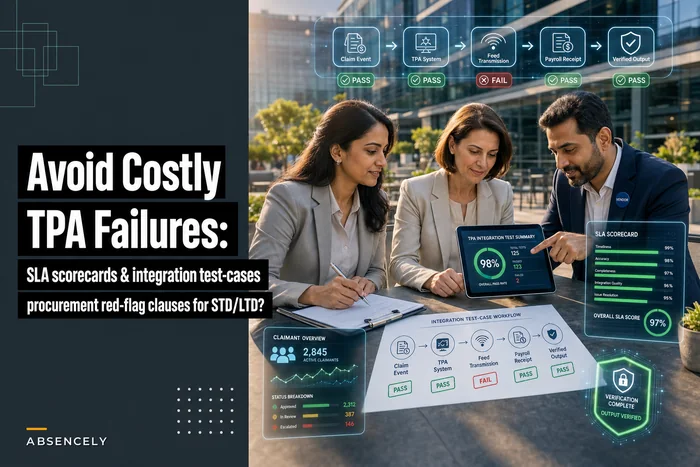
The upgrade is to tie SLA performance directly to price and renewal terms, with triggers that escalate. The TPA and carrier side of this has its own nuances, and the breakdown on avoiding costly TPA failures with SLA scorecards and contract red-flag language is worth reading alongside this if you're dealing with STD/LTD administrators — the same mechanics apply.
Build your SLA structure in tiers, where sustained underperformance progressively shifts leverage to you:
-
Measure-only tier. First miss on any metric
logged, reported in the quarterly review, no financial action. This builds the evidence record.
-
Credit tier. Two consecutive misses or three in a rolling quarter: meaningful service credits — enough to actually sting, benchmarked against the business impact, not a token percentage.
-
Price-adjustment tier. Sustained misses across two quarters
the contract triggers a price freeze or rollback, so you stop paying escalators for a service that's degrading.
-
Renewal-right tier. Chronic underperformance crossing a defined threshold: you gain an early termination right or a mandatory renegotiation window, regardless of the auto-renew clause.
The key design principle: penalties should scale with duration, not just severity. A single bad week during open enrollment is noise. The same miss every month for a quarter is a pattern, and your contract should treat patterns differently from incidents. Most contracts don't make that distinction, which is why vendors can absorb occasional misses indefinitely.
Write the penalty triggers as mechanical rules, not judgment calls. "If payroll feed success rate falls below 98% for two consecutive months, service credit of X applies automatically." No negotiation at the moment of the miss — the rule already decided. This removes the awkward relationship dynamics that normally stop ops teams from enforcing SLAs they're perfectly entitled to enforce.
The renewal decision framework: KPIs to contract levers
Now the lifecycle connects. Everything above — the procurement scoring model, the onboarding behavior log, the SLA miss record — feeds a single renewal decision grounded in evidence instead of inertia.
The framework is a mapping: each scorecard KPI trend points to a specific contract lever. You're not asking "do we like this vendor." You're asking what the data tells you to do.
| KPI trend over the term | Decision signal | Contract lever to pull |
|---|---|---|
| All KPIs green, stable | Healthy relationship | Renew, negotiate multi-year discount |
| Green but costs rising faster than value | Overpaying | Renew with price cap, benchmark clause |
| Integration/support degrading | Early warning | Renew short-term, add penalty triggers, PIP |
| Chronic SLA misses, pattern established | Broken relationship | Trigger renegotiation or exit, run procurement |
| Compliance gaps or audit findings | Risk exposure | Remediation milestone before any renewal |
The lifecycle of a vendor relationship — from procurement scoring through onboarding, quarterly SLA review, and into the renewal decision — follows a flow where each stage generates the artifacts that feed the next:
Procurement scoring model ↓ Onboarding behavior log + PS scope tracking ↓ Quarterly SLA scorecard (measure → credit → price-adjust → renewal-right) ↓ KPI trend map → contract lever decision ↓ Renew / renegotiate / exit
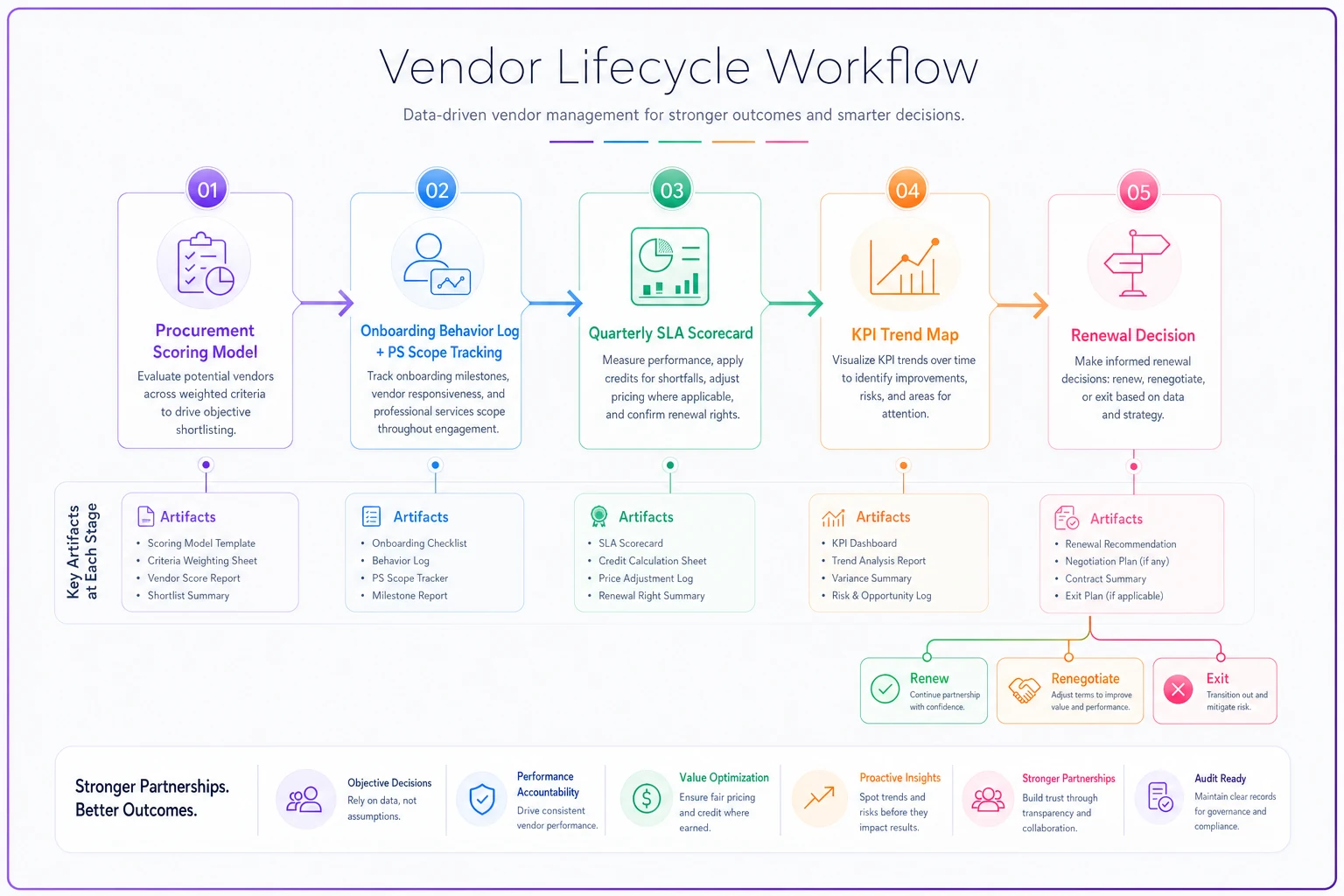
What makes this work is that the decision isn't made at renewal. It's made continuously, and renewal just formalizes it. By the time the contract date arrives, you already know which row you're in because you've been scoring quarterly. Teams that get surprised at renewal are the ones who only looked at the vendor when the renewal notice landed.
A practical rule: start the renewal decision process at least two full quarters before the term ends. If your scorecard is yellow or red, that runway is the difference between negotiating from strength and getting cornered into an auto-renewal because you ran out of time.
A real scenario: a mid-size employer catches the drip before it costs them
A regional healthcare group running absence administration for roughly 2,400 employees had been with the same vendor for three years. On paper the relationship was fine — no fires, no escalations to leadership. The contract was heading toward its default auto-renewal with a 6% price escalator.
What changed was that their ops team started scoring the vendor quarterly against the same model used in the original selection. Within two quarters the data told a different story than the "everything's fine" narrative. The payroll feed had been failing on roughly one in four cycles and getting manually patched — invisible at the leadership level because the ops team just quietly fixed it. Support resolution times had drifted from same-day to around three days. Adjudication rework had crept up noticeably.
None of that had triggered a formal complaint. But scored against the baseline, it was clearly a degrading relationship sliding toward the "early warning" row of the framework. Instead of auto-renewing, they went into the renewal with a documented miss record. The result wasn't dramatic — they didn't rip the system out. They negotiated the escalator down to flat, added real penalty triggers tied to feed reliability, and secured an early termination right if the patterns continued. Somewhere in the range of $40k–$50k a year in avoided escalators and credits, plus a vendor that suddenly started answering tickets faster once the SLA had teeth.
The outcome that mattered more than the money: the decision was defensible. When finance asked why they didn't just take the standard renewal, the answer was a scorecard, not a hunch.
When heavy lifecycle governance makes sense — and when it doesn't
This level of governance isn't free. Scoring a vendor quarterly, maintaining the miss log, keeping PS scope templates current — that's real ongoing effort. Worth being honest about when it actually pays off.
When it makes sense: You're running absence administration at enough scale that vendor failures hit payroll accuracy, compliance exposure, or employee experience in a way leadership would care about. Usually that's a few hundred employees and up, or any workforce with complex multi-jurisdiction leave rules where a vendor stumble creates legal risk. If a feed break means real people get paid wrong, you need the governance.
When it's overkill: A small employer with simple PTO and a lightweight tool doesn't need a four-tier SLA penalty ladder. The relationship is small enough that a direct conversation solves most problems, and the overhead of formal quarterly scoring would cost more than it saves.
Who should not do this: Teams that won't actually enforce the triggers they write. A penalty clause nobody is willing to invoke is worse than no clause — it signals to the vendor that your contract language is bluffing. If your organization's culture avoids confrontation with vendors at all costs, fix that before building an elaborate SLA structure, because the structure only works if someone will pull the lever.
Making the lifecycle actually connect
The whole point of treating this as a lifecycle rather than four disconnected projects is that the artifacts carry forward. The minimum set of connected pieces to put in place:
-
One scoring model used at selection and re-run quarterly, so your baseline and your ongoing measurement are the same instrument.
-
A PS-scoping template detailed enough that onboarding scope creep becomes a priced change order, not an unfunded internal project.
-
SLA triggers written as mechanical rules tied to price and renewal terms, scaling with duration.
-
A rolling miss log that becomes your negotiating evidence at renewal.
-
A KPI-to-lever map so the renewal decision is made from data, started two quarters early.
The organizations that run this well aren't smarter negotiators. They're just the ones who refused to let procurement, onboarding, SLA management, and renewal live in separate silos. They built the thread that connects the vendor they chose to the vendor they're still paying, and measured the gap the whole way through.
Vendor governance fails quietly, which is exactly why it needs a system that makes the quiet failures visible before the renewal notice forces your hand. Score continuously, tie the scores to levers you'll actually pull, and renewal stops being the moment you discover how the relationship really went — and becomes the moment you act on what you already knew.
Ready to optimize your workforce absence management?
Join 2,000+ HR teams using Absencely to reduce administrative burden, improve compliance, and boost employee satisfaction.