



Most TPA relationships don't fail loudly. They erode. A claim sits three days longer than it should. A payroll bridge amount comes over wrong. A carrier feed drops a status change and nobody notices until an employee calls asking why their check is short. By the time HR realizes the administration has quietly degraded, you're already cleaning up back-pay corrections and fielding angry emails from managers.
Most STD/LTD contracts are written to protect the TPA, not the employer. The SLAs are vague ("commercially reasonable efforts"), the penalties are toothless, and there's usually no defined test for whether the data integration actually works before go-live. This is a TPA SLA playbook for STD LTD built around the three things that actually prevent expensive failures: weighted scorecards tied to payroll and claims outcomes, integration test-case scripts you run before you sign off, and contract language that gives you real leverage when things slip.
Why standard TPA SLAs don't protect you
Open almost any TPA service agreement and you'll find SLAs measured on things the TPA can easily control — things that don't map to your actual pain. "Average speed to answer under 30 seconds." "First contact resolution rate." These look reassuring in a quarterly business review and mean almost nothing when a disability claim adjudication is late and payroll has to guess whether to run the bridge payment.
The gap is that TPA metrics are activity-based, while your risk is outcome-based. What hurts you isn't a slow phone queue. It's the specific handoff points where a delay or error becomes a payroll problem, a compliance exposure, or an employee escalation. A typical example: the TPA hits every published SLA — call times, acknowledgment letters, portal uptime — while three claims a month get adjudicated late enough to force manual payroll adjustments. The scorecard says green. Your payroll team is drowning.
The fix isn't more metrics. It's weighting the few metrics that touch payroll and claims accuracy heavily, and tying financial consequences to those specifically. Everything else is context.
Building a weighted SLA scorecard that ties to payroll and claims
A scorecard only works if the weights reflect real downstream cost. Across STD/LTD programs, three categories cause almost all the expensive damage: adjudication timeliness, payroll data accuracy, and status-change communication. Phone metrics and portal uptime matter, but they rarely trigger a check correction or a DOL question.
Stop managing absences manually.
Absencely simplifies leave requests, approvals, and absence monitoring for your entire workforce.
- Automated leave tracking
- Manager approval workflows
- Compliance & reporting tools
No credit card required
| SLA Category | What It Measures | Weight | Why It's Weighted This Way |
|---|---|---|---|
| Adjudication timeliness | Days from complete file to decision | 25% | Directly drives payroll bridge decisions and back-pay |
| Payroll data accuracy | Correct benefit amount, offset, and dates sent to payroll | 25% | Errors here create clawbacks and W-2 corrections |
| Status-change communication | Notification lag on approvals, denials, RTW, extensions | 20% | Late notices cause overpayments and coverage gaps |
| Overpayment identification | Speed of flagging and recovery of overpaid benefits | 12% | Delayed flags = harder recovery, tax mess |
| Documentation completeness | Adjudication rationale documented for appeals/audit | 8% | Protects you in disputes and litigation |
| Responsiveness (calls/portal) | Standard service metrics | 10% | Real, but rarely the source of costly failures |
The point of the weighting is that a TPA can't "green-wash" the scorecard by crushing the easy service metrics. If they miss payroll accuracy two months running, the composite score drops enough to trigger the remedies you wrote into the contract — regardless of how fast they answer the phone.
One thing that gets missed consistently: measure adjudication timeliness from "complete file received," not "claim opened." TPAs love to reset the clock every time they request one more document. If your SLA doesn't define what a complete file is and cap the number of information requests, the timeliness metric is essentially meaningless. Define it. Attach it to the contract as an exhibit.
Setting thresholds that actually mean something
A weighted score is only useful with defined thresholds and consequences. A structure that holds up in practice:
-
Green (95–100% composite) Program healthy, standard QBR cadence
-
Yellow (88–94%) Written corrective action plan required within 10 business days, weekly check-ins until back to green
-
Red (below 88%) Service credits triggered, right-to-audit invoked, escalation to TPA account executive
-
Two consecutive Red months Termination-for-cause window opens without penalty
Track it monthly, not quarterly. A quarterly average hides the exact bad month that generated eight payroll corrections. If you're already running an executive absence view, the STD/LTD scorecard should feed into it as its own line rather than getting buried in aggregate absence numbers.
Integration test-cases: prove the data flow before go-live
The most expensive TPA failures aren't adjudication disputes. They're integration failures — the feed between the TPA's system and your payroll/HRIS that quietly sends wrong amounts, wrong dates, or nothing at all. Almost nobody tests these properly before go-live. They do a "connectivity test" (the file transmitted successfully) and call it validated. Connectivity is not correctness.
You need scripted test-cases that push realistic, messy scenarios through the integration and verify the output on the payroll side. The philosophy mirrors what we've laid out for avoiding costly RFP mistakes with integration test-cases and payroll-risk red flags — you test the ugly edge cases, not the happy path, because the happy path always works in a demo.
A test-case script you can run
Run each of these end-to-end and confirm the payroll system shows the correct result, not just that a file arrived:
-
Clean STD approval — Standard 60% benefit, no offsets. Confirm exact benefit amount, start date, and scheduled duration land correctly in payroll.
-
STD with state disability offset — Employee in a state with statutory disability (e.g., CA, NJ, NY). Confirm the offset math and that payroll doesn't double-count.
-
Mid-claim benefit change — Approved claim where the weekly amount changes after week 4 (salary adjustment or offset kicks in). Confirm the feed sends the change, not the original amount.
-
Denial after partial payment — Claim denied after two weeks of payment. Confirm overpayment flag transmits and payroll can initiate recovery.
-
STD-to-LTD transition — Claim rolls from short-term to long-term. Confirm the handoff doesn't create a coverage gap or a duplicate payment during the transition week.
-
Retroactive approval — Claim approved 3 weeks after leave started. Confirm back-pay calculation and that prior unpaid weeks reconcile correctly.
-
Return-to-work mid-period — Employee returns Wednesday of a pay period. Confirm the partial-week proration and benefit stop-date are correct.
-
Duplicate/correction file — TPA resends a corrected record. Confirm payroll applies the correction and doesn't process both.
The failures that surface most often in this testing are #3 and #6 — mid-claim changes and retroactive approvals. Systems that handle clean claims fine will silently send the original benefit amount when something changes mid-stream, or fail to reconcile back-pay entirely. You want to find that in a test environment, not in a live payroll run three months in.
> WORKFLOW NOTE: Map your integration test-case sequence as a linear flow — Claim Event → TPA System → Feed Transmission → Payroll Receipt → Verified Output — so your implementation team can track pass/fail at each handoff point during go-live testing.
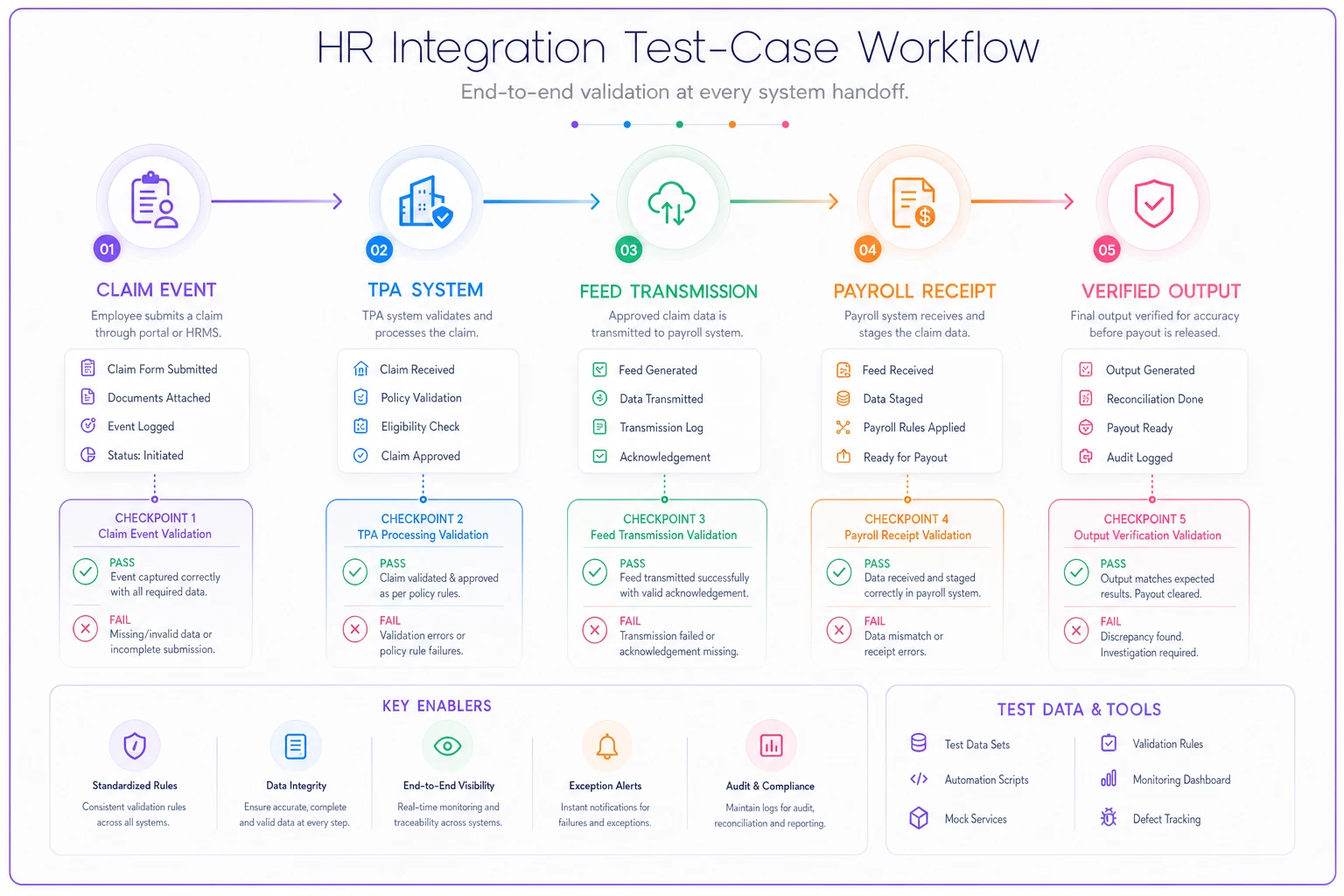
Don't sign the go-live approval until every one of these cases produces a verified-correct result on the payroll side and is documented with a screenshot or record. Make the TPA's implementation lead sign off on the same document. That signed test log becomes your evidence if the integration breaks later and they claim it was configured correctly.
Contract red-flag language specific to STD/LTD
This is where most employers leave money and leverage on the table. STD/LTD contracts are dense, and the risky language is usually buried in definitions and limitation-of-liability sections. Here's what to flag before signing.
Vague effort standards. Any SLA that says "commercially reasonable efforts" or "industry standard" instead of a specific measurable target is not an SLA. Replace with defined numbers and defined measurement windows. If they won't commit to a number, that tells you something.
Uncapped information requests resetting the clock. TPAs reset adjudication timers by requesting documents. Add language: adjudication timeliness measured from receipt of a complete file, complete file defined per Exhibit X, maximum of two supplemental information requests before the claim is escalated.
Service credits capped at pennies. Many contracts cap total annual service credits at something trivial — a few percent of fees. If your real exposure from bad administration is payroll corrections and compliance risk, a 2% fee credit doesn't protect you. Negotiate for meaningful credits tied to the weighted red thresholds, plus a termination-for-cause path after repeated failures.
No right-to-audit or data portability. You need contractual right to audit claim files and adjudication rationale, and you need clear ownership and export rights for your claims data. TPAs that make it hard to leave — proprietary formats, exit fees, slow data transfer — are protecting themselves at your expense. Get data portability and a defined transition-services obligation in writing.
Silent auto-renewal with rate increases. Watch for evergreen renewal clauses that lock you in with built-in annual increases and a narrow termination window. Cap the increase and widen the notice window.
Limitation of liability that excludes payroll errors. Read the carve-outs. If the TPA's liability cap or exclusions cover the exact failures that cost you the most — like transmitting wrong payroll amounts — you're absorbing their mistakes. At minimum, carve out payroll-data-accuracy failures from the standard liability cap.
Quick red-flag checklist
Before signing any STD/LTD administration agreement, confirm:
-
Every SLA has a specific number and measurement window, no "reasonable efforts"
-
"Complete file" is defined and information requests are capped
-
Service credits are meaningful and tied to weighted scorecard thresholds
-
Termination-for-cause path exists for repeated Red months
-
Right-to-audit on claim files and adjudication rationale is explicit
-
Data ownership, export format, and transition services are defined
-
Auto-renewal terms and rate increases are capped, with adequate notice
-
Payroll-accuracy failures are carved out of the liability cap
If a TPA pushes back hard on more than two or three of these, that's its own signal about how they handle accountability once you're under contract.
A real scenario: mid-size employer, quiet integration failure
A regional healthcare group with around 900 employees ran STD/LTD through a national TPA. On paper, everything was green — the TPA's quarterly review showed strong service scores. Meanwhile, payroll was spending roughly 6–8 hours a month on manual corrections and nobody had connected the two.
When they finally ran a version of the test-cases above against historical claims, the pattern was obvious: mid-claim benefit changes and retroactive approvals were transmitting the original amount, not the updated one. Around 4 to 5 claims a month were coming through wrong, each requiring a correction, an employee conversation, and sometimes a back-pay run. Annualized, the rework and overpayment recovery was running somewhere in the low five figures — plus the harder-to-quantify cost of employees losing trust after a short check.
The fix wasn't switching TPAs. It was building the weighted scorecard so payroll accuracy actually showed up as a Red metric, running the integration test-cases to pinpoint the two broken scenarios, and adding contract language on the next renewal that tied service credits to payroll-data accuracy specifically. Within two quarters, monthly corrections dropped to roughly one or two, and the ones that remained were genuine edge cases rather than systematic feed errors.
The scorecard did what the old QBR never could — it made the real problem visible instead of letting it hide behind green call-time metrics.
When this level of rigor makes sense — and when it doesn't
This full framework — weighted scorecards, scripted integration tests, negotiated red-flag language — is worth the effort if you have enough STD/LTD claim volume that errors compound, or if you're running multi-state operations where offsets and statutory disability interactions get complicated. If you're managing dozens of disability claims a year across several states, the rigor pays for itself in avoided corrections and compliance protection.
It's overkill if you're a very small employer with a handful of claims a year and a simple single-state setup. The integration test-cases still matter in that scenario, but building a heavily weighted scorecard for three claims a year is more process than the risk justifies. Right-size it.
Who should absolutely not skip this: anyone switching TPAs or implementing a new carrier feed. The go-live window is exactly when integration failures get baked in, and it's far cheaper to catch them during implementation than to discover them via a payroll complaint six months later. The same discipline applies to any vendor activation with SLA-driven handoffs — the logic mirrors what a solid temp agency activation playbook with SLA triggers and contract clauses does for staffing partners: define the measurable commitments and the consequences before you're dependent on the vendor.
Bringing it together
TPA failures are rarely dramatic and rarely obvious from the standard reports. They hide in the metrics the TPA chose to measure, in the integration paths nobody tested past connectivity, and in contract language written to protect the vendor.
The three moves that change the equation: weight your scorecard toward the metrics that actually hit payroll and claims accuracy, script real integration test-cases and don't sign go-live until they pass, and rewrite the vague, TPA-favorable clauses into specific, enforceable commitments. None of this requires a legal team or a major process overhaul. It requires deciding in advance what accountability actually looks like — and putting it in writing before you need it.
Do those three things and you shift from finding out about problems when an employee's check is short, to catching them in a test environment and a monthly scorecard. That's a meaningful difference in how much of your time goes to fixing administration versus managing it.
Ready to optimize your workforce absence management?
Join 2,000+ HR teams using Absencely to reduce administrative burden, improve compliance, and boost employee satisfaction.