

When a distribution center loses eight warehouse associates to a norovirus wave in the same week, the problem isn't finding a temp agency. There are twelve of them within a 20-mile radius, all happy to take the call. The problem is that the call happens on a Thursday, the agency needs a signed service agreement, the ops manager has to loop in legal, legal wants three days, and by the time bodies show up, the surge is half over and overtime has already eaten the budget you were trying to protect.
That delay — the activation lag — is the single most expensive part of surge hiring, and almost nobody plans for it in advance. Everybody plans for the need. Very few plan for the speed.
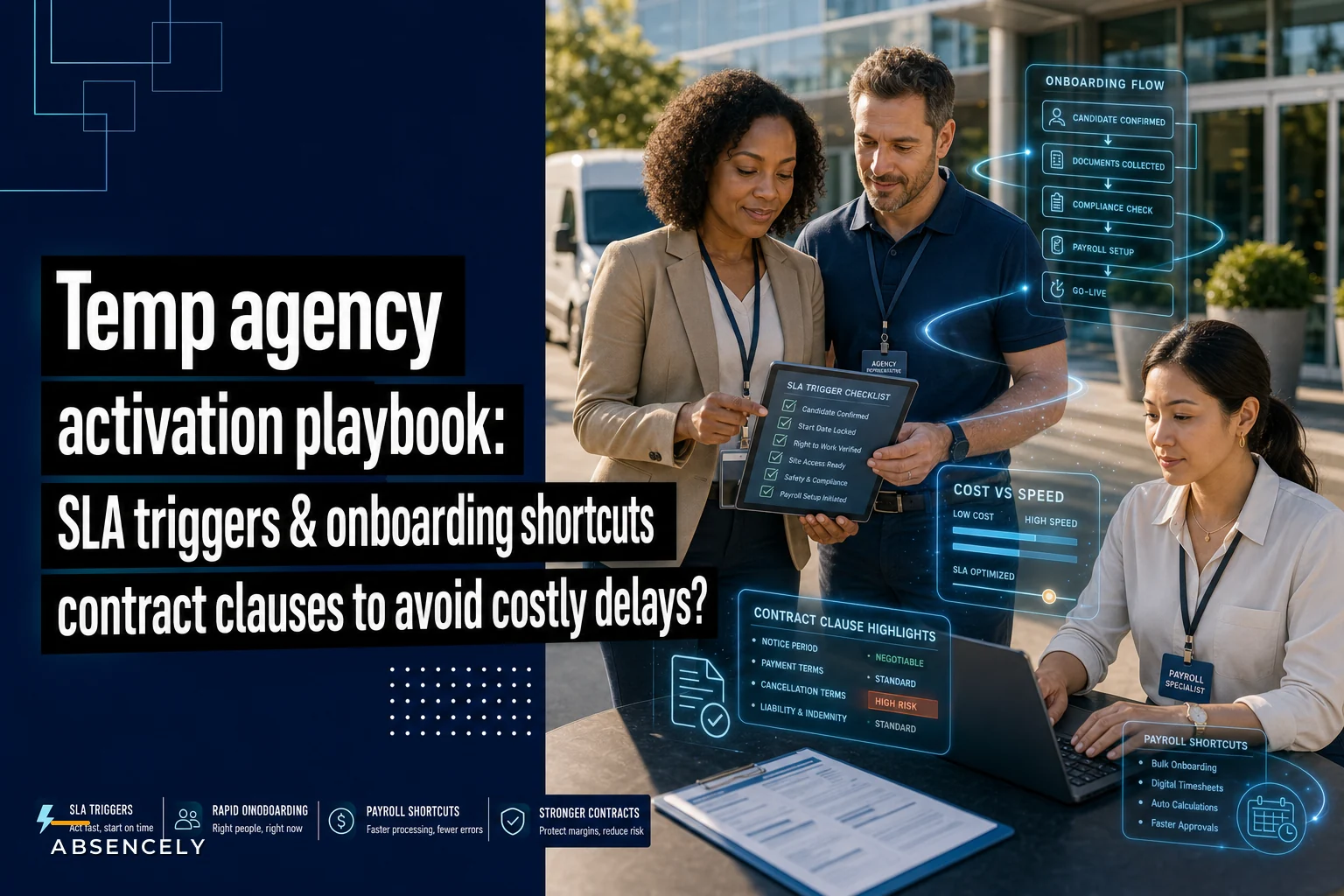
This is what a temp agency activation playbook actually solves. Not "should we use temps" — that decision usually makes itself. The playbook answers a narrower, more operational question: when an absence spike crosses a threshold, what set of pre-built triggers, contracts, and onboarding shortcuts gets you from "we're short" to "they're clocked in" in hours instead of days?
Why activation is slow (and it's rarely the agency's fault)
In real operations, the delay almost never comes from the staffing firm. Agencies want the placement; they move fast. The friction is internal, and it's usually one of these four things:
-
No pre-signed master agreement. Every activation starts contract negotiation from zero, which means legal review, redlines, and a signature chain that ignores the fact that people are already out.
-
Unclear approval authority. The line manager knows they need four temps but doesn't know if they're authorized to approve the spend, so it goes up the chain and sits there.
-
Onboarding paperwork treated as a fresh problem each time. I-9 verification, payroll setup, badge access, and safety orientation get improvised on day one instead of being pre-staged.
-
No pricing baseline. Nobody knows what a fair bill rate looks like under pressure, so someone tries to negotiate mid-crisis and loses two days doing it.
The companies that activate temps fastest aren't the ones with the best agencies. They're the ones who did all the boring paperwork before they needed anyone. A temp agency activation playbook is basically pre-authorized bureaucracy, and that's not a criticism — that's the whole point.
Build the triggers before the crisis, not during it
The trigger is what turns an absence pattern into an action without requiring a meeting. If you already track absence data for forecasting — and if you don't, it's worth reading through turning absence data into staffing outcomes first — you can tie activation directly to a threshold instead of a manager's gut feel.
Stop managing absences manually.
Absencely simplifies leave requests, approvals, and absence monitoring for your entire workforce.
- Automated leave tracking
- Manager approval workflows
- Compliance & reporting tools
No credit card required
A clean trigger has three parts: the condition, the authorized action, and the owner who executes without asking permission.
Here's what a workable trigger set looks like for a mid-sized operation:
| Trigger condition | Authorized action | Owner | Target activation time |
|---|---|---|---|
| Coverage drops below 85% on any shift for 2+ days | Notify agency, request 2–3 temps from pre-approved roster | Shift supervisor | Same day |
| 3+ unplanned absences in a single department within 48 hrs | Auto-issue work order under master agreement | Ops manager | < 4 hours |
| Critical-role absence with no cross-trained backup | Emergency activation, premium rate pre-approved | HR business partner | < 2 hours |
| Forecasted absence spike (seasonal/known event) | Pre-stage temps 5 days ahead | Workforce planner | Scheduled |
The point of pre-approving the premium rate on that third row is subtle but important. In a genuine emergency you will pay more, and pretending otherwise just adds a negotiation cycle you can't afford. Deciding the ceiling in advance — "we'll accept up to a 20% premium for sub-2-hour critical activation" — means nobody wastes the crisis haggling.
If your manager absence workflow already defines SLAs and escalation triggers, the vendor activation trigger should live inside that same document — not in a separate binder nobody opens until things go sideways.
A simple visual of the flow helps stakeholders agree on roles and timing quickly.
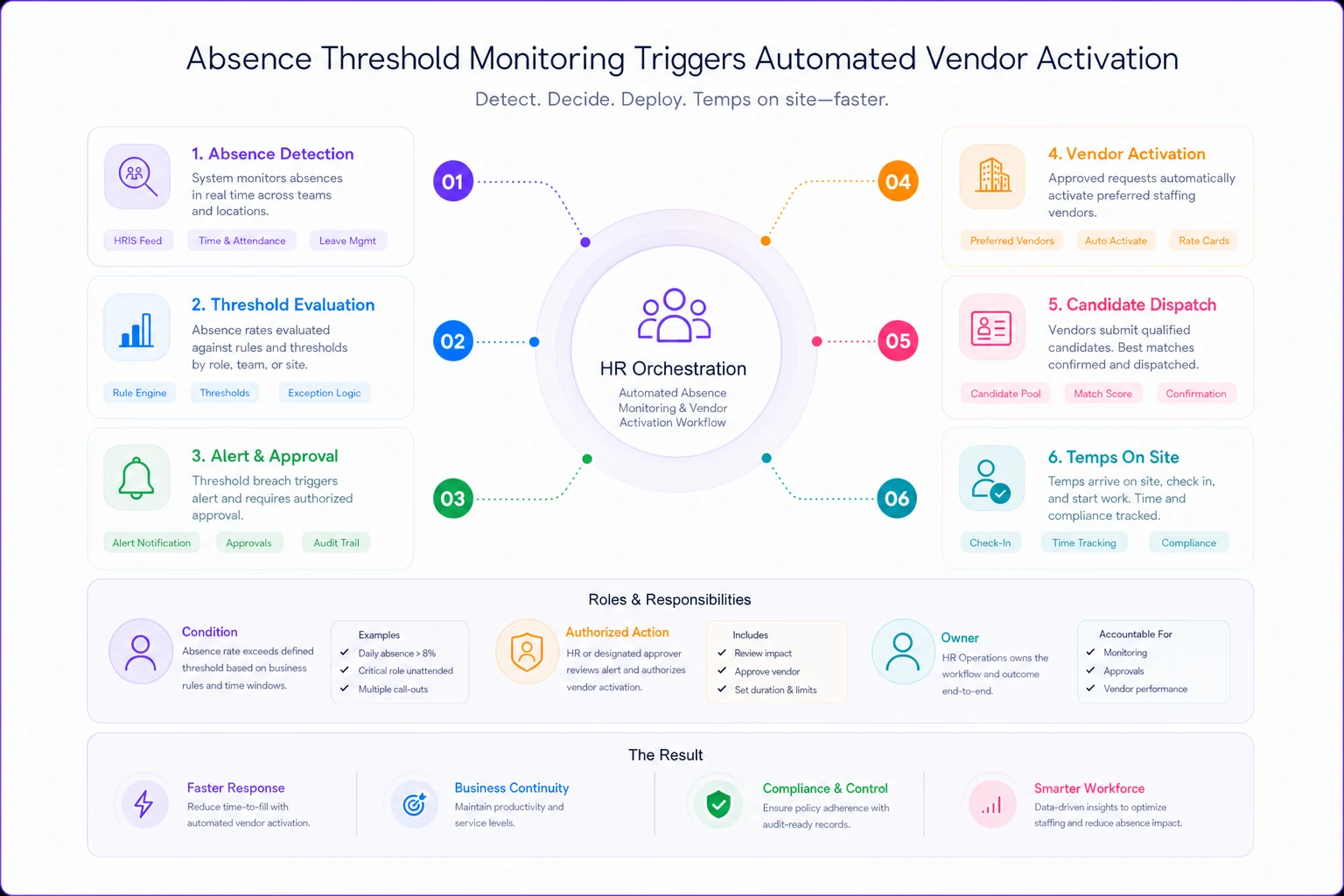
This also connects directly to your escalation rules.
The SLA template that actually holds agencies accountable
Most temp agency SLAs are useless because they measure the wrong things. They promise "quality candidates" and "responsive service," which mean nothing when you're trying to enforce something at 6 a.m. on a Monday.
The metrics that matter for surge hiring are time-based and fill-based. A tight SLA covers:
-
Time-to-response Agency acknowledges the work order within a defined window — e.g., 30 minutes during business hours, 2 hours after.
-
Time-to-fill Workers on-site within X hours for standard roles, Y hours for pre-rostered critical roles.
-
Fill rate Percentage of requested headcount actually delivered. A 60% fill on an urgent order is a failed activation, not a partial win.
-
No-show/replacement guarantee If a temp no-shows or washes out in the first shift, replacement within a set window at no additional markup.
-
Rate lock Bill rates fixed for the contract term so surge pricing can't creep upward mid-engagement.
One small but telling detail: put a fill-rate floor with a penalty or credit in writing. Agencies that consistently deliver 4 of 6 requested temps have learned they can under-deliver without consequence. When the SLA says "below 90% fill on a standard order triggers a 5% credit on that order," delivery discipline tightens up fast — not because the credit amount is significant, but because it forces the agency to prioritize your order over the client who didn't bother writing anything down.
Vague SLAs protect the agency, not you. The more specific the language, the less room there is for a polite conversation about why they fell short again.
I-9 and payroll setup shortcuts that don't cut corners
Onboarding is where a fast activation goes to die. You got temps placed in four hours, and then they stood around for ninety minutes because nobody could complete I-9 verification and payroll wasn't set up to pay them yet.
Worth being direct about this: with agency temps, the staffing agency is usually the employer of record, which means the agency handles I-9 completion and payroll — not you. This is the single biggest shortcut available, and a surprising number of companies forget it exists. If the agency is the W-2 employer, your I-9 obligation for those workers is essentially zero. The agency owns Form I-9, E-Verify if applicable, and tax withholding.
-
Co-employment blur. If you start directing temps like full employees on tax and benefits matters, you invite co-employment risk. Keep the employer-of-record line clean in the contract.
-
Direct-hire conversions. The moment a temp converts to your payroll, now the I-9 clock starts and you own it. Pre-stage a conversion onboarding packet so this isn't a scramble when the time comes.
-
Access and safety — those are always yours. Even though the agency employs them, badge access, equipment, and site-specific safety orientation fall on you. Pre-build a 20-minute temp orientation and a badge-provisioning checklist so on-site time isn't wasted.
A practical pre-staging checklist for the day temps arrive:
-
Site orientation deck (short, temp-specific, safety-focused)
-
Badge/access request template with same-day turnaround
-
Supervisor assignment sheet (who owns each temp on the floor)
-
Equipment/PPE issue log
-
Timekeeping method the agency can reconcile against for billing
-
Emergency contact and check-in procedure
None of that requires HR to touch payroll or I-9 — because the agency already handled it. That separation is what makes fast onboarding actually fast.
Sample contract clauses worth having pre-written
You don't want to draft language during a crisis. Keep a master agreement on file with these clauses already negotiated. Rough examples of what belongs in each:
Rapid activation clause. "Upon issuance of an emergency work order, Agency shall respond within [30 minutes] and deliver requested personnel within [4 hours] for standard roles and [2 hours] for pre-rostered critical roles."
Rate-lock and surge-cap clause. "Bill rates set forth in Exhibit A remain fixed for the term. No surge, holiday, or urgency premium shall apply except as expressly pre-authorized, and in no case exceeding [20%] of the standard bill rate."
Fill-rate service credit clause. "Where Agency delivers fewer than [90%] of requested personnel on a standard order, Client shall receive a [5%] credit on the affected order."
Replacement guarantee clause. "Any placed worker who fails to report or is deemed unsuitable within the first [8 worked hours] shall be replaced at no additional markup within [4 hours]."
Conversion clause. "Client may convert any temporary worker to direct hire after [X] hours worked, with conversion fees scaling down to zero at [Y] hours, ensuring cost-neutral long-term retention."
That conversion clause matters more than people expect. When a temp turns out to be excellent, you don't want a punitive buyout fee blocking you from keeping them. Negotiate the decay schedule up front, not when you're ready to make an offer and suddenly discover there's a four-figure fee attached.
The cost comparison nobody runs until it's too late
The reason activation lag is so expensive is that the default response to an absence spike isn't temps — it's overtime and stretched shifts. And overtime feels invisible because it's already buried in the payroll system.
| Approach | Effective cost/hr | Two-week cost (est.) | Hidden costs |
|---|---|---|---|
| Mandatory overtime (existing staff) | ~$36 (1.5× of $24 base) | ~$17k–$19k | Burnout, error rates climbing, secondary absences |
| Scrambled temp hire (no playbook) | ~$34 bill rate + delay | ~$14k + 3 lost days | Coverage gaps during activation lag |
| Pre-activated temps (playbook in place) | ~$32 bill rate | ~$13k, near-zero lag | Minimal |
The numbers move around by industry, but the shape holds: overtime almost always looks cheaper per-decision and costs more per-outcome, mostly because of what it does to the people you kept. Two weeks of forced overtime frequently generates the next round of absences — tired people call out, which is exactly the pattern you were trying to break.
When this playbook makes sense — and when it doesn't
When it's worth building: operations with genuine surge exposure — seasonal peaks, shift-based coverage requirements, roles where one absence directly stops output. Warehousing, manufacturing, food production, healthcare support, call centers. If a single-shift shortfall costs you real money, the pre-work pays for itself the first time you use it.
When it's a bad idea: highly specialized roles where no temp can realistically fill in on short notice. If your surge role requires six weeks of certification, a fast activation playbook is the wrong tool — you need cross-training and a bench, not a phone number. Forcing temp activation onto specialized work just gets you expensive people who can't do the job.
Who should skip it: very small teams where surge needs are rare and unpredictable. If you activate temps twice a year, a lightweight pre-signed master agreement is probably enough. The full trigger matrix is overkill. Build to your actual frequency, not to a template someone handed you.
A real scenario
A regional food-packaging operation with around 90 hourly workers kept getting hammered every time flu season hit the production floor. Their old process: production manager flags the shortage, emails HR, HR calls two agencies, someone negotiates rates, contract gets reviewed, temps show up around day three or four. Meanwhile the floor ran on overtime.
Over one bad two-week stretch the prior year, they'd burned roughly $16k in overtime and still missed output targets twice, because the fastest activation they managed was about 72 hours.
They spent an afternoon building the boring stuff: one pre-signed master agreement with two agencies, a rate-lock exhibit, a fill-rate credit clause, a trigger tied to their existing absence tracking (3+ unplanned absences in a department within 48 hours = auto work order), and a 20-minute temp orientation deck sitting in a shared folder.
Next spike, activation dropped to under six hours. Overtime for a comparable two-week window came in closer to $11k–$12k, and they hit output targets both weeks. The dollar savings weren't dramatic on paper — a few thousand — but what actually changed was that the production manager stopped dreading flu season. The response was a checklist now, not a fire drill.
The takeaway
Most of the value here comes from work you do when nothing is wrong — the pre-signed agreement, the negotiated clauses, the trigger tied to a threshold you're already tracking. The crisis part is manageable once the paperwork is done.
What kills operations isn't the absence spike. It's discovering at the worst possible moment that every activation starts from a blank page. Build the triggers, lock the rates, pre-stage the onboarding, and tie the whole thing to the absence signals you already watch. When eight people go down in a week, activation becomes a decision you already made — not a scramble you're stuck running live.
Ready to optimize your workforce absence management?
Join 2,000+ HR teams using Absencely to reduce administrative burden, improve compliance, and boost employee satisfaction.