

Most absence integration problems don't announce themselves. They show up three months later as a payroll discrepancy nobody can trace, or a manager complaining that a leave they approved never made it into the scheduling tool. By the time someone opens a ticket, the actual failure happened days earlier — a field mismatch, a silent API timeout, a duplicate event that got processed twice.
What makes absence integration uniquely painful is that it sits at the intersection of the most sensitive systems in the company: the HRIS, payroll, time-and-attendance, benefits carriers, the scheduling platform, and increasingly a leave-management vendor or TPA. Every one of those systems has its own idea of what "a day of leave" means. And when you wire them together with one-off mappings, you end up with a web that only one engineer understands — and that engineer is usually the one about to leave.
This is a blueprint for the people who have to make those systems talk to each other without creating a maintenance nightmare. Written for HR leaders who need to understand the architecture decisions their IT partners are making, and for IT teams who need HR to define what the data actually means before they build anything.
Why point-to-point mapping quietly wrecks you
The default way most companies connect absence systems is point-to-point. HRIS talks directly to payroll. Payroll talks directly to time tracking. The leave vendor pushes straight into two of them. Each connection gets built when someone needs it, using whatever fields happened to be available that quarter.
The math is what gets you. Four systems that all need to share absence data means up to twelve directional connections if everything talks to everything. Add a fifth system and you're looking at twenty. Each connection has its own field mappings, its own retry logic, its own assumptions about timing. Nobody documented most of them because they were "just a quick integration."
What breaks first is usually semantic, not technical. One system stores a half-day of sick leave as 0.5. Another stores it as 4 (hours). A third stores it as two records — a start and an end — and calculates duration downstream. When you pipe these together without a shared definition, the numbers reconcile fine in testing and then diverge the moment someone takes an oddly-shaped intermittent leave.
A pattern worth naming: the systems that break most often aren't the ones with the most volume. They're the ones with the most exceptions. Predictable full-day vacations flow cleanly. It's the intermittent FMLA, the partial-day accommodations, the leave that gets corrected retroactively — that's where point-to-point mappings fall apart, because each system handles the edge case differently and there's no shared truth to reconcile against.
The canonical absence data contract
The fix isn't a better integration tool. It's agreeing on what an absence is before anything gets wired together. A canonical absence data contract is a single, versioned definition of an absence event that every system either produces or consumes. Instead of System A learning System B's quirks, both systems learn the canonical format.
Stop managing absences manually.
Absencely simplifies leave requests, approvals, and absence monitoring for your entire workforce.
- Automated leave tracking
- Manager approval workflows
- Compliance & reporting tools
No credit card required
Here's the core of what a usable contract needs to specify. Not a full schema dump — just the decisions that actually cause problems when left ambiguous:
-
Event identity — a stable, globally unique absence event ID that survives corrections. Not the primary key from any single source system. If the leave gets amended, the ID stays; a version number increments.
-
Duration representation — pick ONE. Storing both a start timestamp, an end timestamp, and an explicit
duration_minutesfield means consuming systems never have to calculate it themselves. Ambiguity here causes more payroll errors than anything else. -
Absence type taxonomy — a canonical list of types (sick, vacation, FMLA-intermittent, bereavement, jury, unpaid, etc.) with a mapping table from each source system's local codes. This is HR's job to own, not IT's.
-
Status lifecycle —
requested → approved → in_progress → completed → corrected → cancelled. Every system needs to agree that these are the only valid states and what transitions are legal. -
Effective date vs. record date — when the leave happened vs. when the record was created or changed. Retroactive corrections make this distinction non-negotiable.
-
Source and confidence — which system originated the record, and whether it's authoritative or provisional.
The single most useful discipline here is deciding, per field, which system is the system of record. Not "the HRIS owns everything." Duration might be owned by time-and-attendance. Approval status might be owned by the leave platform. Type might be owned by HRIS. Write it down. When two systems disagree, the contract tells you who wins — no debate, no Slack thread.
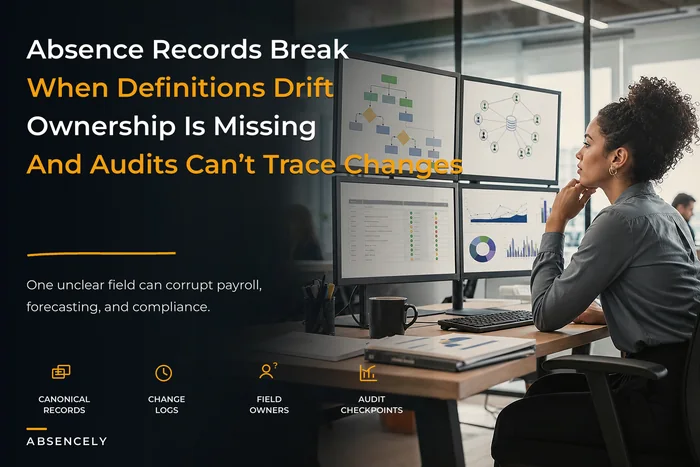
This is also where your governance discipline either pays off or fails. If you haven't already sorted out record definitions and ownership, the contract has no foundation. It's worth fixing absence data governance before it breaks forecasting — the canonical contract is essentially the technical expression of that governance work.
Event-driven vs. batch: choosing the right pattern per flow
A common mistake is treating this as an all-or-nothing decision. Teams either go "real-time everything" and drown in complexity, or "nightly batch everything" and accept a 24-hour lag on data that sometimes needs to move faster. The right answer is usually a mix, chosen per data flow based on how quickly a wrong answer causes damage.
| Flow | Pattern | Why | Acceptable lag |
|---|---|---|---|
| Leave approval → scheduling | Event-driven | A manager needs coverage gaps visible immediately | Seconds to minutes |
| Absence event → payroll | Batch (with event-triggered pre-close) | Payroll runs on a cycle; real-time adds risk without benefit | Until next pay cycle cutoff |
| HRIS org changes → all systems | Event-driven | Stale org data breaks approval routing | Minutes |
| Absence data → analytics/forecasting | Batch | Forecasting doesn't need sub-hour freshness | Nightly |
| Carrier/TPA status updates → HRIS | Event-driven (webhook) if supported, else polling batch | Depends entirely on vendor capability | Hours |
The insight most teams miss: event-driven and batch aren't opposites — batch is what you fall back to when events fail. A resilient design uses events for speed and a nightly reconciliation batch as a safety net that catches anything the event stream dropped. Build only events and one missed webhook means permanent drift. Build only batch and you accept lag everywhere. You want both, with the batch job explicitly comparing state and flagging discrepancies rather than blindly overwriting.
One warning about event-driven flows for absence data specifically: order matters, and events arrive out of order more than people expect. An "approved" event can land before the "requested" event it depends on if two systems fire near-simultaneously. Consuming systems need to handle events idempotently and tolerate arrival order — otherwise you get phantom states that require manual cleanup.
The orchestration layer: one hub instead of a web
Once you have a canonical contract and a sense of which flows need speed, the architectural move that changes everything is introducing an orchestration layer. Instead of every system talking directly to every other system, they all talk to a central hub that speaks the canonical contract.
The workflow in plain terms: a leave gets approved in the leave-management platform. It emits an event in whatever native format it uses. An adapter translates that into the canonical absence event. The orchestration layer receives it, validates it against the contract, assigns or confirms the canonical event ID, and then routes it to every system that needs it — payroll's adapter translates it into payroll's format, scheduling's adapter into scheduling's format, and so on. Each system only ever has to understand the canonical format plus its own. Nobody has to understand anyone else's internals.
The diagram below shows the orchestration workflow.
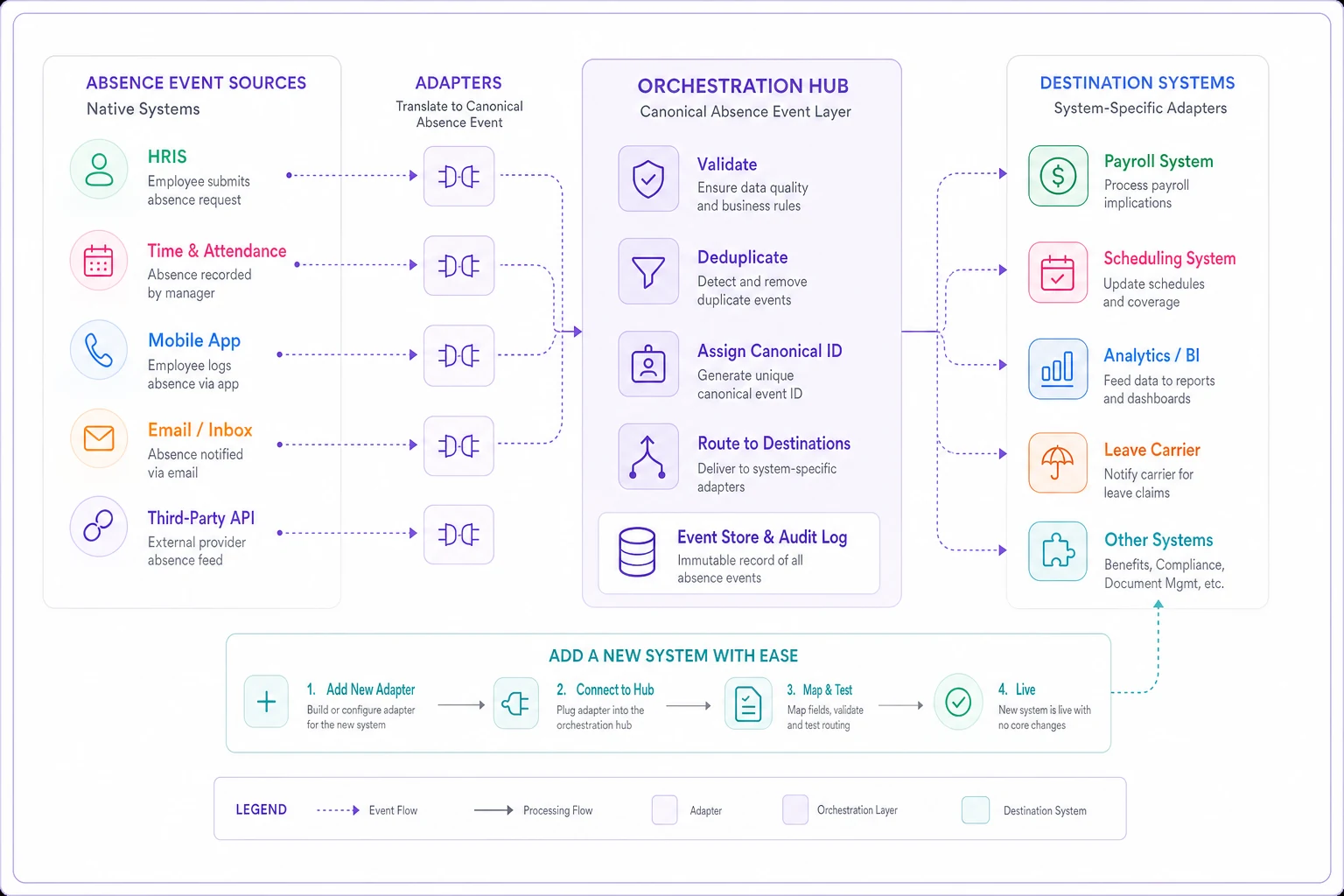
The practical payoff is that adding a sixth system no longer means building five new integrations. You build one adapter to the canonical format, register it as a subscriber, and it starts receiving events. The blast radius of any single system's quirks stays contained inside its own adapter.
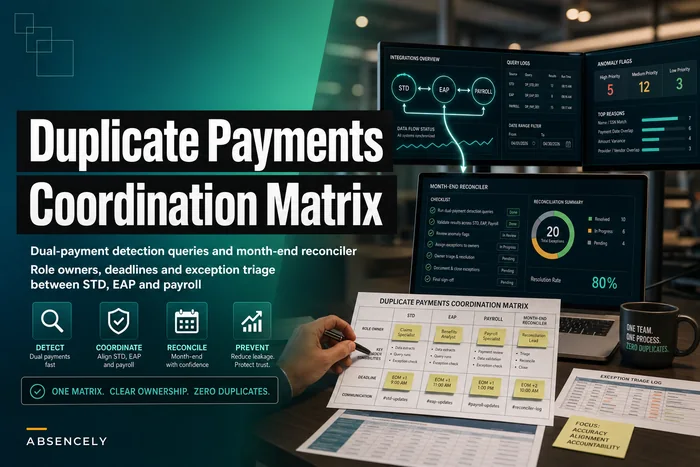
The orchestration layer is also the only sane place to put cross-system business logic that doesn't belong to any one system. Deduplication lives here. So does the reconciliation logic that prevents the kind of overlapping payments that happen when a leave record exists in three systems and each triggers its own downstream action. If you've dealt with the mess of aligning benefits, disability, and payroll, you'll recognize the value — this is the architectural home for the coordination described in stopping duplicate payments across EAP, STD and payroll. The reconciliation matrix becomes real, enforceable logic instead of a spreadsheet someone runs at month-end.
Identity: SCIM and SSO as the foundation nobody budgets for
Absence integration falls apart if the systems don't agree on who the employee is. This is the least glamorous part of the architecture and the most likely to be underfunded.
Every system has its own user identifier. The HRIS has an employee ID. Payroll has a different one. The leave platform generates its own. When an absence event flows through the orchestration layer, it needs to carry an identity that every downstream system can resolve to the right person — and it has to keep working when someone changes their name, transfers departments, or gets rehired.
-
SSO (usually SAML or OIDC) handles authentication — proving who a user is when they log in. This matters for absence tools because leave data is sensitive and you don't want a separate password sitting in every vendor's system.
-
SCIM handles provisioning — automatically creating, updating, and deactivating user accounts across systems from a single source of identity. This is what keeps identifiers in sync.
The failure mode that burns people: an employee leaves, gets deactivated in the HRIS, but SCIM deprovisioning isn't wired to the leave platform. Their pending intermittent leave keeps generating events with an identity that no longer resolves cleanly downstream. Or a rehire gets a brand-new identity while their old absence history still points to the old one, and suddenly accrual calculations are wrong.
The architectural principle: one authoritative identity provider, propagated everywhere, with a stable internal person ID that never gets reused. The canonical absence contract references that stable person ID, not any system's local user ID. Even when a display name or email changes, the linkage holds.
Integration test cases that actually catch the failures
Most integration testing checks the happy path — a normal full-day vacation flows from A to B correctly — and misses everything that actually breaks in production. The test cases worth writing are the ugly ones. Here's a starter set that maps to real failure modes:
-
Half-day and partial-hour leave — confirm duration survives translation across all systems without rounding drift.
-
Retroactive correction — submit a leave, approve it, let it flow downstream, then amend the dates and confirm every system updates to the corrected state without creating a duplicate.
-
Out-of-order events — deliver an "approved" event before its "requested" event and confirm the consuming system handles it gracefully.
-
Duplicate event delivery — send the same event twice and confirm idempotency (no double payment, no double schedule block).
-
Overlapping leaves — same employee, two absence types on the same day, and confirm each system's business rules apply consistently.
-
Identity edge cases — leave in progress when an employee transfers departments or changes name; confirm the record still resolves.
-
Timezone boundaries — a leave spanning midnight across a timezone difference between two systems.
-
Vendor timeout / partial failure — one downstream adapter is unavailable when an event fires; confirm the event queues and retries rather than vanishing.
-
Cancellation after downstream processing — cancel a leave that already hit payroll pre-close, and confirm the reversal propagates.
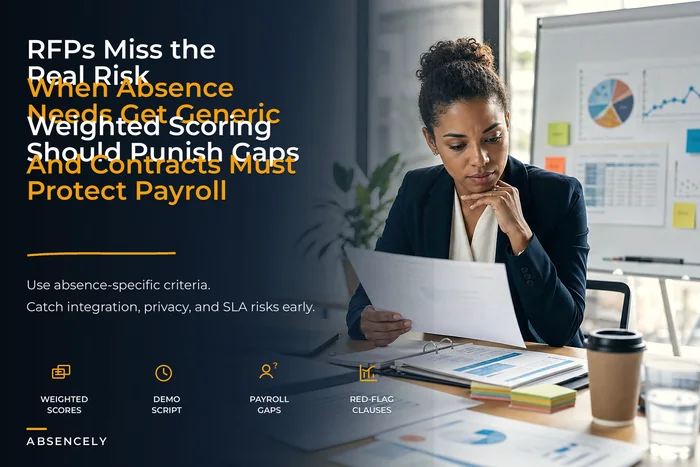
If you're evaluating vendors or writing an RFP, these test cases double as evaluation criteria — the difference between a system that survives real operations and one that looks good in a demo. The same rigor applies when you're scoring vendors, which is worth doing carefully before you sign; there's more on that in avoiding costly RFP mistakes for absence systems.
A real scenario
A mid-sized logistics company — around 900 employees across three states — ran HRIS, a separate payroll provider, a workforce scheduling tool, and had just added a leave-management platform. Everything was connected point-to-point. Six integrations, built over two years by three different contractors.
The symptom that finally forced a rebuild: intermittent FMLA leaves were showing up correctly in the leave platform and in the HRIS, but scheduling was double-blocking coverage — treating one leave day as two — because an "approved" and an "in-progress" event were both being interpreted as separate absences. Managers were over-hiring temp coverage. The estimated waste ran somewhere in the range of $4k–$6k a month in unnecessary coverage costs, plus the manager hours spent untangling schedules.
The rebuild took about a quarter. They defined a canonical absence contract first — the actual arguing over "what counts as a duration" took nearly three weeks and involved HR and payroll more than IT. Then they stood up a lightweight orchestration layer with per-system adapters and killed the direct connections. SCIM got wired properly so identities stayed consistent through transfers.
The double-blocking stopped almost immediately once events flowed through a single deduplicating hub. The less-obvious win came later: when they added a benefits carrier feed six months on, it took a couple of weeks instead of the two-month slog the previous integrations had been. The architecture had turned "add a system" from a project into a task.
HR + IT integration maturity checklist
Where you land on this list tells you how fragile your current setup really is.
-
Absence types have a canonical taxonomy owned by HR, with mapping tables to each system's local codes
-
A single canonical absence data contract exists, is versioned, and is documented somewhere other than one engineer's head
-
Every field in the contract has a designated system of record
-
Each system has a stable person identifier that never gets reused
-
SSO is in place for all systems holding leave data
-
SCIM provisioning and deprovisioning is wired end-to-end, including the leave platform
-
Data flows are classified as event-driven or batch based on damage-from-lag, not convenience
-
A nightly reconciliation batch exists as a safety net behind event streams
-
All events are processed idempotently and tolerate out-of-order arrival
-
Integration test cases cover corrections, duplicates, overlaps, and identity edge cases — not just the happy path
-
Cross-system logic (dedup, reconciliation) lives in an orchestration layer, not scattered across point-to-point mappings
-
Adding a new system requires building one adapter, not N new integrations
-
There's a documented owner for the integration architecture — a named person, not a team in the abstract
Most organizations sit somewhere in the middle and don't realize how much risk lives in the gap.
When this architecture makes sense — and when it's overkill
The orchestration-layer approach earns its cost once you cross roughly four systems that need to share absence data, or once you're operating across multiple jurisdictions where absence types and rules differ. Below that, the overhead of building and maintaining a hub can genuinely exceed the pain of a couple of clean point-to-point connections.
Where it's a bad idea: a company with an all-in-one suite that handles HRIS, payroll, time, and leave natively. If your vendor already owns all those modules and they share one data model internally, building an orchestration layer on top is solving a problem you don't have. The canonical contract still matters conceptually, but you don't need the plumbing.
Who should not start here: a small team without any dedicated IT or integration ownership. The architecture is sound, but it needs someone to maintain the adapters and the contract as systems change. Without an owner, you'll build a beautiful hub that rots the first time a vendor changes their API and nobody notices for a month.
The through-line across all of this: absence integration fails at the seams, not in the systems themselves. Every organization has decent HRIS, decent payroll, decent scheduling. What separates the companies that scale smoothly from the ones drowning in reconciliation tickets is whether they defined what their data means before they connected it — and whether they built a place for those connections to live that one person leaving won't take down with them.
Ready to optimize your workforce absence management?
Join 2,000+ HR teams using Absencely to reduce administrative burden, improve compliance, and boost employee satisfaction.