

The nastiest payment errors don't come from one broken system. They come from three systems that are each working fine, in isolation, with no idea the other two exist.
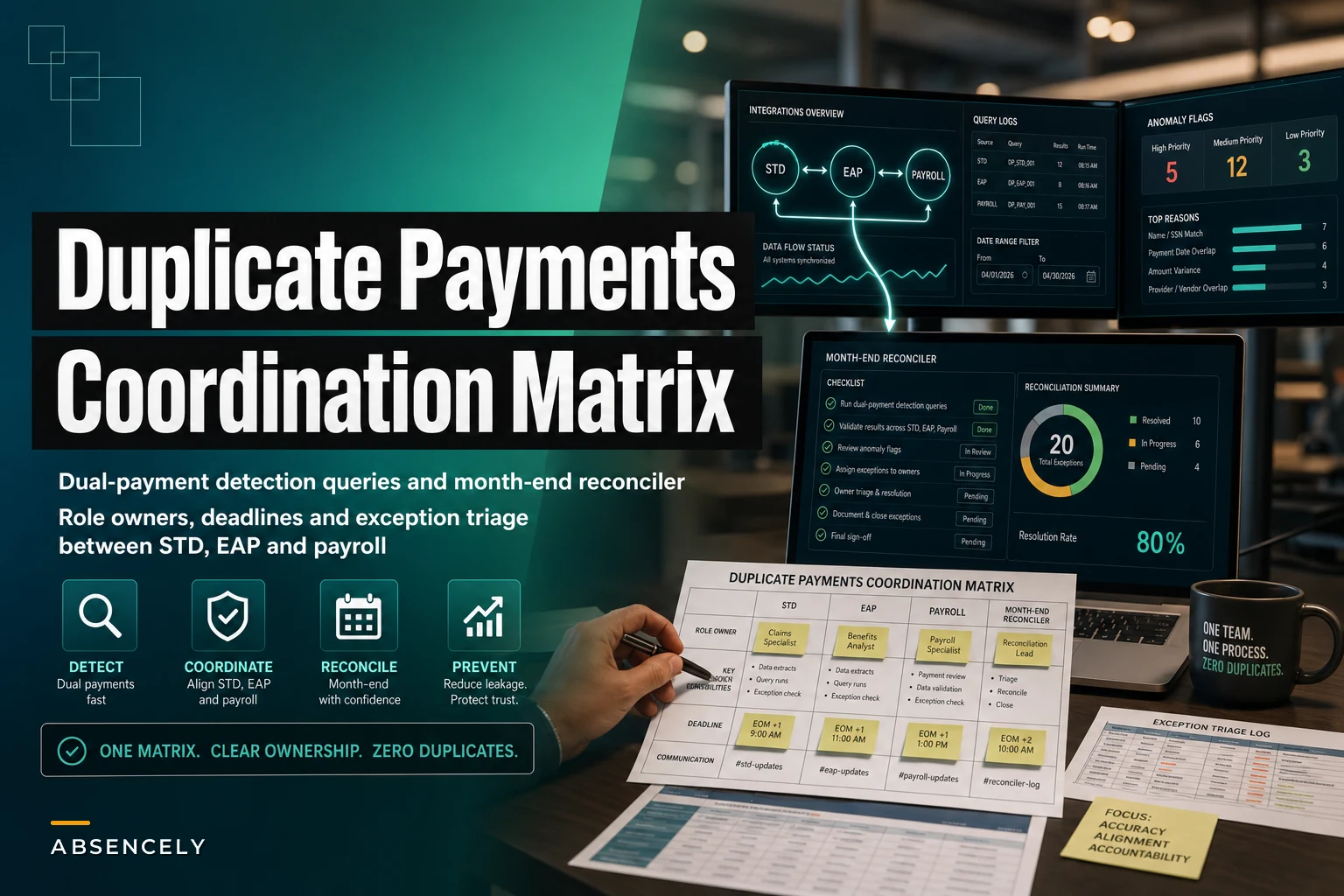
An employee goes on short-term disability. STD starts paying a wage replacement percentage. Payroll never got a clean stop-date, so it keeps issuing partial salary. And because the same employee was referred through the EAP for counseling before the leave, there's a separate case file HR is tracking on yet another spreadsheet. Three programs, three owners, three timelines — and nobody holds the full picture until finance flags a variance six weeks later. That gap is where coordination between STD, payroll and duplicate payments turns into real money leaking out the door. This post is narrowly about one thing: building an operational coordination matrix, writing the detection queries that catch overlaps, and running a month-end reconciler with named owners so the same dollar never gets paid twice.
Why the overlap happens even in well-run HR teams
The failure isn't incompetence. It's that STD, EAP referrals, and payroll operate on different clocks and different triggers.
-
STD activates on an approval event. The carrier or TPA adjudicates and starts paying from an effective date that often lands retroactively — approved on the 20th, effective from the 5th.
-
Payroll runs on a calendar. It doesn't wait for adjudication. If the stop-pay instruction misses the cutoff, one more full or partial check goes out.
-
EAP sits off to the side. It's usually a benefit-utilization record, not a pay-affecting event — but when an EAP referral escalates into a leave, the handoff between "wellness case" and "pay-affecting leave" is where dates get muddy.
The danger window is almost always the first pay period after leave begins and the first period after return-to-work. Those two edges are where the retroactive STD effective date collides with a payroll cycle that already committed.
A typical example: STD approved effective the 5th, paying 60% of salary. Payroll already cut the full check for the period covering the 1st–15th because the stop instruction arrived on the 16th. Now the employee has full pay for days 5–15 and 60% STD for the same days. That's a 60% overpayment on roughly a third of a month — and it sat unnoticed because each system's own records looked correct.
The coordination matrix: who owns what, and when
Before any query or reconciler works, you need a matrix that assigns a single accountable owner to every state transition. Not a RACI for the whole department — a tight grid mapping the events that move money to the person who must act.
Stop managing absences manually.
Absencely simplifies leave requests, approvals, and absence monitoring for your entire workforce.
- Automated leave tracking
- Manager approval workflows
- Compliance & reporting tools
No credit card required
| Event / trigger | STD status | Payroll action required | Owner (accountable) | Deadline relative to event |
|---|---|---|---|---|
| Leave request submitted | Pending | Flag employee "pending stop" | Leave coordinator | Same day |
| STD approved (effective date set) | Active | Enter stop-date + retro correction | Payroll specialist | Before next cutoff |
| STD effective date is retroactive | Active (backdated) | Calculate overlap window | Payroll + Leave jointly | Within 2 business days |
| EAP referral escalates to leave | N/A → Pending | Convert case, re-check pay status | HR case manager | Same day as escalation |
| Return-to-work confirmed | Terminating | Resume full pay, stop STD bridge | Payroll specialist | Before RTW pay period |
| Month-end close | All statuses | Run reconciler | Reconciler owner | 3 days before payroll lock |
The single most important column is the last one — the deadline relative to the event, not relative to the calendar. Most duplicate payments happen because someone treated "enter the stop-date" as a month-end task instead of a same-week task.
One pattern worth calling out: when payroll and leave jointly own the retroactive overlap calculation, error rates drop compared to assigning it to either side alone. The reason is simple — the leave side knows the effective date, and payroll knows what already went out the door. Neither has the full arithmetic on their own.
If you're still building out the day-by-day mechanics of how STD moves through your process, the short-term disability operational playbook covers the timeline and payroll-bridge rules this matrix sits on top of.
Dual-payment detection: the queries that actually catch overlaps
A coordination matrix tells people what to do. Detection queries assume they'll occasionally fail to do it. You want both.
-
STD-vs-payroll overlap. Pull every active STD claim with its effective and end dates. Join against payroll disbursements by employee ID. Flag any row where a payroll pay-period date range intersects the STD active range and the disbursement amount is above the expected bridge/top-up amount. This is the big one — it catches the retroactive-effective-date problem directly.
-
Return-to-work double-pay. Flag employees where the STD end date and the resumed full-pay start date overlap by one or more days. On paper it looks like a rounding issue; in practice it's the second most common overpayment, because the RTW date gets entered as "the day they came back" while STD was paid through end-of-week.
-
EAP-to-leave status mismatch. Flag any employee with an open EAP case, an active leave, and a full-salary payroll record in the same period. EAP itself doesn't pay wages, but this query surfaces cases where an escalation never got converted into a proper leave stop — the record that most often slips through because nobody thinks of EAP as a payroll risk.
A practical note: run these on overlapping date logic, not exact-match dates. Duplicate payments almost never share identical start and end dates — they share a window. If your query only catches exact matches, it'll miss the exact cases you're trying to prevent.
Set the amount threshold with a small tolerance too. A few dollars of variance is usually a proration artifact, not a duplicate. Chasing every one-cent difference trains people to ignore alerts, which defeats the whole point.
The month-end reconciler template with role assignments
The reconciler is the safety net that runs whether or not the daily matrix worked. It should execute a few days before payroll locks, not after, so there's time to correct rather than claw back.
-
Pull the population. Every employee with any STD, EAP, or leave status active during the closing month. Reconciler owner assembles the list.
-
Run all three detection queries. Output a single exception report — one row per flagged overlap.
-
Triage by type. STD-vs-payroll overlaps go to the payroll specialist. RTW double-pay goes to the leave coordinator. EAP mismatches go to the HR case manager. Each type has a named owner, not a shared inbox.
-
Verify against source. Each owner confirms the flag against the actual carrier statement or payroll register. False positives get logged — this improves your thresholds over time.
-
Correct before lock. Real overlaps get adjusted in the current cycle wherever possible. Anything requiring a retro correction gets a dated note and an assigned follow-up.
-
Sign-off. Reconciler owner confirms every flagged row is either corrected or has an owned action item before payroll locks.
Your month-end checklist should look roughly like this:
-
- [ ] Exception report generated and distributed to the three owners
-
- [ ] Every STD claim's effective date reconciled against payroll stop-date
-
- [ ] Every RTW date checked against STD end date for one-day overlaps
-
- [ ] Every open EAP-to-leave escalation confirmed converted
-
- [ ] Retroactive corrections dated and assigned
-
- [ ] False positives logged for threshold tuning
-
- [ ] Sign-off recorded before payroll lock
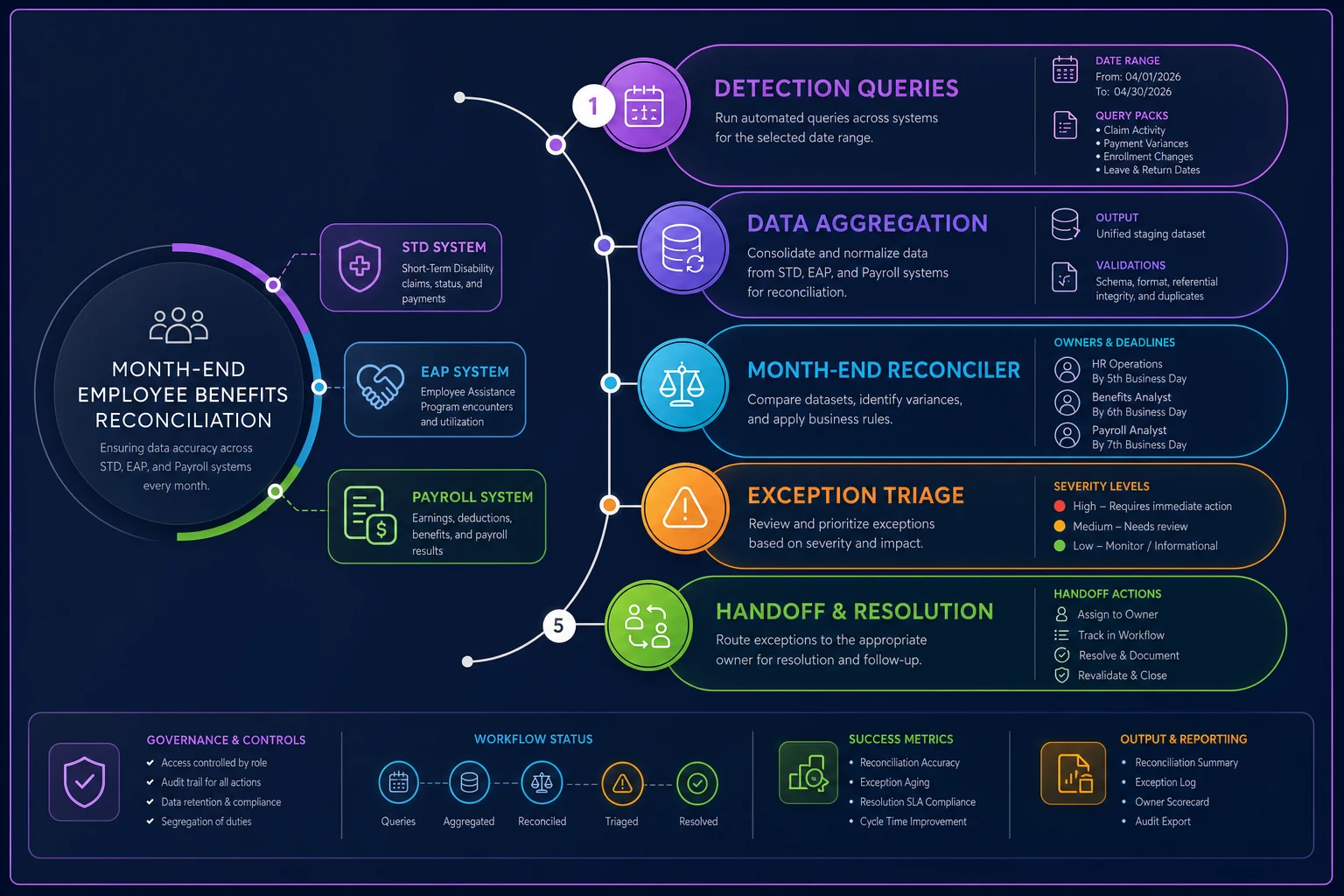
The diagram above shows the reconciler steps, owner handoffs, and where the detection queries plug into the flow.
What makes this template actually work is the sign-off with a name attached. A reconciler with no accountable closer becomes a report nobody reads. When one person has to confirm every flagged row is resolved, it stops being decorative.
A real scenario: mid-size services firm, ~280 employees
A regional facilities-services company with around 280 employees was running STD through a TPA, EAP through a separate vendor, and payroll on a bi-weekly cycle. No reconciler. Overpayments were caught by finance during quarterly review, which meant recovery efforts started months late — and clawing back pay from an employee who's already spent it is awkward, slow, and sometimes legally constrained.
Over two quarters they'd accumulated somewhere around $18k–$24k in duplicate or partial-overlap payments, mostly from retroactive STD effective dates hitting already-committed payroll periods. Recovery on stale overpayments ran maybe 40–50% at best.
After introducing the coordination matrix and a pre-lock reconciler with the three-owner triage, within about two cycles the exception report was catching overlaps before payroll locked instead of after. The recurring monthly leak dropped to near zero, and the handful of flags that did appear were corrected in-cycle rather than chased for months. Honestly, the bigger win wasn't even the dollars — it was ending the quarterly standoff where finance and HR took turns pointing at each other over who missed the stop-date. If you want to put a number on what these leaks actually cost before building the case internally, the cost-per-absence model and ROI workbook gives you a spreadsheet-ready way to size it.
When this is worth building — and when it's overkill
When it makes sense:
-
You run STD (or LTD) and payroll on different systems that don't share a stop-date automatically.
-
Retroactive approval dates are common — meaning payroll frequently commits before STD adjudicates.
-
You've had at least one overpayment surface during a finance review rather than at the source.
When it's overkill:
-
Fewer than roughly 30 employees with maybe one or two leave events a year. A simple shared checklist beats a formal matrix.
-
Your STD carrier and payroll are on a single integrated platform that hard-blocks concurrent full-pay and disability pay. You still want the RTW check, but the heavy query layer is redundant.
Who should not rely on this alone: anyone treating the reconciler as the only control. The reconciler is the net. The matrix — with same-week deadlines tied to events — is what prevents most overlaps in the first place. If you skip the matrix and lean entirely on month-end detection, you'll catch errors but spend your time on retro corrections instead of clean stops.
Where automation quietly earns its keep
None of this requires fancy tooling to start — a matrix and three queries in a spreadsheet will catch most of the damage. The part that breaks down manually is timing. The detection has to run before payroll locks, every cycle, without someone remembering to schedule it.
This is where an operational platform with AI-assisted reconciliation actually helps. It can watch for the retroactive STD effective date the moment it's entered, cross-check it against committed payroll periods, and surface the overlap to the right owner automatically — instead of waiting for a human to run the query at month-end. The value isn't automation for its own sake; it's that the flag arrives while there's still time to correct in-cycle rather than claw back later.
Keep the humans on the judgment calls — verifying against carrier statements, deciding on retro corrections, tuning thresholds. Let the system handle the tedious part: checking every date range against every other date range, every cycle, without fail.
Closing thought
Duplicate payments across STD, EAP and payroll aren't a sign of a careless team. They're the predictable result of three programs running on three different clocks with no shared owner for the overlap.
Fix ownership at the event level, write queries that hunt for date-range collisions rather than exact matches, and run a named-owner reconciler before payroll locks. Do that, and the quarterly overpayment surprise stops being something that happens to you.
Ready to optimize your workforce absence management?
Join 2,000+ HR teams using Absencely to reduce administrative burden, improve compliance, and boost employee satisfaction.