

Cost-per-absence is a fine number for a dashboard. It falls apart the second a CFO looks at you and asks, "So what do you want me to do with that?"
That's the gap most HR teams never close. You walk in with a clean absence rate, maybe a fully-loaded cost figure, and walk out with nothing because none of it mapped to a decision finance could actually fund. Absence data that doesn't connect to a hire, a cross-train plan, or a temp budget line is just trivia with a decimal point.
This piece is about closing that gap — moving from "here's what absence costs us" to "here's the decision rule that triggers spend, here are three scenarios the board can choose between, and here's the number attached to each." If you've already built the underlying math from a cost-per-absence model and ROI workbook, this is the layer that sits on top: turning the cost into choices.
The real problem: absence lives in HR, budgets live in finance, and nobody owns the bridge
Here's the structural issue. Absence metrics get produced in one system, by one team, on one cadence. Headcount budgets get built in a completely different cycle — usually annual, usually driven by last year's numbers plus a growth assumption. The two almost never talk.
Across most mid-sized operations, absence quietly inflates the real cost of running a team while the budget was built assuming everyone shows up every day. By Q3, a department is burning overtime and temp spend to cover gaps that were statistically predictable back in January. Finance sees the overrun and assumes it's a management problem. HR sees it and knows it's a planning problem. Both are half right.
The reason this persists isn't incompetence. Nobody owns the bridge between the absence signal and the budget line. HR produces the metric. Finance owns the dollars. The decision — hire, cross-train, or lean on temps — sits in no-man's-land between them. And decisions without an owner default to doing nothing until the overrun forces a panic hire at the worst possible rate.
What this looks like in practice
A regional services company with around 180 field staff runs an absence rate in the 6–7% range. On paper that sounds manageable. But 6–7% across 180 people is roughly 11–13 full-time-equivalent bodies missing on any given week, concentrated unevenly across crews. Some weeks a crew loses one person; some weeks three. The budget was built assuming full coverage, so every gap gets filled reactively — overtime at time-and-a-half, or a last-minute temp at a markup.
Nobody made a bad decision. They just never made a deliberate one. That's the pattern worth fixing.
The missing layer: decision rules, not just metrics
A metric tells you what happened. A decision rule tells you what to do when it happens. That jump is where absence data starts earning its keep in a budget.
Stop managing absences manually.
Absencely simplifies leave requests, approvals, and absence monitoring for your entire workforce.
- Automated leave tracking
- Manager approval workflows
- Compliance & reporting tools
No credit card required
A decision rule is simple to write and surprisingly rare in practice. It looks like this:
> When sustained absence in a role family exceeds X% for Y consecutive weeks, and the role carries a criticality tier of Z, the default action is [hire / cross-train / temp], subject to a cost ceiling of $N.
The exact formula matters less than the fact that the trigger, the threshold, and the default action are agreed on before the overrun happens. When you pre-commit the rule, you remove the two things that kill good absence budgeting: the delay while everyone argues about what to do, and the premium you pay for deciding under pressure.
The teams that do this well don't have more data. They have fewer open questions at the moment a gap appears.
Hire vs cross-train vs temp: the three-way tradeoff finance actually cares about
Every absence-driven coverage gap resolves into one of three moves. The whole game is matching the right move to the right situation, and attaching an honest number to each. Here's the breakdown finance will recognize:
| Move | Up-front cost | Ongoing cost | Time to coverage | Best fit |
|---|---|---|---|---|
| Permanent hire | Recruiting + onboarding (often 15–25% of first-year salary) | Full loaded salary + benefits | 6–12 weeks | Structural, year-round gaps in critical roles |
| Cross-train | Training hours + temporary productivity dip | Minimal; mostly skill-maintenance time | 2–6 weeks | Predictable, intermittent gaps where existing staff have slack |
| Temp / contingent | Agency markup (often 40–60% over base) | Pay only for days used | Days to ~2 weeks | Spiky, seasonal, or genuinely unpredictable absence |
The mistake almost everyone makes is treating these as a ranking — "hiring is best, temps are the fallback." They're not a ranking. They're a fit problem. A permanent hire to cover genuinely spiky absence is overspending; it loads your OPEX with a full salary to solve a part-time problem. Leaning on temps to cover a structural, year-round gap is also overspending — you pay the markup forever instead of buying down the rate with a permanent head.
The FTE vs OPEX framing that gets approvals
Finance thinks in two buckets: headcount (FTE, which hits the long-term cost base and is hard to reverse) and operating expense (OPEX, which is flexible but often more expensive per unit). This is the translation step that actually gets budgets signed off.
-
A hire converts an absence problem into a permanent FTE commitment — lower unit cost, higher reversibility risk.
-
A cross-train investment is a one-time OPEX spend that raises your coverage ceiling without adding headcount — usually the highest-leverage move nobody budgets for.
-
A temp strategy keeps everything in flexible OPEX — expensive per hour, but you can turn it off.
When you present absence decisions in this language, you stop sounding like HR asking for more bodies and start sounding like someone managing a cost base. That shift alone changes how the conversation goes.
Building the worked scenarios the board will actually read
Boards don't approve metrics. They approve scenarios. The job is to give them two or three clearly costed paths and a recommendation — not a data dump.
A process that holds up in a real budget review:
-
Pick the role families that matter. Don't model everything. Isolate the 3–5 role groups where absence actually threatens output or revenue. Tie this back to criticality tiering if you have it.
-
Pull the sustained absence rate per family, not the company-wide average. Averages hide the crews that are on fire.
-
Translate the rate into coverage gaps — how many FTE-equivalents are missing per week, and how spiky versus steady the pattern is.
-
Attach the three moves to each gap and cost them out honestly, including the hidden costs: overtime premiums, temp markups, cross-train productivity dips.
-
Build three named scenarios — typically "status quo," "cross-train and stabilize," and "hire into structural gaps." Each gets a total annual cost and an expected reduction in reactive spend.
-
Run a sensitivity table on the two assumptions most likely to be wrong: the absence rate itself and the cost per coverage day.
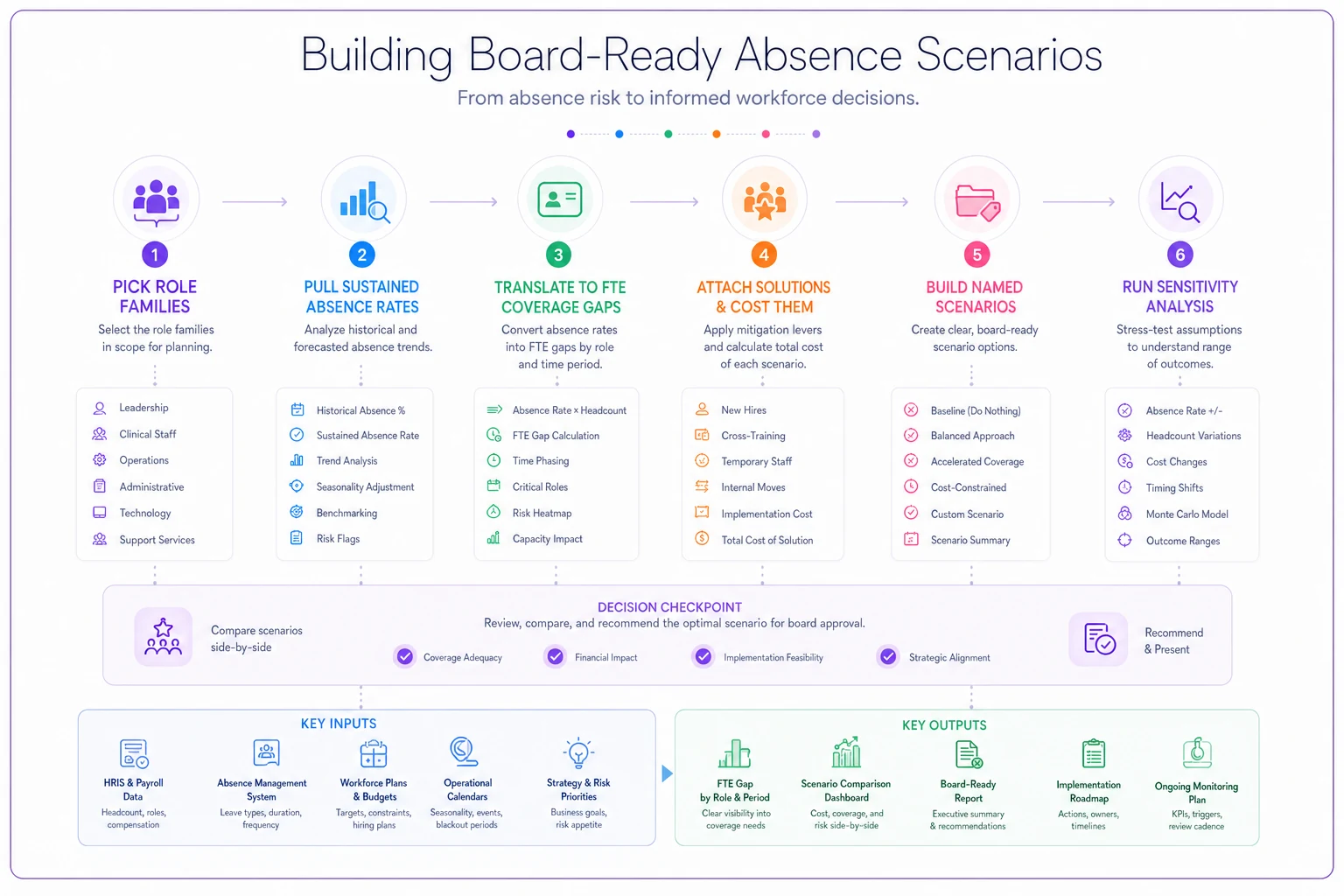
Here's a quick visual of the steps above to help explain the process in a budget meeting.
That sensitivity step matters more than people expect. A scenario that only works if absence stays exactly at today's rate is a scenario the board shouldn't trust. Show them what happens if absence climbs two points or temp markups rise — and whether your recommendation still holds. A recommendation that survives a bad assumption is one that gets funded.
A minimal sensitivity table
Even a rough grid beats a single point estimate. The table below models annual coverage cost against two moving variables — absence rate and temp markup — to show the board where the cost curve actually bends.
| Scenario | Absence 5% | Absence 7% | Absence 9% |
|---|---|---|---|
| Low temp markup (40%) | ~$180k | ~$255k | ~$330k |
| High temp markup (55%) | ~$205k | ~$290k | ~$375k |
The numbers are illustrative, but the shape is the point. In this example, absence rate moves the number more than markup does — which means the cross-train scenario (which attacks the rate) probably beats the temp scenario (which only manages the markup). That's a defensible argument, not a guess, and it's the kind of framing that holds up when a board member pushes back.
The board slide that does the work
One slide. Three scenarios across the top, costs and expected outcomes down the side, your recommendation highlighted, and the decision rule stated plainly so they know what triggers future spend without another meeting.
What to keep on it:
-
The three named scenarios with total annual cost each
-
Expected reduction in reactive/overtime spend per scenario
-
The FTE vs OPEX split for each path
-
The one or two sensitivity ranges that matter
-
A single-line decision rule for ongoing triggers
What to cut: the methodology, the raw absence data, every caveat you're tempted to add. Those belong in an appendix. The slide is for the decision, not the defense of the decision. If this feels familiar, it's the same discipline behind a good executive absence scorecard — surface the decision, bury the mechanics.
A real scenario: distribution center coverage
A single-site distribution operation, roughly 140 warehouse staff, was running absence around 8% during peak months and closer to 5% off-peak. The budget was built on a flat 5% assumption all year. Predictably, every peak season blew through its labor line.
The reactive pattern: peak-season gaps got filled with a mix of mandatory overtime and same-week agency temps at roughly a 50% markup. Nobody had costed it as a strategy because it was never a decision — it was just what happened when someone called out.
When they finally modeled it properly, the numbers reframed everything. The peak-season gap was structural and predictable — same months every year. That's not a temp problem; temps are for the unpredictable stuff. The honest answer was a blend: cross-train a group of off-peak staff into flex roles to absorb the predictable swing, and reserve temps only for the genuinely spiky weeks on top.
That shift moved a chunk of spend out of high-markup temp OPEX and into a one-time cross-training investment plus a smaller, smarter temp buffer. The projected annual coverage cost dropped from somewhere in the mid-$200ks to the high-$100ks — not a dramatic headline number, but a real improvement, and more importantly a predictable one. The budget stopped surprising them in Q4.
The outcome that mattered wasn't the savings. It was that coverage became a planned line item instead of a recurring overrun the CFO had to forgive.
When each approach actually makes sense
When a permanent hire is the right call: the gap is structural and year-round, the role is critical enough that temps can't safely cover it, and the fully-loaded cost of the hire comes in below what you're currently spending reactively. If you're paying overtime premiums and temp markups every single month for the same gap, you're already paying for the hire — just inefficiently.
When cross-training wins: the absence is predictable and intermittent, you have staff with genuine slack or adjacent skills, and the gap doesn't demand deep specialization. This is the most under-used move because the cost shows up now (training time) while the benefit shows up later (coverage flexibility) — and quarterly budgets punish that timing. Do it anyway. It's usually the highest-return option.
When temps are correct: the absence is genuinely spiky, seasonal, or unpredictable, and the role can be filled by someone with limited ramp-up. Temps are expensive per hour by design — you're paying for flexibility. That's a fair trade for unpredictable demand and a bad trade for a steady, obvious gap.
Who should not do this
If your absence data is unreliable — inconsistent definitions, gaps in recording, no agreement on what counts as an absence — don't build board scenarios on top of it yet. You'll be making expensive decisions on noise. Fix the data foundation first. A scenario is only as defensible as the metric underneath it, and finance will find the crack faster than you think.
And if you're a very small team where one absence is handled by everyone pitching in, you don't need a sensitivity table. You need a calendar and some flexibility. This level of modeling earns its keep once coverage gaps start costing real, repeating money.
Keeping the scenarios alive instead of annual
The quiet failure of absence budgeting is that it's done once a year and then ignored until the overrun. Scenarios built in January are stale by April if absence patterns shift and nobody re-runs them.
The fix is making the inputs continuous rather than annual. When absence metrics feed a shared workbook or system on a rolling basis — the same discipline behind a proper cost-allocation and showback framework — the scenarios stay current and the decision rule can actually fire when its trigger hits. That's what turns this from a once-a-year slide into an operating rhythm: absence crosses a pre-agreed threshold, the rule names the default action, the cost is already modeled, and the decision takes a conversation instead of a crisis.
Feed absence metrics into a shared workbook on a rolling basis so scenarios can be updated and the decision rule can trigger without delay.
The businesses that get this right aren't the ones with the fanciest absence analytics. They're the ones who decided, in advance, what number means what action — and attached a dollar figure to each path before anyone was under pressure to choose.
Bringing it together
Cost-per-absence answers "how bad is it." Budgeting and headcount decisions need "what do we do, how much does it cost, and what happens if we're wrong about the assumptions." Those are different questions, and most HR teams only ever answer the first one.
The bridge is three things: a decision rule that pre-commits the action, honest scenarios that cost out hire versus cross-train versus temp in language finance uses, and a sensitivity view that proves your recommendation survives a bad assumption. Build those once, keep the inputs fresh, and absence stops being the line item that surprises everyone in Q4 and becomes one of the few parts of the labor budget you can actually defend.
Ready to optimize your workforce absence management?
Join 2,000+ HR teams using Absencely to reduce administrative burden, improve compliance, and boost employee satisfaction.