


Most leave-data privacy problems don't start with a breach. They start with a spreadsheet. Someone in HR exports a leave report to answer a manager's question, drops a diagnosis code into a shared folder "just for now," and six months later that file is sitting in a Google Drive that half the department can open. Nobody meant to do anything wrong. But if that team has employees in Germany or France, and the export included medical certification details, you've now got a GDPR problem sitting next to a potential HIPAA-adjacent one, depending on how the health data flowed in.
The hard part about leave data privacy under HIPAA and GDPR isn't understanding the rules on paper. It's that leave data is mixed data. A single leave case can contain scheduling info (low sensitivity), a reason category (medium), and a physician's note describing a specific condition (high). Treat it all the same and you either over-restrict everyone so nobody can do their job, or under-restrict everyone and quietly build a liability. This piece is about building a system where the field determines the rule, not the person who happens to be looking at the file.
Why leave data breaks differently than other HR data
Payroll data is sensitive but predictable. Everyone knows a salary figure is confidential, and access controls around it tend to be tight from day one. Leave data is sneakier because it looks administrative. A calendar entry saying "out Mon–Wed" feels harmless. But the moment that entry is linked to an intermittent FMLA case, a workers' comp claim, or a doctor's certification, it becomes health-adjacent information — and in the EU, health data is a special category under GDPR Article 9 that requires an explicit lawful basis and tighter handling.
The pattern that trips people up is almost always the same: the data is collected correctly, but it travels badly. HR collects a medical certificate the right way. Then a manager asks why someone's been out, and instead of getting a clean "approved medical leave, return date pending," they get forwarded the actual certificate. Now high-sensitivity health data is in a line manager's inbox, in a jurisdiction that may not permit it, with no retention clock and no redaction. The collection was compliant. The flow wasn't.
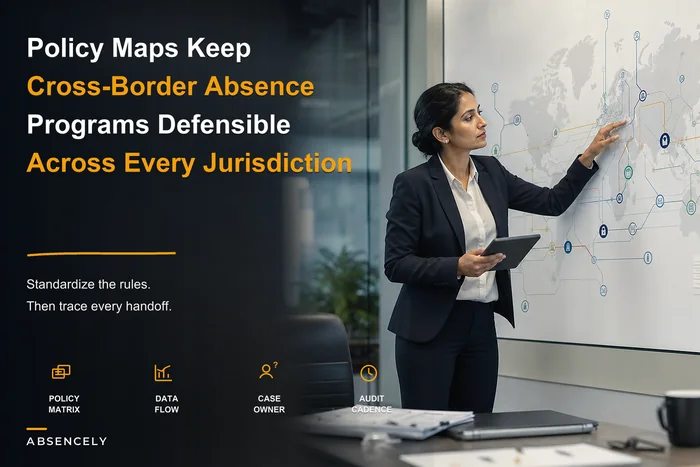
Cross-border makes this worse in a specific way. A US-based HR team is often comfortable seeing more detail than an EU works council would ever allow a manager to see. When a US HR generalist administers leave for a French employee using US-normal habits, the mismatch isn't malicious — it's just default behavior colliding with stricter local expectations. If you've already mapped your policies and data flows the way we walked through in the multi-jurisdiction absence management blueprint, this is the natural next layer: deciding who touches which field, and for how long.
Step one: classify the fields, not the file
The single most useful move is to stop thinking about "the leave record" as one object and break it into fields, then assign each field a privacy category. This is boring work that pays off constantly, because every access decision after this becomes mechanical instead of a judgment call.
Stop managing absences manually.
Absencely simplifies leave requests, approvals, and absence monitoring for your entire workforce.
- Automated leave tracking
- Manager approval workflows
- Compliance & reporting tools
No credit card required
| Leave field | Example value | Privacy category | Primary driver | Typical retention |
|---|---|---|---|---|
| Employee ID / name | J. Okafor | Identifier (low) | Both | Employment + statutory |
| Leave dates | Aug 4–18 | Operational (low) | GDPR (min.) | 2–3 yrs post-case |
| Leave type (broad) | "Medical leave" | Category (medium) | GDPR | 2–3 yrs post-case |
| Leave sub-reason | "Surgery recovery" | Health (high) | HIPAA + GDPR Art. 9 | Minimize / short |
| Physician certification | Signed cert w/ diagnosis | Health (high) | HIPAA + GDPR Art. 9 | Retain separately, restricted |
| Accommodation details | Reduced hours, no lifting | Health (high) | Both | Case duration + defined tail |
| Pay/benefit impact | STD bridge %, offset | Financial (medium) | Payroll rules | Statutory (often 4–7 yrs) |
| Manager notes | "Seemed stressed" | Risk (high) | Both — often shouldn't exist | Avoid free text |
A few things worth calling out. First, notice that "leave dates" and "leave type (broad)" are deliberately kept separate from "sub-reason." A manager almost always needs the first two to run a schedule. They almost never need the third. That single split solves the majority of over-sharing.
Second, that last row — free-text manager notes — is where quiet liability accumulates. In practice, this usually happens when a well-meaning manager documents a conversation ("said the chemo is rough this cycle") inside a general HR system field. That's now high-sensitivity health data sitting in a low-controlled field, and it's discoverable. The fix isn't more training reminders. It's designing the form so that field either doesn't exist or is locked behind the same controls as the medical certificate.
Step two: build the role-by-role access matrix
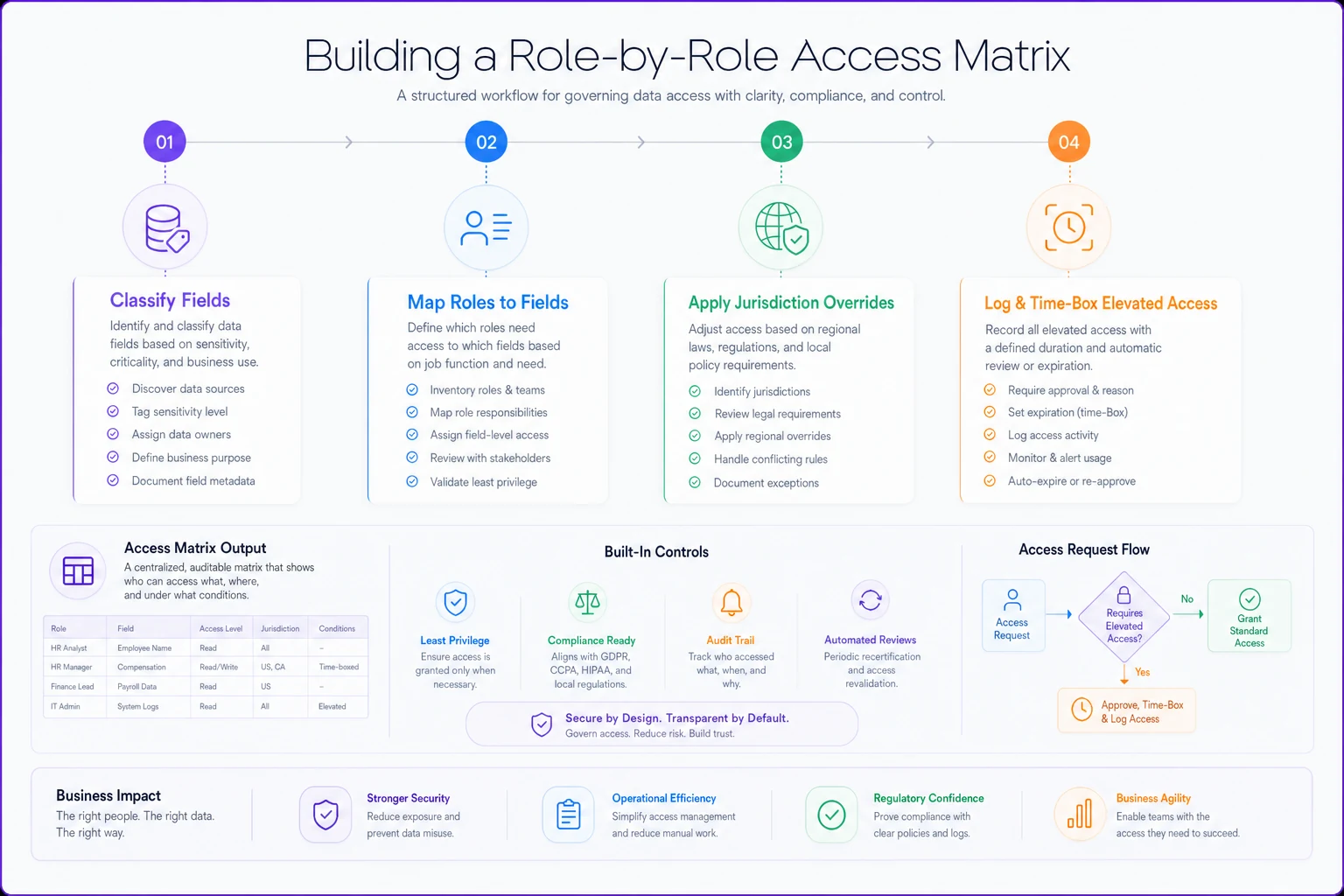
Once fields are classified, access becomes a grid. The mistake most teams make is granting access by seniority ("directors see everything") instead of by need to operate. A regional director rarely needs a diagnosis. A payroll analyst needs the pay impact but not the physician's note. Map it explicitly.
Here's a quick workflow you can visualize: classify fields → map roles to fields → apply jurisdiction overrides → log and time-box any elevated access.
| Field | Line manager | HR generalist | HR leave specialist | Payroll | Occ. health | Regional director |
|---|---|---|---|---|---|---|
| Leave dates | ✅ | ✅ | ✅ | ✅ | ✅ | ✅ |
| Leave type (broad) | ✅ | ✅ | ✅ | ✅ | ✅ | Aggregate only |
| Sub-reason (health) | ❌ | ❌ | ✅ | ❌ | ✅ | ❌ |
| Physician cert | ❌ | ❌ | ✅ | ❌ | ✅ | ❌ |
| Accommodation (operational) | ✅ (what to do) | ✅ | ✅ | ❌ | ✅ | ❌ |
| Accommodation (medical why) | ❌ | ❌ | ✅ | ❌ | ✅ | ❌ |
| Pay/benefit impact | ❌ | Limited | ✅ | ✅ | ❌ | Aggregate only |
The important subtlety is the accommodation split. A line manager needs to know "no lifting over 10kg, no shifts before 9am." They do not need to know the medical reason behind it. Most systems collapse these into one field, which forces you to either hide the accommodation (breaking operations) or expose the reason (breaking privacy). Splitting the operational instruction from the medical rationale is the cleanest way to keep both sides functional.
When broader access actually makes sense
There are legitimate cases for wider visibility. During an active adjudication dispute, or a suspected fraud investigation, the leave specialist and legal may need fuller access across fields — that's fine, as long as it's time-boxed and logged. The rule isn't "never grant broad access." It's "never grant broad access silently or permanently."
When it's a bad idea
Granting standing full access to a regional director because they asked, or to a manager because "they're going to find out anyway," is where things go wrong. Convenience access that never expires is the most common root cause of the exports-in-a-shared-drive problem. If someone needs it once, grant it once, with an end date.
Step three: retention and redaction templates
Access controls stop the wrong people from seeing data. Retention and redaction stop the right people from keeping it too long — which is its own violation under GDPR's storage-limitation principle, and just good hygiene under any regime.
-
Operational leave record (dates, broad type, status) — retain 2–3 years past case closure to support forecasting, reconciliation, and any wage/hour claims. This is the data your planning depends on, and it's low sensitivity.
-
Health documentation (certifications, sub-reasons, medical accommodation rationale) — store separately from the general HR file, with the shortest defensible retention, and redact identifiers where the record is only kept for aggregate reporting.
-
Financial/benefit records (STD/LTD bridge, offsets, payroll adjustments) — follow the longer statutory payroll retention, often 4–7 years depending on jurisdiction, but strip the reason — payroll needs the amount, not the diagnosis.
The redaction template matters most at the boundary between these streams. A workable redaction rule set:
-
Before any manager-facing export remove sub-reason, physician cert, and medical rationale. Keep dates, broad status, operational accommodation.
-
Before any aggregate/analytics use remove name and employee ID; replace with a case token. Bucket dates to week or month if individual precision isn't needed.
-
Before cross-border transfer to a US entity confirm lawful basis, and redact special-category detail unless there's a specific, documented reason it must travel.
-
At retention expiry delete the health stream first and on its own schedule, even if the operational record persists.
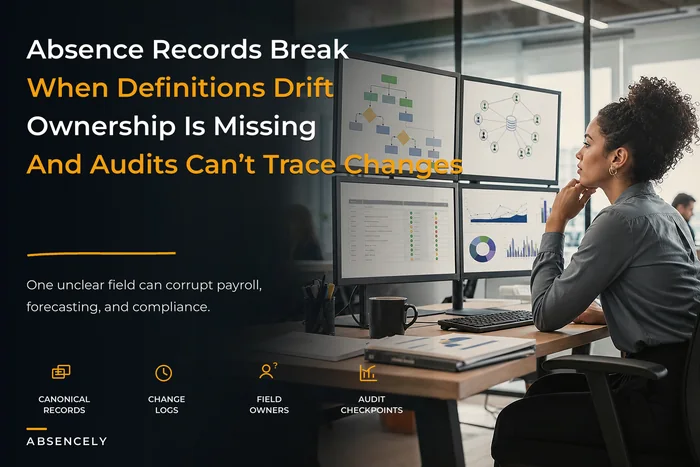
One thing that shows up consistently in practice: the operational record and the health record almost never should expire on the same day, yet most systems delete (or fail to delete) them together. Decoupling those clocks is what separates a defensible program from one that just looks tidy. If your underlying record definitions are still fuzzy, this is much harder — it's worth fixing your absence data governance and record definitions first, because you can't apply a retention clock to a field you haven't defined.
Step four: audit artifacts you'll actually be asked for
When a regulator, a works council, or your own legal team comes asking, "prove your handling was appropriate," they don't want your policy PDF. They want evidence of the policy in operation. That's the difference between a compliant-on-paper program and a defensible one.
-
Access log per case who viewed which field, when, and under what role. Not just "opened the file" — field-level where possible.
-
Access grant/revoke history when temporary elevated access was granted, by whom, for what reason, and when it expired.
-
Redaction record confirmation that the manager-facing version excluded health fields, ideally with a system-generated stamp rather than someone's word.
-
Retention/deletion log proof that the health stream was deleted on schedule, separate from the operational record.
-
Cross-border transfer record lawful basis, what fields moved, and any redaction applied before transfer.
> Case #EU-2024-0417 — French employee, medical leave. > Collection: cert received by EU leave specialist 04 Mar, stored in restricted health stream. > Manager view: operational record only (dates + "medical leave" + "no shifts before 09:00"). Sub-reason and cert not accessible to line manager — confirmed by field-level access log. > US HR access: none during case. Aggregate reporting only, tokenized. > Retention: operational record → delete 2027; health stream → delete 2025. > Transfer to US parent: not performed; no lawful basis established.
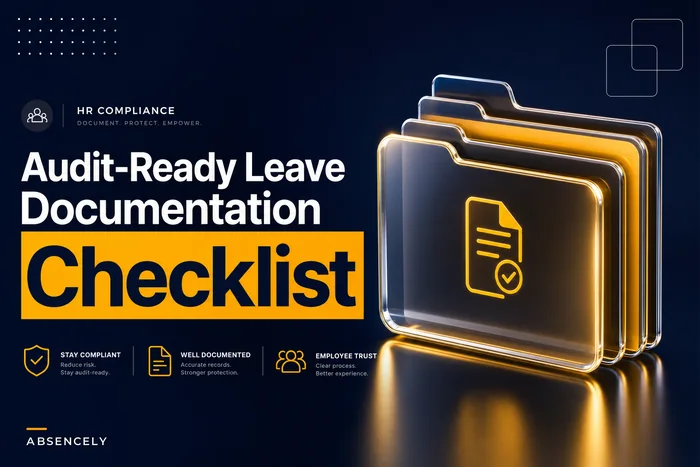
That's the level of specificity that survives scrutiny. Notice it reads almost boring — that's the point. A defensible artifact is one where nothing surprising happened. Pair this with the folder structure and case-file discipline from the audit-ready leave documentation checklist and you've got both the "where things live" and the "who touched them" halves covered.
A real scenario: where the leaks actually happen
A mid-sized software company, around 240 employees, split roughly 60/40 between a US HQ and offices in Germany and Ireland. Their leave process was "fine" on paper — HR collected certs properly, access was password-protected, the usual.
The problem surfaced during a routine data-protection review. The reviewer pulled a sample of leave cases and found that for German employees, line managers had been receiving forwarded emails containing medical certification details in roughly 1 in 4 cases — usually when a manager pushed back on a schedule gap. There was no field-level access control. Everyone with "HR system access" could open the full record, and email was doing the rest. No breach, no complaint. Just a steady, quiet exposure that would have been very hard to defend if a works council had asked.
The fix wasn't dramatic. They split accommodation into operational-vs-rationale fields, moved health documentation into a separate restricted stream, and rebuilt the manager-facing view to exclude anything above the "category" tier by default. Temporary elevated access got an expiry date. Within about two quarters, the forwarded-cert pattern essentially disappeared — and the part leadership actually cared about — they could generate a per-case access log on request in minutes instead of reconstructing email threads. Managers still got their dates and coverage info. They just stopped getting the parts they never needed.
Where the right system quietly helps
Most of this can be enforced by policy and discipline. The trouble is discipline degrades under pressure — a manager pushes, someone's rushing, and the certificate gets forwarded anyway. This is where a leave platform with field-level permissions earns its keep: when access is enforced at the field rather than the file, the over-share literally can't happen, because the manager-facing view never contains the health fields to begin with.
Automated retention clocks that run independently per data stream, tokenization for aggregate reporting, and a built-in access log turn "we have a policy" into "we can prove it" — without someone manually redacting exports at 6pm. Leave data privacy under HIPAA and GDPR fails at the seams — the handoffs, the exports, the "just this once" access — and those seams are exactly where consistent, automatic enforcement beats human vigilance. The goal is making the compliant path also the easy path, so people follow it without thinking about it.
Bringing it together
Defensible leave-data governance for cross-border teams comes down to a shift in how you think about the unit you're controlling: stop governing the file, start governing the field. Classify every leave field by sensitivity, decide access role by role (with jurisdiction overrides, not a single global rule), split retention clocks so health data expires on its own schedule, and keep artifacts that show the policy actually ran.
The companies that get this right aren't the ones with the strictest policy. They're the ones where the everyday, convenient thing to do also happens to be the compliant thing — because the system made the medical details invisible to the people who didn't need them in the first place.
Ready to optimize your workforce absence management?
Join 2,000+ HR teams using Absencely to reduce administrative burden, improve compliance, and boost employee satisfaction.