



After building operational platforms for businesses with cross-border teams, one pattern keeps surfacing: multi-jurisdiction absence management typically evolves backwards. Companies expand first, then scramble to patch together compliance frameworks as violations pile up.
The real mess isn't just different laws — it's how information flows break when you scale from one location to twelve. A retail chain with stores across California, Texas, and New York discovers their manager in Austin has been approving FMLA requests using California's pregnancy disability leave requirements. Meanwhile, their Toronto location runs their own spreadsheet because "Canadian rules are different" while nobody tracks whether Quebec's distinct parental leave provisions actually apply to their Montreal warehouse workers.
This backward evolution creates compounding operational debt. Each new jurisdiction adds exponential complexity because the connections between systems multiply, not just add up.
Why traditional compliance approaches crumble at scale
Most HR teams attack multi-jurisdiction compliance like they're collecting stamps — one policy document per location, filed away in separate folders. Works fine when you've got three offices. Falls apart completely when you hit fifteen locations across seven jurisdictions.
The fundamental mistake? Treating compliance as a documentation problem instead of an operational system. Documentation tells you what should happen. Systems ensure it actually happens, repeatedly, at scale.
Consider what occurs when an employee in Germany requests sick leave while their manager sits in Florida and payroll processes from India. German worker protection laws require immediate acknowledgment within 24 hours. Florida labor code has no such requirement. Indian payroll needs verification documents that German privacy laws prohibit sharing across borders.
Three jurisdictions, three conflicting requirements, one broken workflow.
Traditional approaches rely on regional HR managers memorizing local requirements. But regional managers change jobs. New ones inherit partial knowledge. Critical compliance steps get lost in transition. The company discovers gaps only when facing an audit or lawsuit — usually 18 months too late.
Mapping the actual flow of absence decisions
Real compliance starts with understanding how absence decisions actually move through your organization, not how the org chart suggests they should move.
Stop managing absences manually.
Absencely simplifies leave requests, approvals, and absence monitoring for your entire workforce.
- Automated leave tracking
- Manager approval workflows
- Compliance & reporting tools
No credit card required
Start with a typical request: An engineer in Amsterdam needs surgery recovery time.
Current reality flow:
-
Engineer emails manager (sits in Austin)
-
Manager forwards to HR generalist (works from Manila)
-
HR checks policy document (last updated 2019)
-
Confusion about Dutch vs EU requirements
-
Email thread grows to 14 messages
-
Someone remembers to check with legal (3 days later)
-
Approval given without proper documentation
-
Payroll processes incorrectly
-
Discovered during year-end audit
System-designed flow:
-
Request enters jurisdiction-aware intake form
-
Amsterdam location triggers Dutch compliance ruleset
-
Required documentation checklist auto-generated
-
Manager sees only relevant decision points
-
HR receives pre-validated submission
-
Audit trail captures each decision timestamp
-
Payroll receives correct coding automatically
The difference isn't technology — it's designing workflows that acknowledge jurisdictional requirements from the start, not as an afterthought.
Building your policy mapping framework
Policy mapping sounds academic until you're explaining to regulators why your Seattle employees got Texas-sized unpaid leave allowances. The framework needs three core components working together.
Component 1: Jurisdiction hierarchy
Create a decision tree, not a flat list. Federal requirements form the trunk. State/provincial rules branch off. Municipal additions create the leaves.
Example structure:
-
US Federal FMLA baseline
12 weeks unpaid
-
California adds Paid Family Leave
8 weeks at 60-70% wages
-
San Francisco adds Paid Parental Leave
supplemental pay to 100%
-
Your specific industry might trigger additional requirements
Each level inherits from above but can't contradict it. San Francisco can't offer less than California. California can't undercut federal minimums.
Component 2: Trigger mapping
Document what initiates each policy. Employee request types like medical, family, personal leave. Automatic triggers such as consecutive sick days or patterns. Manager observations including performance changes or concerning behaviors. External requirements covering quarantine orders, jury duty.
A seemingly simple "sick day" request in British Columbia triggers different requirements than the same request in Ontario. BC requires accommodation discussions after patterns emerge. Ontario focuses on individual occurrence documentation.
Component 3: Intersection rules
When multiple policies overlap, things get complex fast.
Employee works remotely from Oregon for a company based in Washington, serving clients in California. Which meal break rules apply? All three states have different requirements. The answer changes based on where work gets performed, not where the company sits.
Your framework needs clear precedence rules. Work location generally trumps company location. Most restrictive rule typically wins. Industry-specific regulations override general ones. Collective bargaining agreements supersede standard policies.
Data flow architecture that scales
Privacy laws alone make uniform data flow impossible across jurisdictions. GDPR means your European employee data can't casually flow to US servers. California's CCPA creates similar restrictions. Healthcare information triggers HIPAA. Canadian PIPEDA adds another layer.
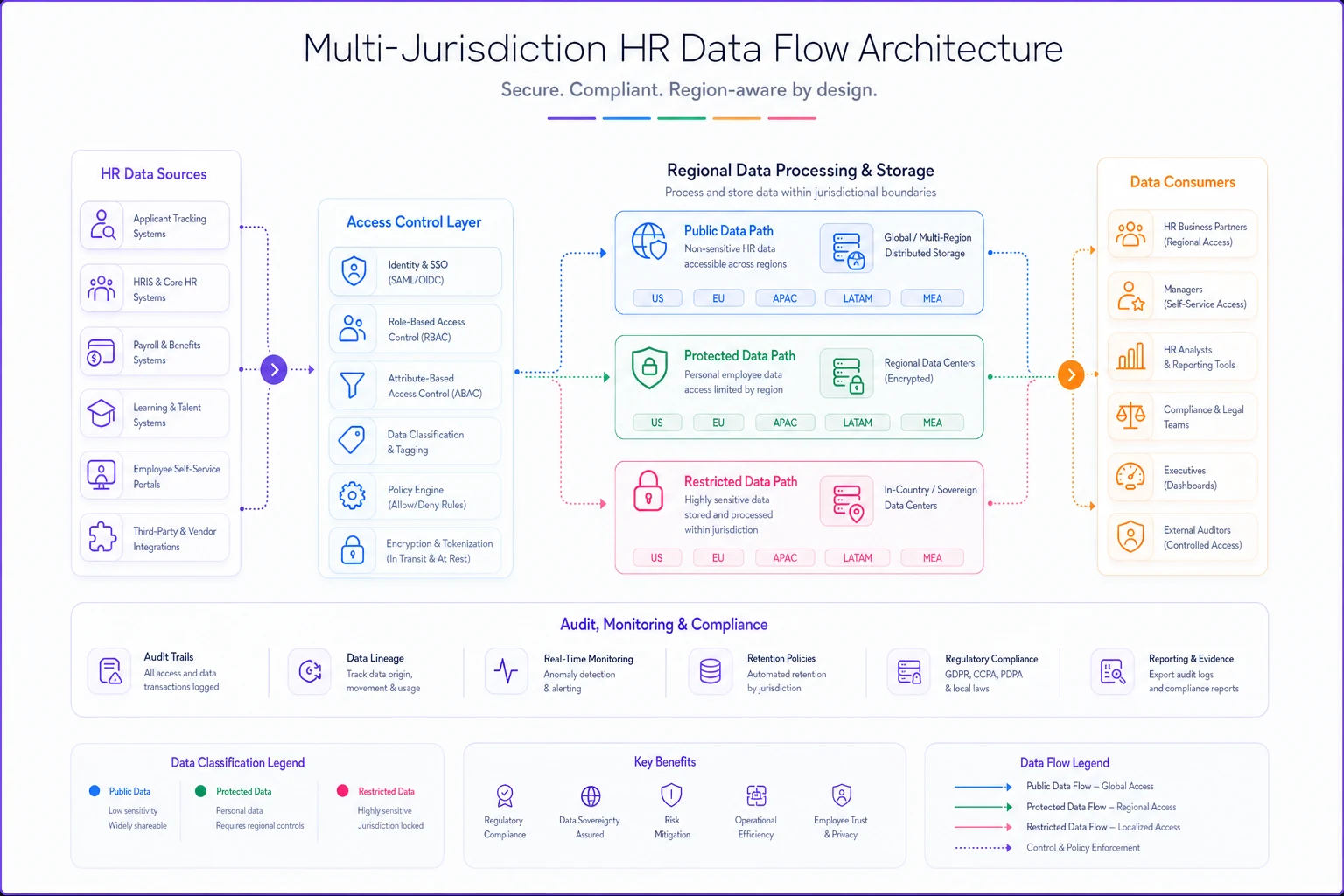
Design separate data paths based on information sensitivity.
-
Public flow (low restriction)
Dates requested, general leave type, coverage arrangements.
-
Protected flow (moderate restriction)
Specific medical categories, family situation details, accommodation discussions.
-
Restricted flow (maximum security)
Medical documentation, mental health records, disability details.
Each flow needs different access controls, retention periods, and audit requirements. Your Berlin office manager can see dates but not diagnoses. Payroll sees codes but not conditions. Only designated compliance officers access full records — and only for their jurisdiction.
The architecture must also handle data sovereignty requirements. German employee data stays on German servers. Chinese data never leaves China. Some countries require physical server presence, not just logical separation.
The diagram below shows how public, protected and restricted flows move between regional servers and access layers.
Some countries require physical server presence, not just logical separation.
Owner assignment matrix with real accountability
Generic "HR owns compliance" statements create dangerous gaps. Real accountability requires specific owners at multiple levels.
Level 1: Process owners
Someone owns intake to ensure requests enter correctly. Another person validates that documentation is complete. A specific individual makes approval or denial calls. Someone else manages all notifications. And someone maintains compliance records for audits.
Level 2: Jurisdiction owners
Regional compliance lead for each major jurisdiction. Backup owner for continuity. Escalation path clearly defined. Update responsibility when laws change.
Level 3: System owners
Data flow architect maintains privacy compliance. Integration owner ensures systems talk correctly. Reporting owner produces audit-ready documentation. Training owner keeps everyone current.
Most companies miss the critical part: overlap coverage. When your California compliance lead takes maternity leave, who handles urgent requests? Not "someone in HR" but specifically "Sarah Chen, backup California lead, reachable at..."
| Process Step | California | New York | Texas | Ontario |
|---|---|---|---|---|
| Initial intake | R: Local HR | R: Regional HR | R: Central HR | R: Canadian HR |
| Medical verification | A: Compliance Mgr | A: Regional Lead | A: Central Lead | A: Provincial Lead |
| Payroll coding | C: Finance | C: Finance | R: Payroll | R: Can Payroll |
| Audit prep | I: Legal | R: Compliance | I: Legal | A: Can Legal |
Without this specificity, critical decisions stall or get made by whoever answers email fastest — rarely the right person.
Audit cadences that catch issues early
Annual compliance audits are like annual dental checkups when you've been eating candy daily. Problems compound between checks.
Design cascading audit cycles instead.
Weekly spot-checks: Pull three random recent requests. Verify correct jurisdiction rules applied. Check documentation completeness. Flag any confusion points. Takes 5-10 minutes.
Monthly systematic review: All requests from highest-risk jurisdictions get reviewed. Pattern analysis for potential discrimination. Manager decision consistency checks. Look for unusual approval or denial rates. Budget 2 hours.
Quarterly deep dive: Complete documentation audit for 10% sample. Policy update integration check. Cross-jurisdiction consistency review. System data flow verification. Full day commitment.
Annual comprehensive audit: Full compliance verification. External auditor preparation. Trend analysis across all jurisdictions. Policy framework overhaul if needed. Multi-day process.
Start weekly spot-checks with the highest-risk jurisdictions to surface immediate issues.
Frequent lightweight checks catch more issues than intensive annual reviews. A weekly 10-minute check across 52 weeks provides more coverage than a three-day annual audit marathon.
Track what you find. California requests consistently miss documentation? Training issue. Managers in one region approve everything while another denies similar requests? Consistency problem. Certain request types always cause confusion? Process gap.
Escalation paths that actually function under pressure
Standard escalation usually means "email your boss and wait." Multi-jurisdiction complexity requires more sophisticated routing.
Build escalation triggers based on risk, not just confusion. Request involves protected class employee. Previous similar request led to complaint. Jurisdiction recently changed laws. Manager-employee conflict exists. Union involvement likely.
Escalation routing logic
-
Same jurisdiction first (they know local law)
-
Then functional expert (medical leave specialist)
-
Then legal review (for high-risk situations)
-
Finally executive decision (CEO/CHRO level)
The routing must account for time zones. An urgent Friday afternoon request from Hong Kong can't wait for Monday morning in New York. Your escalation path needs follow-the-sun coverage.
Document resolution timeframes. Standard requests get 24-48 hours. Urgent medical situations need same business day response. Complex multi-jurisdiction cases get 72 hours with interim communication. Legal review required situations get 5 business days maximum.
Create templates for common escalations. When a manager faces their first international FMLA-equivalent request, they shouldn't write a novel asking for help. They should fill out a standard escalation form that captures the essential decision factors.
Building checkpoint systems that prevent violations
Compliance violations rarely happen at decision points — they happen in the gaps between decisions. Build checkpoints that catch problems before they become violations.
Pre-request checkpoints: Manager training confirmation before supervision begins. Employee handbook acknowledgment in local language. System access verification for decision-makers. Jurisdiction rules loaded for new locations.
During-request checkpoints: Documentation timer starts upon receipt. Required forms auto-generated. Conflicting jurisdiction flag raises immediately. Accommodation interactive process triggers tracked.
Post-approval checkpoints: Return-to-work date approaching notifications. Certification expiration warnings. Pattern detection for potential abuse. Benefit exhaustion alerts.
Ongoing checkpoints: Law change notifications. Policy update confirmations. Training expiration warnings. Audit finding remediation tracking.
Each checkpoint needs an owner, a schedule, and a consequence for missing it. If nobody checks whether managers completed jurisdiction-specific training, you'll discover untrained managers only during depositions.
Technology enablement without technology dependence
Most companies either over-rely on technology or ignore it entirely. The balance lives in using AI-powered operational software to enforce your framework, not replace it.
Effective multi-jurisdiction absence management platforms should automatically route requests based on employee location and applicable laws — not force HR to remember which rules apply where. When someone in your Munich office requests leave, the system should immediately apply German federal law, Bavarian state requirements, and any Munich-specific provisions without manual intervention.
Generate jurisdiction-appropriate documentation sets. The forms needed for California pregnancy disability leave differ completely from Quebec parental leave. Your platform pulls the right forms, in the right language, with correct legal citations.
Track certification deadlines across different requirement cycles. US FMLA recertification timing differs from Canadian medical leave requirements. The platform maintains separate timers and sends alerts based on applicable rules.
Create audit trails that satisfy different regulatory standards. European regulators want different documentation than US Department of Labor investigators. Your system maintains parallel audit paths that meet each jurisdiction's specific requirements.
But the technology amplifies your framework, it doesn't create it. An AI-assisted platform can ensure your German employees get correct leave calculations, but only if you've properly mapped German requirements first. It can flag potential discrimination patterns, but only if you've defined what patterns matter in each jurisdiction.
Real-world implementation timeline
Rolling out multi-jurisdiction absence management isn't a weekend project. Here's what realistic implementation actually looks like:
Months 1-2: Current state assessment
Map existing processes. Identify all operating jurisdictions. Document current violations or near-misses. Catalog available resources.
Months 3-4: Framework design
Build jurisdiction hierarchy. Create owner matrix. Design data flows. Establish audit cadences.
Months 5-6: High-risk jurisdiction pilot
Start with your most complex location (usually California or Germany). Test all workflows. Identify gaps. Refine processes.
Months 7-8: Gradual rollout
Add 2-3 jurisdictions monthly. Maintain parallel systems initially. Document lessons learned. Adjust framework based on reality.
Months 9-12: Full deployment
Complete all jurisdiction integration. Retire legacy processes. Establish ongoing maintenance protocols. Conduct comprehensive audit.
Most companies want to compress this timeline. They end up with gaps that surface during audits or lawsuits. Companies that succeed treat the first year as infrastructure investment, not overhead expense.
Maintaining compliance as regulations evolve
Laws change constantly. California adjusts CFRA. Germany updates BGB. Quebec modifies parental leave. Your framework needs built-in evolution capability.
Assign regulatory monitoring by jurisdiction, not centrally. Your Ontario compliance owner subscribes to Canadian employment law updates. Your California lead tracks both state legislature and major city councils. Central HR aggregates changes but doesn't own monitoring.
Change integration protocol
-
Legal alert triggers review process
-
Impact assessment within 48 hours
-
Implementation plan within 2 weeks
-
System updates within 30 days
-
Training completion within 45 days
-
Audit verification within 60 days
Build buffer time into your compliance. If new regulation takes effect January 1st, your systems should be ready by November 1st. This buffer lets you catch integration issues before they become violations.
Document everything about changes. What changed and why. Who made decisions. What got updated. Who got trained. How you verified compliance.
This documentation becomes critical during audits. Regulators look more favorably on companies that show systematic compliance effort, even if minor issues exist.
Starting Monday morning
The framework outlined above takes months to fully implement, but you can start improving immediately.
This week, pick your highest-risk jurisdiction. Map one common absence request type through your current process. Document every decision point, every hand-off, every place where information sits waiting. You'll find gaps immediately.
Next week, assign owners to those gaps. Not committees, not departments — actual humans with names and phone numbers.
Within a month, establish a basic audit rhythm. Nothing elaborate — just weekly spot-checks of recent requests.
Within a quarter, you'll have enough pattern data to prioritize which jurisdictions need framework attention first.
Multi-jurisdiction absence management isn't about perfection — it's about systematic improvement. Build the framework piece by piece. Let operational software handle the repetitive compliance checks while your team focuses on complex decisions. Most importantly, design for the organization you're becoming, not just the one you are today.
The companies that master this build competitive advantages in their ability to operate anywhere. The ones that don't face mounting compliance costs that eventually restrict where they can grow.
Ready to optimize your workforce absence management?
Join 2,000+ HR teams using Absencely to reduce administrative burden, improve compliance, and boost employee satisfaction.