


Most absence programs die quietly in a budget meeting. Not because the data is wrong, but because nobody can explain — on one slide — who absorbs the cost when a key operator calls out for six weeks, and whether fixing it is actually worth funding. HR shows the absence rate. Finance shows the overtime line. Ops shows the missed SLAs. And then everyone stares at each other because the numbers live in three different ledgers and none of them connect to a decision.
The gap isn't analytical. It's a funding and ownership problem. Until you decide which budget absorbs absence cost and which model you'll use to fund the fix, every intervention turns into a one-off fight. This piece walks through three funding models that actually survive a board review — with the ROI signoffs, the manager incentive levers, and the journal entries your controller will ask for before approving anything.
Why absence funding breaks down before it even reaches the board
The usual failure isn't that absence is expensive. It's that the expense is invisible where decisions get made.
Absence cost gets buried inside overtime, temp spend, blown service levels, and quiet productivity drag. None of those carry a label that says "absence." So when HR proposes a tiered intervention program or a surge roster, Finance sees it as new spend — not as a reallocation of money the company is already bleeding. The proposal competes against headcount and marketing, loses, and nothing changes.
The second failure is ownership. When no cost center formally owns absence outcomes, managers have zero incentive to manage them. A frontline manager whose overtime gets reimbursed from a central pool will happily burn that overtime instead of fixing coverage patterns — because it's free to them. Multiply that across 40 locations and you've built a system that rewards exactly the behavior you're trying to kill.
Third, and this one bites at scale: the funding model and the accounting treatment don't match. HR negotiates a chargeback scheme in a conference room, but payroll and the GL have no mechanism to actually move the money. So the "model" exists in a deck and nowhere in the books. Finance quietly ignores it.
A board-ready model has to close all three gaps at once: make the cost visible, assign the owner, and give the controller a clean journal path. Miss any one of those and you don't have a funding model — you have a slide.
The three models, compared
Before the detail, here's the shape of the decision. These aren't mutually exclusive — larger orgs often run Model B at the division level and Model C inside a critical function — but pick a primary one to anchor the board conversation.
Stop managing absences manually.
Absencely simplifies leave requests, approvals, and absence monitoring for your entire workforce.
- Automated leave tracking
- Manager approval workflows
- Compliance & reporting tools
No credit card required
| Criteria | **Model A: Central Absorption** | **Model B: Chargeback / Cost Allocation** | **Model C: Shared Risk Pool** |
|---|---|---|---|
| Who pays | Central HR/Finance budget | The business unit where absence occurs | A funded pool, topped up by all units |
| Manager incentive | Weak (cost is invisible to them) | Strong (hits their P&L directly) | Moderate (pool draw-down is visible) |
| Best for | Early-stage, <200 employees | Multi-site, divisional P&L owners | High-variance critical roles |
| Main risk | Overspend, no accountability | Managers hide/under-report absence | Pool mis-sizing, moral hazard |
| Accounting complexity | Low | Medium (intercompany allocations) | High (accrual + true-up) |
| Board appeal | Simple, hard to optimize | Transparent, drives behavior | Sophisticated, protects critical ops |
The instinct is usually to jump straight to Model B because chargebacks "drive accountability." Sometimes that's right. But chargebacks have a nasty side effect: when a manager's bonus is tied to a P&L line that absence now hits, you create a direct incentive to suppress reported absence — delayed FMLA paperwork, informal shift swaps, people pressured back before they're ready. That's the single most common way these models backfire, and we'll come back to it.
Model A: Central Absorption — the honest default for smaller operations
Central absorption means one budget line owns all absence-related cost: backfill, overtime attributable to coverage gaps, temp activation, STD top-ups. HR and Finance manage it jointly.
It gets dismissed as "not accountable enough," but for a company under a couple hundred people, it's usually the right call. You don't yet have clean enough cost attribution to run chargebacks fairly, and the overhead of intercompany allocations would eat any benefit. Centralizing at least makes the number visible in one place, which is step one.
Worked ROI signoff. Say a 180-person services firm is running an absence rate around 4.2%, with annual absence-linked cost (overtime, temp, lost billable) landing somewhere near $310k. A proposed intervention — tiered manager check-ins, a small backfill reserve, better return-to-work handling — costs roughly $85k fully loaded for year one.
-
Target reduction
absence rate 4.2% → ~3.6% (conservative, roughly 14% relative drop)
-
Estimated avoided cost
~$43k–$48k in year one, ~$60k annualized once ramped
-
Year-one net
negative (~-$40k)
-
Payback
roughly 18–22 months
That negative year-one number is exactly why these proposals die. The board signoff has to frame it as a two-year payback with a sensitivity band, not a year-one win. If the organization can't tolerate an 18-month payback, Central Absorption isn't the problem — the appetite is.
Journal treatment (simplified). Absence cost sits in a dedicated GL sub-account under HR opex rather than being smeared across departmental overtime: Dr 6410 – Absence Coverage Cost (HR opex) 43,000 Cr 2100 – Accrued Payroll / Temp Payable 43,000 The point of the dedicated account isn't elegance. It's that next year, when someone asks whether absence is trending better or worse, there's a single number to look at instead of a forensic exercise.
Who should NOT use this: multi-division companies where one unit's bad coverage habits are quietly funded by everyone else. Central absorption there just subsidizes the worst-run site.
Model B: Chargeback — making the cost land where the behavior lives
Chargeback allocates absence cost back to the business unit, location, or function that generated it. Done well, it's the strongest behavior-changer of the three, because a plant manager who sees $28k of absence cost hit her P&L will actually restructure shift coverage.
The mechanics borrow directly from a showback discipline — if you haven't formalized how absence cost gets attributed yet, the groundwork in absence cost-allocation and showback framework for finance teams is the prerequisite, not an optional add-on. You cannot charge back a number you can't defend line by line.
The allocation logic, in order:
-
Capture the absence event with a cost-center tag at the point of entry — not reconstructed at month-end.
-
Attribute direct backfill cost (temp invoice or incremental overtime) to that cost center.
-
Attribute indirect cost (productivity drag, SLA penalty) using a pre-agreed per-day rate by role band, so you're not re-litigating the number every month.
-
Run the allocation at month-end as a standard intercompany/interdepartmental journal.
-
Publish a showback report before the charge posts, so managers can dispute before it's real.
That fifth step is what separates a chargeback that changes behavior from one that just generates angry emails. If the charge shows up as a surprise, managers stop trusting the data and start gaming the inputs.
Journal treatment. Costs collect in a central clearing account during the month, then allocate out: During month (central pool collects): Dr 6410 – Absence Coverage Clearing 62,500 Cr 2100 – Accrued Payroll / Temp Payable 62,500 Month-end allocation to units: Dr 6410-OPS-West – Absence Charge 21,000 Dr 6410-OPS-East – Absence Charge 18,500 Dr 6410-RETAIL – Absence Charge 23,000 Cr 6410 – Absence Coverage Clearing 62,500 The clearing account should net to zero every month. If it doesn't, something slipped through un-attributed — and that residual is itself a useful signal about data quality.
Publish the showback report before charges post so managers can review and dispute obvious errors.
Where chargeback backfires. The incentive you create is only as good as the metric you attach it to. Tie a manager's variable comp purely to "reduce absence cost on your P&L" and you've just incentivized under-reporting — late leave filings, people guilted back early, intermittent leave logged as casual absence to dodge the backfill charge. Reported absence can "improve" 20% in a quarter purely because managers learned the reporting workarounds, not because anyone actually got healthier.
Which is exactly why the incentive design matters more than the funding mechanic itself.
Tying the incentive to the right KPI (the part most models get wrong)
Chargeback alone pushes cost suppression. The fix is to split the manager scorecard so that reducing cost is only rewarded alongside clean reporting and healthy return-to-work outcomes.
A balanced manager incentive for absence funding has at least three legs:
-
Cost leg — absence-linked cost vs. budget for their unit (the chargeback number)
-
Integrity leg — reporting accuracy
% of absence events logged within SLA, FMLA/leave paperwork completeness, zero late intermittent-leave entries
-
Outcome leg — successful return-to-work rate, repeat-absence rate, and ideally a team-health signal so nobody hits the cost target by burning out their remaining staff
If the integrity and outcome legs aren't gated — meaning you can't bonus on cost unless reporting integrity clears a threshold — the whole thing rots. Make clean data a gate, not a bonus modifier. A manager who hits every cost target but logs absences three weeks late gets zero on the absence component. Blunt, but it's the only version that holds up over time.
| Leg | Weight | Gate? |
|---|---|---|
| Cost vs. budget | 40% | No |
| Reporting integrity | 30% | Yes — must clear 90% to unlock cost leg |
| RTW / repeat-absence outcomes | 30% | No |
The gate is the whole trick. Without it, Model B teaches managers to hide absence. With it, they have to manage the actual problem to get paid.
Target-setting underneath these legs shouldn't be invented per manager. Anchor them to the same methodology used org-wide — the approach in executive absence scorecard: prioritized KPIs, target-setting methodology and a one-page report template keeps unit-level incentive targets consistent with what the board is already looking at, so a manager's bonus KPI and the board slide are reading from the same definitions.
Model C: Shared Risk Pool — for when a single absence can break the operation
Some roles are genuinely different. A lead pharmacist, a sole-certified machine operator, a regional clinical director — when they're out, the cost isn't just "overtime," it's a shut-down line or a compliance exposure. Charging that back to the local unit is both unfair and useless. They didn't cause it, and they can't absorb a $200k hit.
A shared risk pool handles this like self-insurance. All participating units contribute a per-head or per-critical-role premium into a funded pool. When a qualifying critical-role absence hits, the pool pays for surge coverage, cross-trained backfill, or contract specialists — and the affected unit doesn't take a P&L hit for bad luck.
Sizing the pool. This is where it typically goes wrong. Under-fund it and the pool is dry by Q3; over-fund it and Finance correctly calls it a slush fund. Size it off expected claims: (expected qualifying events per year) × (average coverage cost per event), plus a buffer — typically 15–25% — for variance. Then true it up annually.
A rough example: a specialty-care group with around 35 critical roles estimates 6–8 qualifying absences a year at an average coverage cost near $18k. Expected claims roughly $126k, plus a 20% buffer, puts the pool at about $150k, split across units by critical-role count.
Journal treatment. Contributions accrue into a liability; claims draw it down; year-end trues up: Monthly contribution accrual: Dr 6420-UNIT – Risk Pool Contribution 12,500 Cr 2250 – Absence Risk Pool (liability) 12,500 Claim paid from pool: Dr 2250 – Absence Risk Pool (liability) 18,000 Cr 2100 – Accrued Payroll / Temp Payable 18,000 Year-end true-up (if over-funded): Dr 2250 – Absence Risk Pool (liability) 14,000 Cr 6420 – Risk Pool Contribution (credit back) 14,000
When this makes sense: genuinely high-variance, high-impact roles where one absence is catastrophic and no single unit can self-insure. When it's a bad idea: routine absence. Running a pool for ordinary sick days adds accounting overhead for no behavioral benefit — that's a Model A or B problem in a fancy coat.
A real scenario: multi-site retail pharmacy, 14 locations
A regional pharmacy chain, 14 sites, roughly 430 staff. Absence cost was invisible — buried in each store's overtime line and a central temp-coverage budget nobody scrutinized. Combined absence-linked spend was running somewhere around $680k–$720k a year, and store managers had no reason to care because coverage overtime was reimbursed centrally.
They moved to a hybrid: Model B chargeback for routine absence at store level, with the gated manager scorecard described above, plus a Model C pool for pharmacist-level absence — the role that legally shuts a store if uncovered.
-
Routine absence cost fell roughly 12–15% once store managers saw it on their own P&L and started fixing predictable Monday/Friday coverage gaps instead of defaulting to overtime.
-
Reported absence rose slightly in the first two months — which was the goal. The integrity gate forced accurate logging, surfacing intermittent leave that had been under-recorded for years.
-
The pharmacist risk pool was drawn down twice (two medical leaves) without either store taking a P&L hit, which ended the old internal fight about whose budget eats the locum cost.
Net result: not a dramatic savings headline. Maybe $85k–$100k of real reduction in year one against the setup cost. The bigger win was that the board finally had one defensible number for absence cost and a clear owner for each dollar of it.
Making the models hold together as you grow
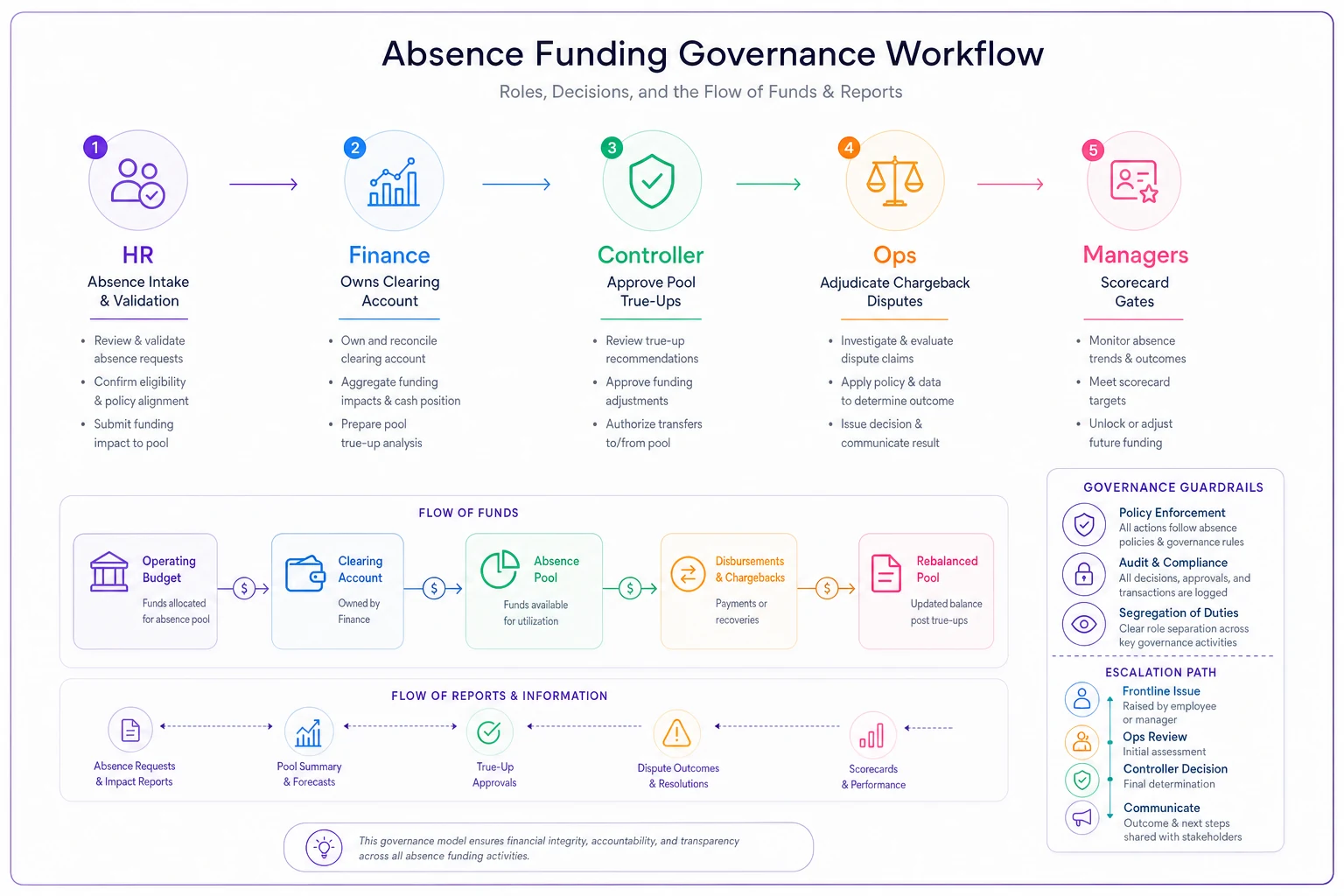
The mistake is treating the funding model as a finance artifact. It's an operating-model decision, and it has to be wired into governance — who owns the clearing account, who approves pool true-ups, who adjudicates chargeback disputes, who owns the manager scorecard gates. If those roles aren't named, the model drifts back to "central absorbs everything, nobody's accountable" within a year, regardless of what the deck said.
This is why the funding model should be built inside your governance structure rather than bolted on after the fact. The role definitions and decision rights in designing an absence governance operating model for enterprise HR are what keep a chargeback or risk pool alive past its first awkward quarter — because someone has to own the disputes, the true-ups, and the integrity gates, or the whole thing quietly reverts.
Here's a simple workflow for who owns what and how funds move as the model operates.
As you scale, the practical progression usually looks like this: start at Central Absorption while you clean up cost attribution, move routine spend to chargeback once your data is trustworthy enough to defend a charge, and layer a risk pool over the handful of roles that can genuinely break the operation. Running all three at once from day one in a 150-person company is just importing complexity you can't yet support.
The board doesn't need the most sophisticated model. It needs one it can understand, a payback window it can stomach, incentives that don't quietly reward hiding absence, and journal entries the controller can actually post. Get those four right and absence funding stops being an annual argument — it becomes a line item with an owner, which is all anyone was really asking for.
The board doesn't need the most sophisticated model. It needs one it can understand, a payback window it can stomach, incentives that don't quietly reward hiding absence, and journal entries the controller can actually post. Get those four right and absence funding stops being an annual argument — it becomes a line item with an owner, which is all anyone was really asking for.
Ready to optimize your workforce absence management?
Join 2,000+ HR teams using Absencely to reduce administrative burden, improve compliance, and boost employee satisfaction.