


The most expensive mistake in absence forecasting workforce planning usually isn't a bad forecast. It's a decent forecast that nobody acts on, because the people who could act on it work on different calendars.
Operations or workforce management owns the absence forecast and uses it to build next month's schedule. HR business partners own the succession plan, which gets refreshed once a year in a talent review and then sits in a slide deck. Talent acquisition works off requisitions that finance approves during the annual budget cycle. Finance owns headcount and overtime, often on separate lines that nobody reconciles against each other.
So the forecast says something like "this team will be short about 1.5 FTE for most of Q3 and Q4." That's real information, but it only reaches the scheduler, who patches it with overtime. Nobody upstream is asked to open a req. Nobody checks whether the named successor for the team lead could cover for six weeks. Finance watches overtime creep up and never connects it to a headcount decision it could have made four months earlier.
This article is about the connective tissue. One absence forecast should feed four decisions (hiring cadence, bench size, successor certification and funding), and there should be gates that make those decisions happen on schedule instead of in a panic.
The mistake: treating the forecast as a scheduling input only
Most organizations that forecast absence at all use it on a short horizon, the next few weeks of shifts. That's useful, but it's the least valuable horizon for leadership. By the time a gap shows up on a four-week schedule, you can only pay for it with overtime, agency staff, or a manager covering when they shouldn't be.
-
Weeks out (0–8 weeks) scheduling, shift swaps, flex pool, agency activation. Most teams already have this layer.
-
Quarters out (1–4 quarters) hiring cadence, bench sizing, cross-training sprints, contingent contracts. This is where most of the money is won or lost.
-
Years out (1–3 years) succession certification, apprenticeship pipelines, structural headcount and funding envelopes. This is where leadership earns its keep.
In most mid-sized businesses we look at, the weeks-out forecast is decent, the quarters-out layer is missing, and the years-out layer is a succession chart with names on it and no evidence behind them.
The quarters-out layer gets skipped mostly because nobody owns it. Scheduling doesn't look that far ahead, and the annual talent review doesn't look that close.
Why the four calendars never line up
The misalignment is mechanical. It isn't a matter of people not caring, so it helps to lay the calendars out side by side.
Stop managing absences manually.
Absencely simplifies leave requests, approvals, and absence monitoring for your entire workforce.
- Automated leave tracking
- Manager approval workflows
- Compliance & reporting tools
No credit card required
| Function | Typical planning rhythm | What it looks at | What it can't see |
|---|---|---|---|
| Operations / WFM | Weekly to monthly | Shift coverage, forecasted absence by team | Whether a hire is coming, who's certified to step up |
| HR / succession | Annually (talent review) | Names on a chart, readiness ratings | Actual absence load, how often successors really covered |
| Talent acquisition | Per requisition, often reactive | Open reqs, time-to-fill | Demand that hasn't been turned into a req yet |
| Finance | Annual budget, quarterly reforecast | Headcount, overtime, agency spend as separate lines | That overtime and the unfilled headcount are the same problem |
That last row does more damage than people expect. A team runs heavy overtime because of predictable absence load, and finance sees two unrelated facts: overtime is over budget, and a headcount request is pending. They get evaluated separately. Overtime earns a "please manage this down" email, the headcount gets deferred for cost reasons, and the overtime keeps costing close to what the hire would have.
If budgeting is the weak link in your setup, start with embedding absence metrics into budgeting and headcount decisions. This playbook assumes absence already shows up in the budget conversation somehow, and it focuses on what happens after that.
Lead time: why hiring can't fix most gaps it's asked to fix
Executives tend to underestimate this part.
-
Req drafted and approved. Anywhere from 1 to 6 weeks, depending on how many signatures you need.
-
Sourcing, interviews, offer. Commonly 4–10 weeks for skilled roles, longer for licensed or niche ones.
-
Notice period at their current employer. Usually 2–4 weeks, sometimes more for senior people.
-
Onboarding and ramp to independent productivity. A few weeks for standardized frontline roles, six months or more for technical, regulated or client-facing ones.
For a mid-skill technical role that often adds up to 4–7 months from "we should hire" to "this person can cover alone." For a lot of roles, that's longer than the absence itself.
So the first decision rule is simple: if forecast lead time is shorter than requisition-to-productive time, a new hire can't solve this specific gap. You cross-train, borrow, contract or eat the overtime. A hire might still make sense, but for the next occurrence.
Bench sizing heuristics that actually hold up
"Bench" means different things in different industries. Here it means people who are productive in their own role but certified to cover a specific other role when its holder is out. It can also include floating or flex roles whose main job is coverage.
The usual mistake is sizing the bench to average absence. A team of 20 averages about 1.2 people out on any given day, so leaders plan for one or two backups and call it covered. Averages hide the distribution, though. At that size you'll regularly see days with three or four people out, especially when planned leave clusters around school holidays and unplanned absence piles on during illness season. Size to the average and you're short on roughly half the days, by definition.
Size to a percentile, not the mean, and pick the percentile by criticality.
Size to a percentile, not the mean, and pick the percentile by criticality. For critical roles (where a gap stops revenue, breaks compliance or creates safety risk), size coverage to roughly the 90th percentile of forecasted concurrent absence. For important roles, around the 75th–80th. For standard roles with good substitutes, size to the mean and let the flex pool and overtime absorb peaks. If you don't have criticality tiers yet, the staffing resilience risk-tier blueprint walks through setting them. The tier should drive the percentile directly.
Count people, not names. A bench member who is also the only certified backup for two other roles isn't three units of coverage. They're one person who might be needed in three places on the same bad day. This double-counting is the most common reason a bench that looks fine on paper fails in practice. Each person should count toward one role's coverage at a time, assigned to wherever they're needed most.
Bench members get absent too. With a bench of 4 and the same absence rate as everyone else, your effective bench on a typical day is closer to 3.7, and lower on the bad days that matter. Small difference, but it adds up when the bench is thin.
Single-knowledge roles get a minimum of one certified backup, whatever the math says. The person who knows how payroll runs under a weird union agreement. The one technician licensed on a specific machine. The only person who can close the month for a particular entity. Percentile math breaks down for a headcount of one. The floor is one certified backup, and for genuinely critical single-knowledge roles, two.
Leave room for growth. If you're adding sites, shifts or product lines, the bench you need in 18 months is bigger than the one you need now. Benches are slow to build, so sizing only for current headcount means you're permanently about a year behind.
Benches also erode quietly. Someone gets cross-trained, then promoted, then leaves, and nobody updates the coverage map. A bench that isn't re-verified at least twice a year is mostly fiction by year two.
Succession certification: named isn't ready
Most succession plans list a successor and a readiness rating: "ready now," "ready in 1–2 years," "ready in 3+." Those ratings are usually a manager's opinion formed in a talent review, and they're rarely tested.
-
Shadowed has observed the role's core responsibilities and has documentation for them.
-
Supervised cover has covered the role for short stretches with the incumbent or a manager reachable for decisions.
-
Solo cover has independently covered for a meaningful stretch (one to two weeks is a reasonable bar for most roles), including at least one non-routine decision, with no critical errors.
-
Certified has done solo cover more than once, across different conditions (a busy period and a quiet one, for example), and the incumbent's manager has signed off against defined criteria.
Two rules make this work.
First, certification expires. Skills and context decay. If a certified successor hasn't covered in roughly 12–18 months, they drop back a level until they do. It sounds bureaucratic, but it's the only way to keep a succession chart honest. Otherwise people stay "ready now" for years on the strength of a two-week cover that happened before the systems changed.
Second, the absence forecast schedules the certification. When the forecast shows a planned absence for someone in a succession-critical role, that absence becomes a certification opportunity for their successor. The HR partner and manager agree beforehand on what the successor will own, which decisions they'll make, and how it'll be assessed. Covering the absence and building succession readiness turn into the same activity.
Organizations that do this well end up with an odd-looking but very useful metric: certified successors per critical role, verified within the last 18 months. It's usually far lower than the succession chart implies. The first time a leadership team sees that number it's uncomfortable, and then it's useful.
Hire vs cross-train: the decision rules
Leaders get asked this constantly, usually informally and under time pressure. A rough set of rules beats gut feel here, mostly because gut feel overrates cross-training. It seems cheaper and faster, and sometimes it is.
-
The gap is shorter than the hire-to-productive lead time, or it's a one-off.
-
The skill is adjacent. The cross-trainee already has 60–70% of what's needed, and the rest can be learned in weeks, not months.
-
The cross-trainee's own role has real slack, or has a cheaper cover option (agency, overtime from a deeper pool).
-
The role is low-to-moderate criticality, so slower or less polished cover is acceptable.
Hiring tends to be the right call when:
-
The gap recurs, meaning the forecast shows it in most quarters rather than once.
-
Cover cost (overtime plus agency premium plus the manager's time pulled in) over the last two quarters is approaching the loaded cost of an FTE. A useful trigger zone is somewhere around 70–80% of a loaded FTE annualized, because past that you're paying for headcount without getting the stability.
-
Cross-training would create a cascade, meaning the cross-trainee's own role becomes the new gap.
-
The role is critical and needs depth that cross-training can't realistically provide.
The cascade point deserves more attention than it gets. Say a senior scheduler goes on leave and a planner is cross-trained to cover. The planner's work gets spread across two coordinators, who then fall behind on their own. Three people are partly underwater to avoid one hire. On paper the absence was covered. In practice the cost moved around the team and showed up as missed deadlines and frustration that nobody traced back to the original decision.
A quick check is to follow the chain two steps. Who covers the gap, and who covers them? If the second answer is "nobody" or "they'll manage," the cross-train decision is weaker than it looks.
There's also a middle path people overlook: hiring into the bench instead of into the gap. Rather than backfilling the specific absent role, you hire someone into a more junior or adjacent role and cross-train an existing person up to cover. You get a permanent hire with a shorter ramp, since junior roles ramp faster, and an existing employee gets a development step that feeds the succession pipeline. For teams with recurring gaps in mid-level roles, this is often the best answer.
Funding triggers: getting money pre-approved instead of begged for
Most absence-driven staffing decisions die at the funding step. The case usually isn't weak. The request just shows up at the wrong time, in the wrong format, from the wrong person.
-
Bench expansion trigger forecasted concurrent absence at the tier's percentile exceeds certified bench capacity for two consecutive quarterly forecasts. This releases funding for one bench hire or a defined block of cross-training hours.
-
Conversion trigger trailing two-quarter cover spend for a role family crosses a set share of a loaded FTE cost. This converts that overtime and agency budget into a headcount line.
-
Succession gap trigger a critical role has zero certified successors verified within 18 months, and the incumbent has a known risk factor (retirement eligibility window, planned extended leave, a forecasted extended absence). This funds an accelerated development plan or an overlap hire.
-
Growth-adjusted trigger a new site, line or shift is approved. This automatically funds bench capacity proportional to the new headcount at the relevant tier's percentile, so the bench doesn't lag a year behind.
The envelope matters as much as the triggers. A common setup is a contingency pool, often a small slice of total payroll, held centrally and released only against triggers. Unused envelope rolls back at year-end. Finance stays comfortable because spending is rules-based and capped, and operations can't hoard headcount "just in case."
Don't let the triggers run on raw cost data alone. Cover spend can drop for bad reasons: the work stops getting done, quality slips, managers quietly absorb it. A trigger that only watches overtime will read that as improvement. Pair cost triggers with at least one service or output measure for the same team.
The decision gate matrix
This is the piece that turns a forecast into owned actions. Each row is a gate. When the forecast crosses the trigger, the listed actions happen, owned by the listed people and funded from the listed source. Adapt the thresholds to your own data. The numbers below are illustrative starting points, not benchmarks.
| Gate | Forecast trigger | TA action | Succession / bench action | Funding source | Owner | Review cadence |
|---|---|---|---|---|---|---|
| G1 – Short gap | Planned absence under ~8 weeks in non-critical role | None | Assign cross-trainee; log as development cover | Existing team budget / overtime | Line manager | Monthly |
| G2 – Long planned gap | Planned absence over ~8 weeks, any tier | Fixed-term or contingent backfill if lead time allows | Successor runs supervised or solo cover; certification assessment scheduled | Backfill line or contingency envelope | HRBP + manager | At absence notification |
| G3 – Recurring gap | Gap appears in 3 of last 4 quarterly forecasts for same role family | Open permanent req (or bench hire into adjacent junior role) | Re-size bench to tier percentile | Conversion from cover spend | Ops leader + finance partner | Quarterly |
| G4 – Bench shortfall | Certified bench below tier percentile for 2 consecutive forecasts | Bench hire if cross-training can't close within 1 quarter | Cross-training sprint with defined certification targets | Contingency envelope | HRBP + WFM | Quarterly |
| G5 – Succession exposure | Critical role with 0 certified successors (≤18 months) and incumbent risk flag | Begin overlap hire search if internal path >12 months | Accelerated development; next planned absence used as solo-cover test | Succession fund | CHRO / exec sponsor | Quarterly exec review |
| G6 – Structural growth | New site/line/shift approved | Bench hires included in launch hiring plan | Pre-certify cover from existing sites before launch | Growth capex/opex plan | COO + CFO | At approval |
| G7 – Retirement wave | 2+ people in a role family within ~3 years of likely retirement | Apprenticeship or early-career pipeline req | Multi-year certification plan per successor | Multi-year capacity plan | CHRO + COO | Annual, checked semi-annually |
A few notes so this doesn't turn into another unused artifact.
Gates should be evaluated by default, not on request. If someone has to remember to check G3, nobody will. The quarterly forecast refresh should produce a list of which gates fired for which role families, and leaders review that list instead of raw data.
Owners have to be real people with authority. "HR" isn't an owner. If G4 fires and nobody specific is accountable for running the cross-training sprint, it slips a quarter, then another.
Gates also need to be allowed to not fire. A matrix that triggers action every quarter for every team gets ignored. If that's happening, your thresholds are too sensitive or your forecast is too noisy, and it's more often the noisy forecast.
Multi-year capacity plans: three layers, rolled forward
The years-out horizon is where succession and funding live, and it's the one most often built on vibes. A multi-year capacity plan that's actually tied to absence forecasting has three layers stacked on top of each other.
Known demand. Things on a calendar or close to it: approved extended leaves, sabbaticals, people inside their retirement eligibility window, contract end dates, planned site openings. These are high-confidence and should be treated almost as fact.
Probable demand. Statistically likely but not tied to named individuals: baseline unplanned absence by role family, expected long-term leaves based on workforce demographics, expected attrition. If a team of 40 is mostly people in their late twenties and thirties, you can forecast some number of parental leaves per year without knowing who, and plan bench depth for it. Same with an aging maintenance or clinical workforce and medical leave.
Structural change. Growth plans, automation that removes or reshapes roles, regulatory changes that create new certification requirements, shifts in operating hours. These carry the most uncertainty and the biggest effect on bench and succession needs.
The plan doesn't have to be elaborate. For each critical and important role family, you want a rough view of required capacity per year, certified bench needed, successors needed, and what's in the pipeline to meet it. Roll it forward every year and check it every six months.
The common failure is building it once and treating it as a strategy document. Multi-year plans are useful because you re-run them. Year one's "probable" layer becomes year two's "known" layer as people announce leaves and retirements get closer. If the plan isn't re-forecast, all it tells you is what you thought two years ago.
As the business grows, what mostly changes is granularity. At 60 people the plan might be a single page covering the handful of roles that matter. At 600 it needs to be role-family-level with site breakouts, since a retirement wave at one location can disappear into company-wide numbers.
What breaks as the organization scales
The coordination problem looks different at each size, and the failure points move.
Under roughly 50 people, the owner or GM usually holds all four calendars in their head. They know who's pregnant, who's thinking about retiring, who could cover for whom. That works until they're the one who's absent, or too stretched to think a quarter ahead. Nothing is written down, so there's no bench map or certification record to fall back on.
Around 100–250 people, middle managers show up and start optimizing locally. A common behavior is hoarding cover capacity. Managers who've been burned by gaps quietly keep an extra person or won't let their trained backups help other teams. Each team looks resilient while the organization as a whole has much less flexibility than its headcount suggests. This is also the size where the annual budget starts locking in headcount before anyone has looked at the absence forecast.
Past 500 or so, the four-calendar problem fully kicks in. TA is its own function with its own metrics, typically time-to-fill and cost-per-hire, and neither rewards hiring ahead of a forecasted gap. Finance treats overtime and headcount separately. Succession is run by a central team far from operations. Forecasts exist but only feed WFM tools. At this size the gate matrix stops being nice-to-have and becomes the only way the pieces connect.
Multi-site operations add a twist: the aggregate looks fine while individual sites fail. A company-wide bench might technically cover company-wide absence, but a bench member at one site can't cover a gap 200 miles away. Bench sizing and gate evaluation have to happen at the level where cover is actually possible, which is usually site-by-role-family.
There's a data-quality threshold too. None of this works if absence records are inconsistent, coded differently across sites, or entered weeks late. If you're not sure where you stand, the stages in the absence program maturity model are a reasonable gut check. Tying forecasts to hiring and succession is realistically a stage-three-or-later capability. Try it earlier and you tend to get confident decisions built on bad numbers.
How the workflow runs, month to month
Here's the operating rhythm in plain terms. The order of the steps matters more than the details of any one of them.
Every month, absence data gets refreshed and the forecast is re-run for the next four quarters at role-family-and-site level. Known items (approved leaves, announced retirements) go in first, and probable absence is modeled on top. The output is a forecasted concurrent absence figure per role family, at the percentile that matches each role's criticality tier.
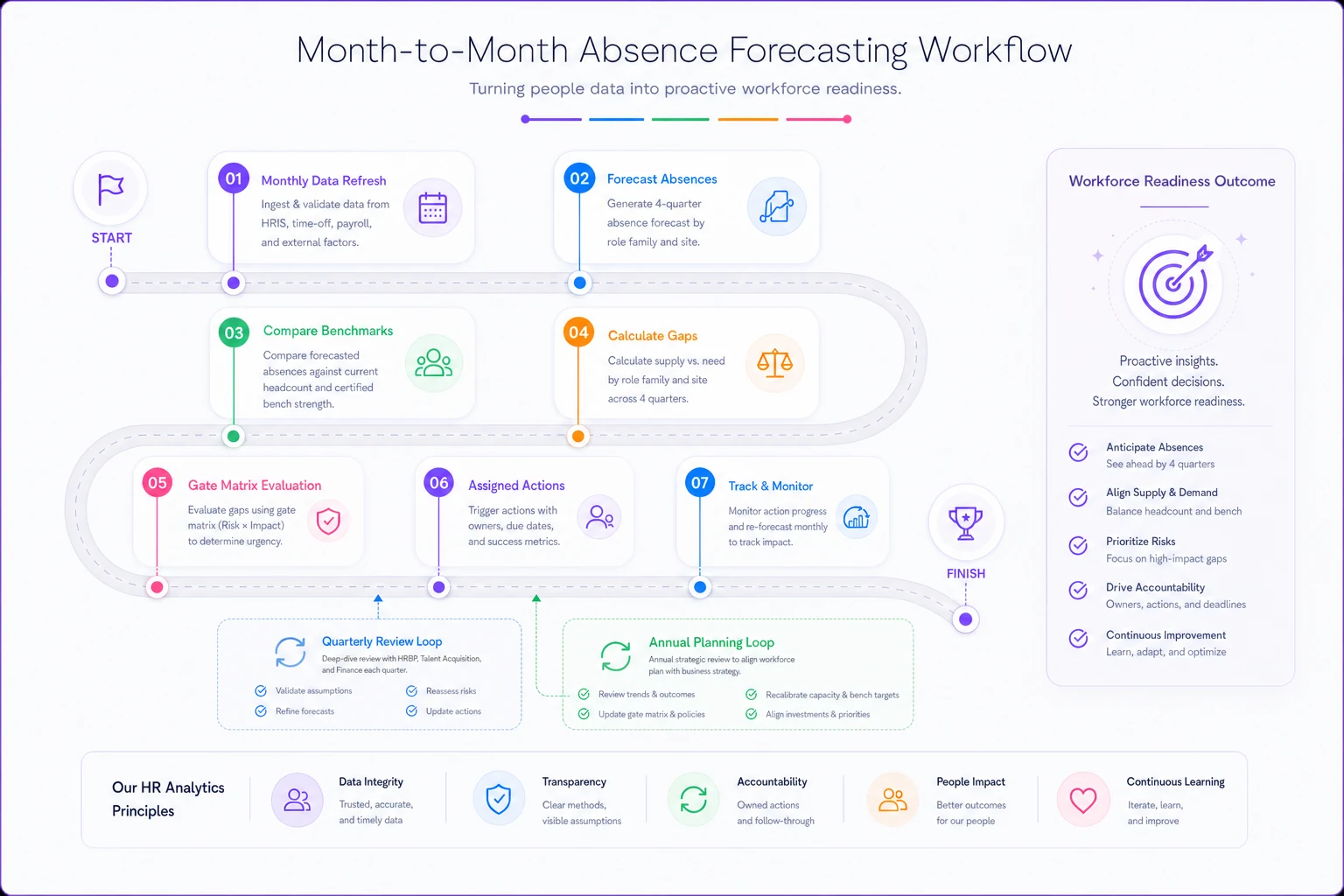
That forecast gets compared against two inventories: current headcount, and the certified bench, meaning only people whose certification is current, each counted once. The difference is the gap, per role family, per quarter.
Each gap then runs against the gate matrix. Most won't fire anything, which is normal. The ones that do produce a short action list: which gate, which role family, which owner, what action, what funding source.
Monthly, line managers and HRBPs handle G1 and G2 actions, mostly assigning cover and scheduling certification opportunities around planned absences. Quarterly, an ops/HR/finance group reviews G3 and G4 firings and releases funding against the pre-agreed envelope. Also quarterly, the exec team looks at G5 succession exposure and anything structural. Once a year, the multi-year capacity plan gets rebuilt with the latest known and probable layers, and the trigger thresholds and envelope sizes get renegotiated with finance based on what actually happened.
One feedback loop makes the whole thing better over time: every time a cover actually happens, the result goes back into the certification records. A successor who covered solo for two weeks without issues moves up a level. A cross-trainee who struggled gets flagged for more development. Skip this and certification levels go stale, and the bench inventory slowly drifts away from reality.
The hard part is keeping the records in sync, not designing the process. Forecasts sit in one tool, certifications in a spreadsheet, reqs in the ATS, funding in a finance model. This is where operational software with some AI automation earns its place. It can recalculate gaps when the forecast refreshes, evaluate gates without anyone having to remember, notice that a certification is about to expire, and route the right action to the right owner. None of that is clever. It just removes the steps that get skipped when people are busy, which is exactly when they matter.
Real scenario: a three-site food manufacturer
Business: Regional specialty food manufacturer, three plants, roughly 280 employees. Maintenance and quality assurance were the role families that mattered most for uptime and food-safety compliance.
The problem: Maintenance had six technicians across the three plants. Two were within about three years of retirement. One had a planned surgery with an expected leave of around ten weeks. The absence forecast existed in the scheduling system and correctly predicted heavy maintenance gaps in the back half of the year, but it was only used to schedule overtime. Maintenance overtime was running somewhere around $14k–$17k a month in heavy periods, and there were recurring stretches of unplanned line downtime when nobody qualified was on site. The succession chart listed a "ready now" successor for the maintenance lead role, but that person had never covered it.
-
G2, for the planned surgery leave. The named successor was assigned to cover the lead role during that leave as a solo-cover certification test, with decision rights agreed upfront.
-
G3, because maintenance gaps showed up in nearly every quarterly forecast. That was a recurring pattern, not a one-off.
-
G7, for the retirement wave.
Instead of hiring a senior tech (five-plus months, and hard to fill), they hired one apprentice-track technician into the plant with the thinnest coverage. They also cross-trained four line operators across two plants for first-line maintenance tasks: basic changeovers, common fault resets, lubrication rounds. Finance agreed to fund both by converting part of the projected overtime budget through the conversion trigger.
Results over roughly 12 months:
-
Maintenance overtime dropped to around $8k–$9k a month in comparable periods.
-
Unplanned downtime from "no qualified tech on site" got noticeably less frequent. The plant managers stopped raising it at weekly ops meetings, which was the clearest sign.
-
The successor's solo cover during the surgery leave surfaced two real gaps, around vendor contract decisions and the spare-parts budget. Both were fixed through targeted shadowing before the first retirement happened.
-
When the first senior tech retired about 14 months later, the lead successor was certified and the apprentice was handling routine work independently.
It wasn't flawless. One cross-trained operator left within six months, which shrank the bench again and forced a second round of cross-training. And in the first quarter after the changes, overtime actually went up slightly because of training time. Leadership had to be told that in advance, or the conversion trigger would have looked like it failed.
Getting started: a sequence that doesn't collapse under its own weight
Trying to build all of this at once is the most common way it dies. This sequence tends to stick:
-
Pick the role families that matter. Use your criticality tiers and start with critical and single-knowledge roles only. That's usually somewhere between 5 and 15 role families, even in a fairly large business.
-
Build an honest bench inventory for those roles. List who can actually cover, counted once each, with the date they last covered. Expect it to be thinner than you thought.
-
Extend the forecast horizon to four quarters for those role families, and layer in known demand (planned leaves, retirement windows) explicitly.
-
Agree on three or four gates with finance, not seven. G2, G3 and G5 are usually the highest-value starting set.
-
Set up the certification levels and start using planned absences as tests. This costs almost nothing and improves succession quality right away.
-
Run one quarterly review cycle, see what fires, adjust thresholds, then expand to more role families and more gates.
-
Build the multi-year plan after you have two or three quarters of gate history. By then you'll know which assumptions hold.
Before your first quarterly review, check that you can say yes to most of these:
-
Absence data for the target role families is coded consistently across sites and entered within a few days, not weeks
-
Each critical role has a criticality tier and a sizing percentile assigned
-
Bench members are counted once, against a single primary coverage role
-
Every named successor has a certification level and a last-covered date
-
Finance has agreed in writing to at least one trigger and an envelope size
-
Each gate has a named owner, a person rather than a department
-
Cost triggers are paired with at least one service or output measure
-
There's a plan for what to tell leadership if costs rise briefly during training
If you can't tick most of those, it's not a failure. It just tells you which step to go back to, and it's usually the data one.
When this actually makes sense
This approach pays off when you have enough people in a role family that absence is a statistical pattern rather than random luck. Roughly 15–20 or more people in a role family is where percentile-based bench sizing starts to mean something. It also fits when ramp times are long, because long ramps are exactly what make reactive hiring fail.
It works best when leadership is willing to give finance real control over triggers in exchange for faster decisions. That trade is what makes pre-approved funding work. It's especially useful in businesses with aging workforces in technical roles, regulated environments where only certified people can do certain work, and multi-site operations where cover can't easily move between locations.
When this is a bad idea
Skip it when your absence data isn't trustworthy yet. Gates that fire on bad data produce bad hires and wasted cross-training, and they burn credibility you'll need later. Fix the data first.
It's also risky when turnover is extremely high, say well over half the frontline workforce per year. Bench and certification investments evaporate faster than you can build them, and the bigger problem is retention, not absence planning. And be careful in unionized environments where seniority rules govern who covers or gets acting assignments. Certification-based succession can conflict with collective agreements unless it's negotiated upfront.
Who should NOT do this (yet)
Businesses under about 40–50 people usually don't need a formal gate matrix. A simpler version works: a written bench map, a list of succession-critical roles, and a habit of using planned absences as cover tests. The full system adds overhead that small teams don't recover.
Organizations in the middle of a restructuring or a major layoff should also hold off. The baseline is moving too fast for forecast-driven triggers to mean much, and gates firing during a hiring freeze just create frustration.
And if there's no executive willing to sponsor the cross-functional piece, meaning someone who can get finance, TA and operations into the same quarterly review, don't build the matrix. Without a sponsor it becomes another document HR maintains and nobody else reads.
The forecast was rarely the problem. Most organizations that bother to forecast absence get reasonably close. What fails is the distance between knowing and acting. The forecast lives in operations, while the decisions it should inform live in HR, TA and finance, each on its own calendar.
Closing that distance doesn't take a huge transformation. It takes a longer forecast horizon for the roles that matter, an honest count of who can actually cover, successors proven in real cover instead of rated in a meeting, and a few funding triggers that finance agreed to before anyone needed them. Start small with the critical roles and three gates, and give it a couple of quarters before judging. Expect the first bench inventory to be a bit humbling. That's usually the moment it starts being useful.
Ready to optimize your workforce absence management?
Join 2,000+ HR teams using Absencely to reduce administrative burden, improve compliance, and boost employee satisfaction.