

Most no‑show problems don't get solved because nobody runs a real test. Someone in leadership decides attendance is bad, announces a bonus, and six weeks later nobody can tell whether it helped. The incentive gets baked into payroll forever, the no‑shows keep happening, and the whole thing quietly becomes another line item.
The teams that actually move the needle treat this like a series of small, cheap experiments. Pick one shift type, one location, one incentive design. Watch the numbers for a few weeks. Keep manager decisions consistent enough that the data means something. Then scale what works and drop what doesn't.
This post covers how to run those experiments without a data science team, how to design incentives that don't just reward people who'd show up anyway, and how to give shift managers a clean flow for making cover decisions in real time — with documentation that holds up later.
Why blanket attendance bonuses usually fail
The classic mistake is paying everyone a bonus for a "perfect attendance" month. It feels fair and simple. It also does almost nothing to reduce the no‑shows you actually care about.
In most hourly teams, somewhere around 70–80% of people already show up reliably. A blanket bonus pays all of them for behavior they were already doing. The 5–10% who genuinely game the system or have chaotic schedules aren't moved by a reward they don't expect to earn anyway. You spend real money and change almost nobody's behavior.
There's a second, subtler failure. Perfect‑attendance bonuses punish people for legitimate absences — a sick kid, a genuine illness — which pushes them to come in sick or, worse, to stop calling out and just ghost the shift. That's the opposite of what you want. A no‑show with no warning is far more expensive than a call‑out with four hours' notice, because at least with the call‑out you have time to arrange cover.
So the design question isn't "should we pay for attendance." It's "what specific behavior are we trying to change, and who actually controls it."
Start by separating the three no‑show types
Before designing any incentive, split your no‑shows into buckets. They have completely different fixes, and lumping them together is why most programs don't work.
Stop managing absences manually.
Absencely simplifies leave requests, approvals, and absence monitoring for your entire workforce.
- Automated leave tracking
- Manager approval workflows
- Compliance & reporting tools
No credit card required
| No‑show type | What it looks like | What actually moves it |
|---|---|---|
| Genuine emergency | Sick, family crisis, car breakdown, early morning call‑out | Better call‑out process, not incentives |
| Predictable churn | Same handful of people, weekend shifts, opening shifts | Targeted incentives + scheduling changes |
| Ghosting / disengagement | No call, no answer, often newer hires | Onboarding fixes, early check‑ins, sometimes exit |
Incentives only really work on the middle bucket — the predictable, semi‑controllable no‑shows tied to specific shifts or specific people. Emergencies need a smoother notification path. Ghosting is usually an engagement or hiring problem that no bonus will fix.
When you pull two months of no‑show records and tag each one, the pattern is almost always lopsided. It's rarely spread evenly. It's Sunday openings, or the 6am shift at one location, or three specific newer hires. That concentration is actually useful — it means a small, targeted intervention can hit most of the problem.
Designing an incentive experiment you can actually read
The whole reason to run this as an experiment is so you can tell whether it worked. That means keeping it small and controlled enough that the numbers aren't noise.
A few principles that keep pilots honest:
-
Pick one shift type or one location. Don't roll it company‑wide. You need a comparison.
-
Keep a control group. The simplest version
Location A gets the incentive, Location B doesn't, and both are similar in size and shift mix.
-
Run it long enough. Four to six weeks minimum. Two weeks of data on a low‑frequency event tells you nothing.
-
Define the metric before you start. Usually
no‑shows per 100 scheduled shifts, for the target shift type only.
-
Write down the baseline. You can't measure improvement against a number you never captured.
The reason most internal "experiments" fail isn't the incentive design — it's that nobody wrote down the starting number, so any result is arguable.
Worked pilot example: the weekend opening shift
Take a small grocery operation, two stores, similar size. Both have a Sunday opening shift that gets flaked on constantly. Baseline over the prior six weeks: roughly 9 no‑shows out of about 48 scheduled Sunday openings across both stores — call it an 18–19% no‑show rate on that shift.
The pilot: Store A offers a $25 on‑time bonus specifically for the Sunday opening, paid only if the person clocks in on time. Store B changes nothing and acts as the control.
After six weeks, Store A's Sunday no‑shows dropped to around 2 out of 24. Store B stayed roughly flat at 4 out of 24. The incentive moved the target shift from around 17% down to under 9%, while the control barely budged.
Now do the math on whether it's worth it. Store A paid the $25 bonus to everyone who showed on time — say 22 shifts × $25 = $550 over six weeks. Each no‑show on that opening shift typically cost them a scrambled cover, a late store open, and a manager pulled off the floor — realistically somewhere in the $120–$180 range per incident. Preventing roughly 5 no‑shows saved somewhere in the $600–$900 range. It roughly paid for itself, and the opening ran smoother.
That's a pilot you can actually make a decision on. Notice what made it readable: one shift, one location tested against a control, a baseline written down first, and a defined metric.
How a cover decision flows once the no‑show is confirmed
Before exploring cheaper incentive variants, it helps to see how the cover process actually connects to the experiment. Once a no‑show is confirmed on the pilot shift, the manager needs a defined sequence — not just whoever they remember to call.
-
Confirm the no‑show after the grace window and log the contact attempt.
-
Pull the cover list in the defined order — volunteers first, then people under their weekly hours, then overtime‑eligible.
-
Offer cover with clear terms
shift length, start time, and any incentive attached.
-
Record who was asked, who accepted, and who declined.
-
Flag if this is a repeat incident for the same person.
Running this process consistently during the pilot matters because it keeps the experiment clean. If cover decisions are chaotic and undocumented, you can't tell whether a drop in no‑shows came from the incentive or just from managers scrambling harder than usual.
A cheaper variant worth testing
The $25 flat bonus isn't the only option, and often not the best. Some lower‑cost designs that tend to work well on predictable‑churn no‑shows:
-
Shift‑swap credit. Instead of cash, showing up reliably for hard shifts earns first pick on next month's schedule. Costs almost nothing, and for a lot of hourly workers schedule control is worth more than $25.
-
Small pooled reward. The whole team earns a modest reward if the store hits a no‑show target for the month. Works when there's real peer accountability — and backfires if the team is fragmented.
-
Early call‑out protection. You explicitly reward early notice. If someone can't make it and calls 6+ hours ahead, that absence doesn't count against any attendance streak. This flips the incentive from "hide your absence" to "give me time to arrange cover."
That third one is underused. The expensive event is the surprise, not the absence itself. Rewarding early notice is cheap and directly reduces the scrambles that actually hurt operations.
The manager cover flow: deciding on the floor, in real time
Incentives reduce the volume of no‑shows. They don't eliminate them. So the other half of this is what the shift manager actually does the moment someone doesn't show — and how that decision gets recorded.
Most cover decisions fall apart because they live entirely in one manager's head. They call whoever they remember, in whatever order, and there's no record of who was asked or why. Two weeks later nobody can reconstruct what happened, and the same person keeps getting called first until they burn out.
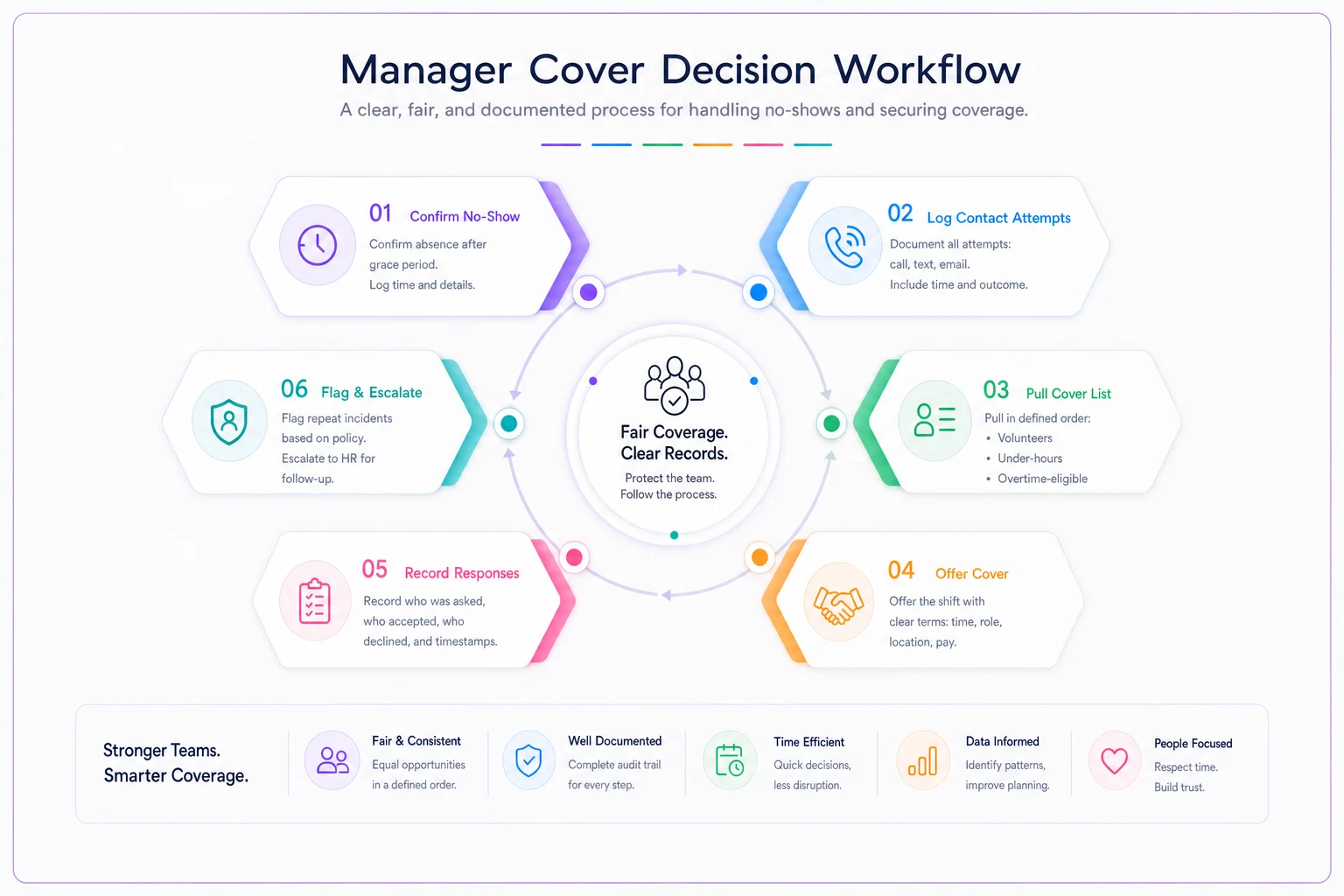
A clean cover flow looks like this:
-
Confirm it's a no‑show, not a lateness. Wait the defined grace window (often 15 minutes) and attempt contact before treating it as a no‑show. Log the contact attempt.
-
Check the cover list, in order. Not "who do I like." A defined order: volunteers first, then people under their weekly hours, then overtime‑eligible. This spreads the load and keeps it fair.
-
Offer cover with the real terms. Say the shift, the length, and any cover incentive up front. Vague asks get vague answers.
-
Record the outcome. Who was asked, who accepted, who declined, and when. This is the part everyone skips and later regrets.
-
Flag repeat no‑shows for HR follow‑up. One no‑show is an event. Three from the same person in a month is a pattern that needs a conversation, not another cover scramble.
The ordering in step 2 is where fairness and burnout intersect. If your cover list is really just "the two reliable people," you're quietly training your best staff to dread their phones. Spreading cover requests across a proper list protects the people you most want to keep. This connects directly to how you tier and protect your critical roles — worth reading alongside the staffing resilience blueprint for critical roles if cover for key positions is where you feel the most pain.
Here's a simple flow to follow on the floor.
This connects directly to how you tier and protect your critical roles — worth reading alongside the staffing resilience blueprint for critical roles if cover for key positions is where you feel the most pain.
Documentation that actually holds up
The pattern that causes real trouble later: a no‑show happens, the manager handles cover verbally, and nothing gets written down. Three months later that employee is being managed out, or is claiming they were never actually scheduled, and there's no record of contact attempts or the pattern of missed shifts.
Documentation for each no‑show doesn't need to be heavy. It needs to be consistent. For every incident, capture:
-
Date, shift, and scheduled start time
-
Whether contact was attempted, and the response (or lack of one)
-
How cover was arranged — who was asked, who took it
-
Any incentive paid or protection applied
-
Whether this is a first, second, or repeat incident for this person
That last field is what turns scattered incidents into a defensible pattern. Without it, every no‑show looks like a one‑off, and the person with a genuine problem never gets flagged for the right conversation.
The manager‑to‑HR handoff is where this usually breaks down. The floor manager knows about the no‑shows; HR only hears about them when things have already gone sideways. Getting that flow right — clear SLAs on when a repeat no‑show gets escalated, and what HR does with it — is its own discipline. The manager absence workflow playbook goes deeper on the escalation triggers and checklists that make this handoff actually work.
Use a one‑line incident form the manager fills out immediately after the no‑show to keep records consistent and avoid memory errors.
The floor manager knows about the no‑shows; HR only hears about them when things have already gone sideways. Getting that flow right — clear SLAs on when a repeat no‑show gets escalated, and what HR does with it — is its own discipline.
When incentive experiments make sense — and when they don't
When they make sense:
-
Your no‑shows are concentrated on specific shifts or a specific handful of people
-
You have at least two comparable locations or teams to test against each other
-
You can capture a baseline and hold the design steady for a month or more
-
The cost of a no‑show is high enough that a small bonus can plausibly pay for itself
When it's a bad idea:
-
Your no‑shows are almost all genuine emergencies — fix the call‑out process instead
-
The core problem is understaffing, not attendance; no bonus fixes a schedule that requires people to work impossible hours
-
You can't or won't measure it, in which case you're just adding a permanent cost with no feedback loop
Who should not run this at all: businesses where the real driver is turnover and disengagement in the first 30 days. If new hires are ghosting, the fix is onboarding and early check‑ins, not an attendance bonus. Layering an incentive on top of broken onboarding just wastes money on people who were leaving anyway.
Keeping the experiment honest as you scale
The trap after a successful pilot is scaling too fast. The Sunday‑opening bonus worked at one store, so leadership rolls a flat bonus across every shift at every location. Now you're back to paying everyone for behavior they'd do anyway, and the targeted effect that made the pilot work is gone.
Scale the design, not the blanket. If the pilot proved that a targeted, shift‑specific incentive plus a fair cover list reduces no‑shows on hard shifts, apply that same logic to the next hard shift — not to every shift indiscriminately. Re‑baseline each new rollout. It's more work up front, but it's the difference between a program that keeps paying for itself and one that quietly bloats.
As you run more of these, the manual side gets heavy — tracking baselines per shift, logging every cover attempt, tagging repeat incidents, reconciling which bonuses were actually earned. This is exactly where operational software that centralizes scheduling, absence logging, and cover records earns its keep. When the no‑show data, the contact attempts, and the incentive payouts all live in one place, you can actually see whether an experiment worked instead of arguing about it. The tooling is downstream of the thinking though — get the experiment design and cover flow right first, and the software just makes it easier to run at scale.
The short version
No‑shows don't get fixed by a company‑wide attendance bonus. They get fixed by splitting the problem into emergencies, predictable churn, and ghosting — then running small, controlled incentive experiments on the predictable middle, with a baseline written down and a control group to compare against. On the floor, a defined cover flow with fair ordering and consistent documentation turns each no‑show from a scramble into a recorded event you can actually learn from.
Do the cheap version first. Pick one bad shift, test one incentive against a location that changes nothing, watch it for six weeks, and let the numbers make the decision. That single disciplined pilot will teach you more about your no‑shows than a year of blanket bonuses ever will.
Ready to optimize your workforce absence management?
Join 2,000+ HR teams using Absencely to reduce administrative burden, improve compliance, and boost employee satisfaction.