

Most absence analytics projects fail their privacy review not because the dashboards are dangerous, but because nobody could answer one question: why do you still have this field?
That question kills more analytics rollouts than any legal objection. When a Data Protection Officer or employment counsel sees a table storing diagnosis codes next to employee names next to manager comments, the conversation stops being about insights and starts being about liability. And once legal loses trust in how you handle leave data, every future request gets slower.
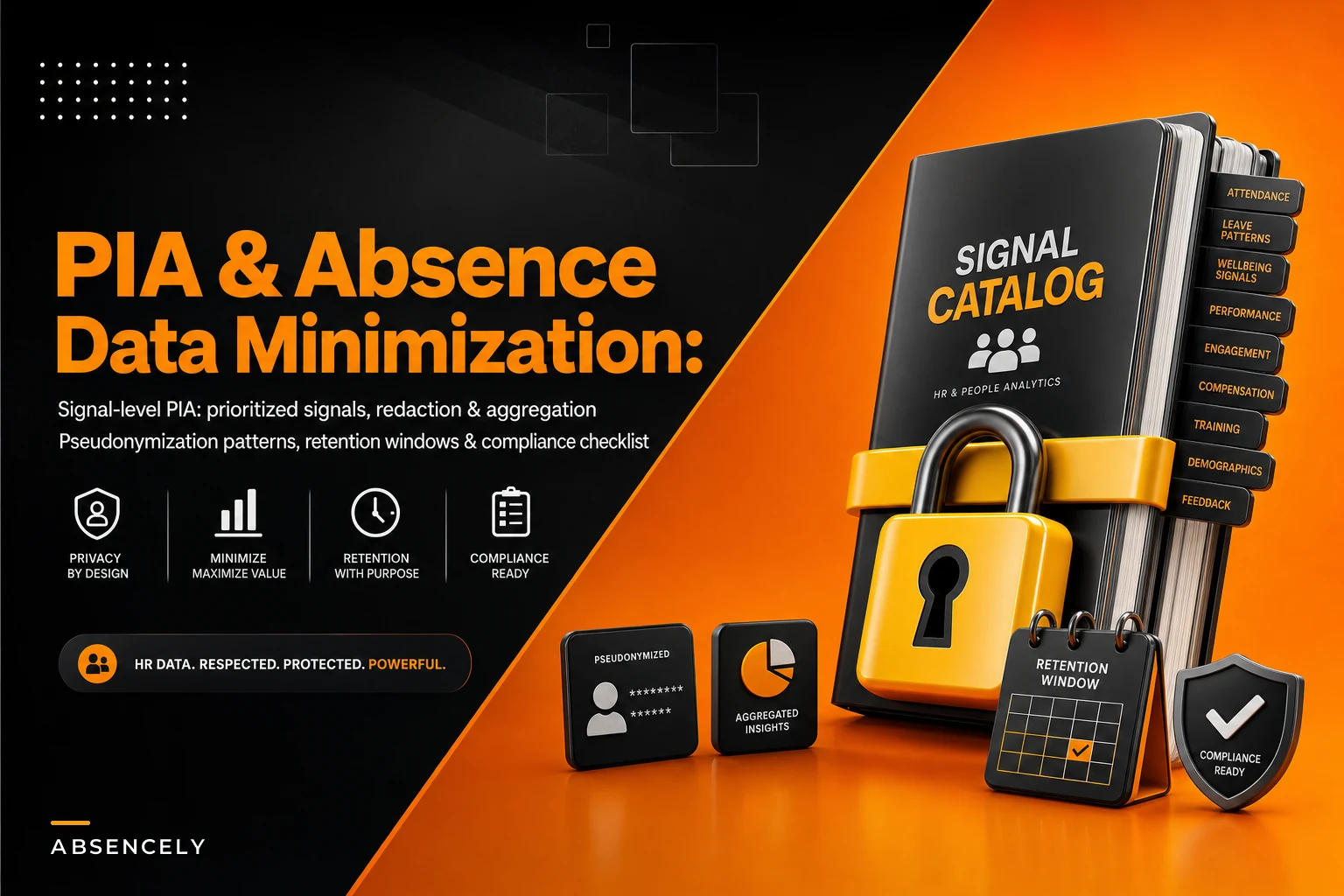
This piece is narrow on purpose. It's about building an absence analytics privacy impact assessment that actually passes review — specifically the part everyone skips: a prioritized signal catalog that tells you what to keep, what to aggregate, what to pseudonymize, and what to throw away before it ever touches a reporting layer.
No general privacy theory. Just the catalog, the checklist, pseudonymization patterns, and retention windows that compliance teams tend to accept without much of a fight.
Why absence data trips every privacy wire at once
Absence data is unusually hard because a single leave record quietly touches four sensitive categories at the same time:
-
Health data (reason for medical leave, STD claims, accommodation notes)
-
Special category data in GDPR terms (anything revealing health status, sometimes religion via observance leave)
-
Behavioral inference (patterns that look like performance issues or burnout)
-
Protected activity (FMLA, pregnancy, disability, jury duty)
Analytics makes this worse. The whole point is to combine fields, slice by team, and spot patterns — but combining fields is exactly what turns "harmless" data into re-identifiable, inference-heavy data.
A typical example: a team-level absence dashboard filtered to a 4-person department. The moment you let a manager filter to a team that small, "aggregated" numbers become individual data. One person out sick for three weeks is instantly identifiable even without a name attached. People assume aggregation equals anonymization, and it almost never does at small group sizes.
The fix starts before the dashboard — it starts with deciding, field by field, what each signal is for.
The prioritized signal catalog
This is the core artifact. Instead of a vague "we minimize data" statement, you walk into the privacy review with a table that classifies every absence signal by purpose, sensitivity, and handling rule.
Stop managing absences manually.
Absencely simplifies leave requests, approvals, and absence monitoring for your entire workforce.
- Automated leave tracking
- Manager approval workflows
- Compliance & reporting tools
No credit card required
Below is the structure that tends to survive scrutiny. Build your own version with your actual fields, but this is the shape of it.
| Signal | Analytics value | Sensitivity | Handling rule |
|---|---|---|---|
| Absence occurrence (date, duration) | High — core to every metric | Low on its own | Keep, pseudonymized ID |
| Absence type (sick / PTO / FMLA / bereavement) | High — needed for category analysis | Medium | Keep category, drop subtype where possible |
| Reason / diagnosis detail | Low for analytics | Very high | Redact — never enters analytics layer |
| Manager free-text notes | Very low | Very high (uncontrolled) | Redact / exclude entirely |
| Department / cost center | High | Low | Keep, but enforce min group size |
| Team (small) | Medium | High via re-identification | Aggregate up to a safe threshold |
| Accommodation status | Low for trend reporting | Very high | Redact from analytics; keep in case file only |
| STD/LTD claim status | Medium | High | Pseudonymize + restrict to HR benefits role |
| Tenure band, role band | High for normalization | Low | Keep as bands, not exact values |
| Return-to-work date | Medium | Medium | Keep, pseudonymized |
The useful discipline here is the middle column. If a field has low analytics value and high sensitivity — diagnosis detail, free-text notes, accommodation specifics — it shouldn't reach the analytics environment at all. Keep it in the operational case record with tight access controls and don't let the analytics pipeline ingest it.
Teams over-collect into analytics environments constantly, pulling in the diagnosis field because the ETL job grabbed the whole table. Nobody uses it in a single report, but it sits there creating risk for years. The signal catalog forces an explicit decision rather than letting defaults decide for you.
One more pattern worth flagging: subtype collapse. You rarely need "migraine" vs "flu" vs "surgery recovery." You need "sick leave." Collapsing subtypes into categories removes most of the health-inference risk while keeping nearly all the analytical value. That single move resolves a surprising share of privacy objections.
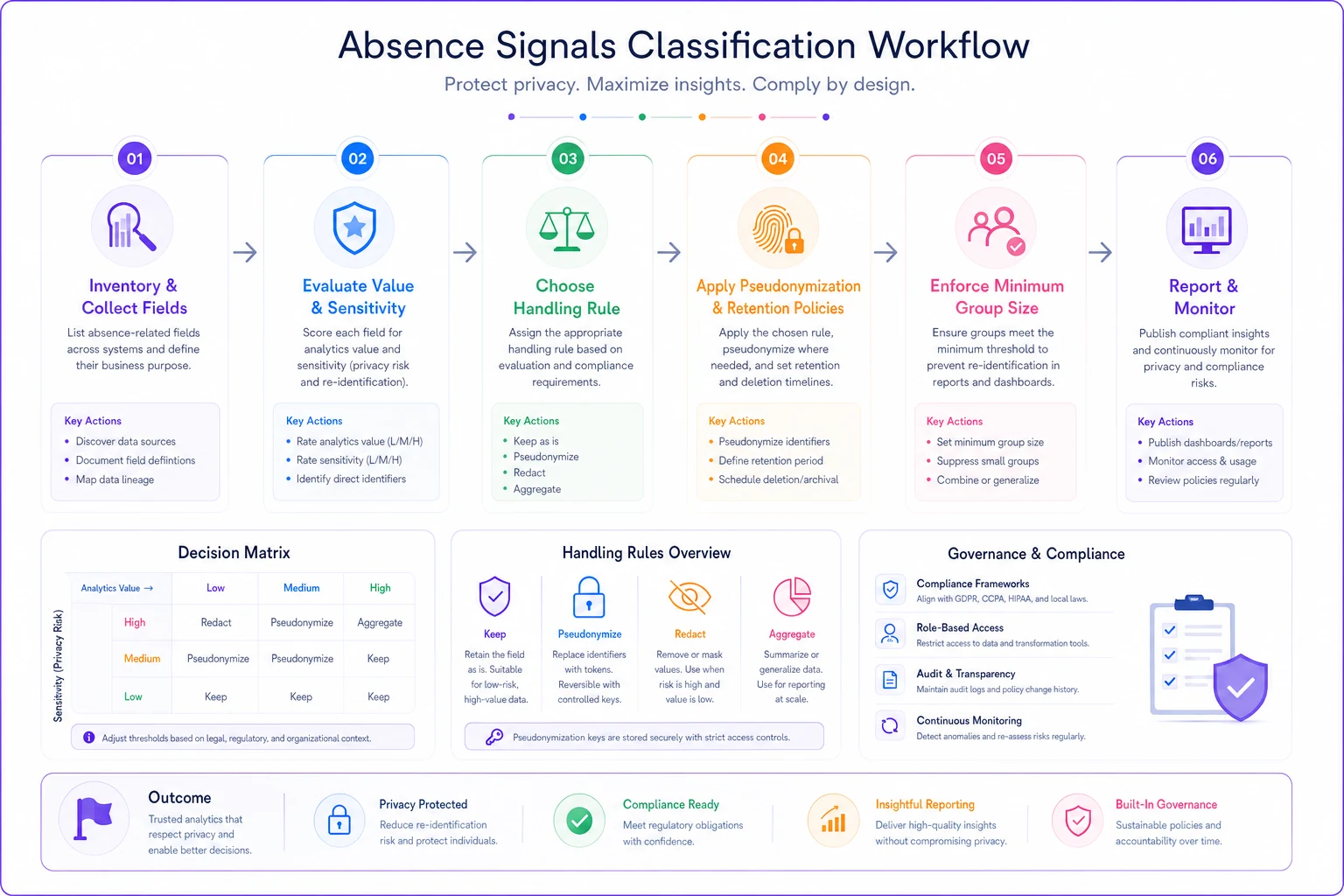
Here's a simple workflow for classifying signals before they hit the analytics layer.
Pseudonymization patterns that hold up
Pseudonymization is where good intentions fall apart, because people do it in ways that are trivially reversible.
1. Salted hash with a separately stored key. Replace the employee ID with a hash, but keep the salt and the mapping table in a separate system with separate access controls. The analytics team can join records across time using the token, but can't re-identify without crossing a controlled boundary. The common mistake is storing the mapping table in the same database — that's not pseudonymization, it's a speed bump.
2. Rotating tokens for cross-period analysis. If you don't need to track the same individual across years, rotate the pseudonym each reporting period. This breaks long-term behavioral profiling while still letting you measure within-period patterns. Use this when the analytics question is "how is this quarter trending," not "which individuals are chronically absent."
3. Generalization before pseudonymization. Convert exact values to bands before tokenizing. Exact tenure (4.2 years) becomes a band (2–5 years). Exact age disappears — use age bands only if truly necessary. The reason this matters: a pseudonymized record with enough precise attributes is still re-identifiable by combination. Generalization is what actually protects people; the token just hides the obvious identifier.
A realistic failure case: a mid-size employer pseudonymized names but kept exact hire date, exact birth date, exact job title, and a two-person team label. Any single row could be matched back to a real person in under a minute. The hash felt like protection. It wasn't.
For cross-border teams, the handling rules get more complicated because the same field may be acceptable in one jurisdiction and restricted in another. If that's your situation, the role-by-role access and retention logic in this guide to defensible leave-data governance for cross-border teams pairs directly with this catalog — the catalog decides what exists, that framework decides who sees it where.
Minimum group size: the single most effective control
If you implement only one thing from this article, make it this.
Set a minimum group size (k) below which no absence metric is displayed. Common thresholds are k=5 or k=10 depending on your risk tolerance. If a filter produces a group smaller than k, the dashboard shows "insufficient data to display" rather than the number.
This quietly solves the small-team re-identification problem that breaks most absence dashboards. It also handles the situation where a manager drills into their own 3-person team and effectively sees individual health patterns — without requiring a case-by-case argument every time.
Two refinements that stop people from gaming it:
-
Suppress complementary cells. If a department of 12 shows totals and one team of 4 is suppressed, make sure the remaining teams don't let someone back-calculate the suppressed figure through subtraction.
-
Apply k-anonymity across filter combinations, not just the top-level view. The risk usually appears when someone stacks filters (team + leave type + month) until the group gets tiny.
Choose k after testing common filter combinations in a staging environment so you can see practical visibility impacts.
The risk usually appears when someone stacks filters (team + leave type + month) until the group gets tiny.
The PIA checklist
Walk through this before the analytics environment goes live. Hand it to your reviewer so they can see the work rather than take your word for it.
-
[ ] Every ingested field mapped in the signal catalog with a purpose statement
-
[ ] All "high sensitivity / low analytics value" fields excluded from the analytics layer
-
[ ] Absence subtypes collapsed into categories wherever detail isn't required
-
[ ] Free-text manager notes excluded from analytics ingestion entirely
-
[ ] Pseudonymization method documented, with key/mapping stored in a separate controlled system
-
[ ] Generalization (banding) applied before tokenization for tenure, age, role
-
[ ] Minimum group size (k) enforced on all views and filter combinations
-
[ ] Complementary suppression tested against subtraction attacks
-
[ ] Retention window defined per signal, with automated deletion
-
[ ] Access roles mapped to signals (who can see claim status vs occurrence vs category)
-
[ ] Re-identification risk test performed on a sample export
-
[ ] Legal basis documented per jurisdiction for each category of processing
-
[ ] Data subject request process covers analytics copies, not just source records
-
[ ] Audit log in place for who queried what, when
The re-identification risk test is the one people skip and shouldn't. Pull a sample export, hand it to someone who knows the organization but not the underlying data, and ask them to identify anyone. If they can, the controls aren't done.
Retention windows compliance tends to accept
Retention is where you win or lose the proportionality argument. "We keep everything forever" is indefensible. Tiered retention tied to purpose is defensible.
-
Operational case records (the detailed leave file with reason, notes, accommodation) — retained per the statutory requirement for that leave type, then deleted or archived with restricted access. These are not analytics data.
-
Pseudonymized analytics records (occurrence, duration, category, bands) — retained for the trend window you can actually justify. Two to three years covers almost every seasonal and year-over-year comparison HR genuinely runs.
-
Aggregated reporting outputs (already above the k threshold, no individual rows) — retained longer, because low re-identification risk is what makes long retention defensible.
The logic reviewers tend to like: sensitivity and retention move in opposite directions. The most sensitive data has the shortest analytics life; the least sensitive, most aggregated data can live longest. When you present retention that way, it reads as deliberate rather than convenient.
Automate the deletion. A retention policy that depends on someone remembering to run a quarterly purge is a policy that quietly fails. If deletion isn't automated and logged, assume the data is still there — because it usually is.
When heavy minimization is the wrong call
Minimization is the right default, but blind minimization can hurt you.
When to keep more detail: running predictive absence or burnout models is one situation where aggressive generalization can degrade model quality to the point of uselessness — or worse, introduce bias because you've stripped variables that would have surfaced disparate impact. The right move in that case isn't "collect less," it's tighter access, stronger pseudonymization, and the validation and bias controls covered in governance for predictive absence models and alerts. Minimization and model governance have to be designed together, not traded off blindly.
When over-redaction becomes a problem: suppressing so much data that you can no longer detect systemic issues — like a particular manager's team showing patterns consistent with harassment-driven absence, or a gap in disability accommodations — defeats the purpose. Over-redaction can mask exactly the problems analytics is supposed to catch.
Who should not do this alone: HR teams without employment counsel input on legal basis per jurisdiction. The catalog is operational, but the lawfulness column isn't something to guess at, especially across borders.
A real scenario
A regional healthcare provider with around 1,400 employees wanted team-level absence dashboards for department leads. The first build pulled the full leave table into the warehouse — including reason codes, STD claim detail, and a free-text "manager comments" field.
The privacy review stalled immediately. Counsel's objection wasn't the dashboards themselves; it was that diagnosis-level data was sitting in a reporting database accessible to the analytics team, with no documented purpose and no retention limit.
The rebuild used a signal catalog. Reason codes collapsed to five categories. Claim detail stayed in the benefits system and never entered analytics. Manager notes were dropped from ingestion entirely. Team views enforced a minimum group size of 8, which meant a few small specialty units rolled up into their parent department. The pseudonymization mapping table moved into a separate access-controlled store.
The dashboard lost almost none of its practical value — leads still saw absence rates, durations, seasonal patterns, and category breakdowns — but the volume of sensitive fields in the analytics environment dropped sharply, and roughly two-thirds of the originally ingested columns were either banded, collapsed, or excluded. The review passed on the second attempt.
The quiet lesson: the catalog didn't just get them through one review. It made every subsequent review faster, because they could point to an existing, trusted classification instead of relitigating each field from scratch. That reusability is the part people underestimate going in.
Where this leaves you
A privacy impact assessment for absence analytics isn't a document you write once to satisfy legal. The useful version is the signal catalog — the living table that forces a purpose decision for every field and gives your reviewers something concrete to trust.
Start there. Classify your signals, collapse what you can, exclude what has high sensitivity and low analytic value, enforce a minimum group size, and tie retention to purpose. Do that, and the privacy review stops being the thing that blocks your analytics and starts being the thing that proves you built it carefully.
Start there. Classify your signals, collapse what you can, exclude what has high sensitivity and low analytic value, enforce a minimum group size, and tie retention to purpose. Do that, and the privacy review stops being the thing that blocks your analytics and starts being the thing that proves you built it carefully.
Ready to optimize your workforce absence management?
Join 2,000+ HR teams using Absencely to reduce administrative burden, improve compliance, and boost employee satisfaction.