

Most occupational health problems don't come from bad providers. They come from vague referrals, undefined deliverables, and nobody agreeing upfront on how fast the provider is supposed to respond. HR sends over "please assess John," the provider sends back a report six weeks later that answers a question nobody asked, and the whole thing has to start over.
This piece is narrowly about fixing the paperwork and the handshake between HR and your occupational health provider — the occupational health referral workflow. Not RTW conversations with the employee (that's a separate skill), not disability adjudication. Just the mechanics: what goes on the referral form, what you should demand back, what a clearance template needs to contain, and what SLA you should hold the provider to.
Where the referral workflow actually breaks
The failure almost never happens at the provider's clinical stage. It happens at the two handoffs on either side of it.
A typical example: a facilities company refers a warehouse worker after a shoulder injury. The referral says "assess fitness for duty." The provider does a competent assessment and returns a note saying the employee "should avoid heavy lifting." Fine — except the manager needs to know how heavy, for how long, and whether he can still operate the pallet jack. So HR calls the provider, waits for a callback, gets a clarification a week later, and the employee sits at home on full pay the whole time because nobody wanted to bring him back on a guess.
That week of ambiguity cost more than the entire assessment. And it was completely avoidable — the question just wasn't framed properly on the way in.
The pattern repeats across industries. Referral too vague, deliverable too vague, nobody set an SLA so the chasing has no teeth. Three separate small failures stacking into one expensive delay.
The referral form: stop asking "is he fit?"
The single biggest upgrade you can make is changing what you ask. "Is this person fit for work?" is a yes/no question that produces a paragraph of hedged medical language. What managers and HR actually need are task-specific answers.
Stop managing absences manually.
Absencely simplifies leave requests, approvals, and absence monitoring for your entire workforce.
- Automated leave tracking
- Manager approval workflows
- Compliance & reporting tools
No credit card required
A referral form that works asks the provider to respond against the actual job, not against some abstract idea of fitness. That means carrying the job's physical and cognitive demands into the referral itself.
-
Employee and role — job title plus the actual current duties, not the job description from 2019
-
Specific tasks in question — "operates forklift," "sits at workstation 6+ hrs," "handles customer complaints," "drives company vehicle"
-
The precise question — "Can she return to full duties? If not, which specific tasks should be restricted and for how long?"
-
Reason for referral — post-injury, post-absence, recurring pattern, self-referral, manager concern
-
Relevant history you're allowed to share — prior related absences, known accommodations already in place
-
Urgency tier — routine, priority, or urgent (this ties to your SLA later)
-
Who receives the report — named HR contact plus format expected
The part most teams miss: the provider can only answer as specifically as you ask. Send a vague referral and you've effectively pre-approved a vague deliverable. Precision on the way in is what makes speed on the way out possible.
What you should expect back — the deliverable spec
Providers vary wildly in what they consider a "complete" report. Left undefined, you get whatever their default template produces — which is usually built to protect them, not to help you make a staffing decision.
-
A clear fitness determination in plain terms
fit for full duties / fit with restrictions / temporarily unfit
-
Specific restrictions written as tasks, weights, durations — "no lifting above 5kg for 4 weeks," not "avoid heavy work"
-
A review date or the trigger for reassessment
-
Whether any workplace adjustments are recommended, and which
-
An estimated timeframe for full clearance where possible
-
Confirmation the assessment addressed the specific tasks you referred
Here's a comparison of what a weak versus usable deliverable looks like in practice:
| Element | Weak deliverable | Usable deliverable |
|---|---|---|
| Fitness statement | "Fit with some limitations" | "Fit for restricted duties from 14th" |
| Restrictions | "Avoid strenuous activity" | "No lifting >5kg; no ladder work; 4 weeks" |
| Duration | Not stated | "Reassess at 4 weeks (review 11th)" |
| Adjustments | "Consider lighter duties" | "Reassign to packing station; no forklift" |
| Task-specific | Generic | Directly answers referred tasks |
The right-hand column lets a manager build a shift roster the same day. The left-hand column starts a phone-tag cycle. Same clinician, same appointment — the difference is entirely in what you told them the report had to contain.
RTW clearance templates that managers can actually action
There's a difference between a medical report and a clearance document. The report is the clinical output. The clearance is the internal document that translates that into "here's exactly what this person can and can't do starting Monday" — the thing a shift supervisor actually reads.
If you're building phased returns off these clearances, the mechanics of staging duties belong in a separate process — we've covered that in detail in the return-to-work interview scripts and phased reintegration plans guide. The clearance template is the bridge between the provider's report and that reintegration plan.
A clean RTW clearance template contains:
-
Employee, role, return date — and whether return is full or restricted
-
Approved duties — spelled out, not implied
-
Restricted duties — with expiry dates on each restriction
-
Required adjustments — equipment, station, hours, supervision
-
Review checkpoints — dates when restrictions get reassessed
-
Sign-offs — HR, manager, and confirmation the employee has seen it
The mistake people make: they file the provider's report and treat it as the clearance. But a clinical report isn't written for a supervisor. Without the translation layer, restrictions either get ignored (liability) or over-applied — the employee sits idle when they could do 80% of the job. The clearance template forces that translation to happen once, in writing, before anything reaches the floor.
Setting SLA expectations the provider will actually meet
An SLA that isn't tiered gets ignored. If everything is "within 5 working days," the provider prioritizes their own queue, and your urgent forklift-operator case waits behind someone's routine annual health check.
Tie response times to the urgency tier you put on the referral form:
Two things make these SLAs real rather than decorative. First, put the report turnaround in writing separately from the appointment turnaround — providers often hit the appointment target and then sit on the write-up for two weeks. Second, define what happens on a miss: escalation contact, and ideally a fee mechanism. A soft SLA with no consequence is just a hope.
| Tier | Trigger | Appointment offered | Report returned |
|---|---|---|---|
| Urgent | Employee blocked from returning, or safety risk | ≤ 2 working days | ≤ 2 working days post-assessment |
| Priority | Return dependent on clearance, no immediate risk | ≤ 5 working days | ≤ 3 working days |
| Routine | Surveillance, pre-placement, non-blocking | ≤ 10 working days | ≤ 5 working days |
Put the report turnaround in writing separately from the appointment, and define escalation or fee consequences for missed SLAs.
Worth flagging — SLA breaches on occupational health referrals often correlate with delays on short-term disability cases, because they frequently involve the same employees and the same payroll-bridge decisions. If you're managing both, the short-term disability operational playbook covers how those timelines interact and where the payroll gaps tend to open up.
Tying it back into the HR workflow
The forms and SLAs only matter if they slot cleanly into your existing case handling. The workflow that tends to hold up looks like this:
-
Trigger — manager or HR flags a case (post-absence, injury, pattern, self-referral)
-
Referral raised using the standard form, with tier assigned and tasks specified
-
Provider acknowledges within the tier window and books the appointment
-
Assessment happens, report returned against the deliverable spec
-
HR translates the report into the RTW clearance template
-
Manager briefed, restrictions loaded into the roster, review dates diarized
-
Checkpoint on the review date — extend, reduce, or close restrictions
Here's a visual of the referral-to-clearance workflow.
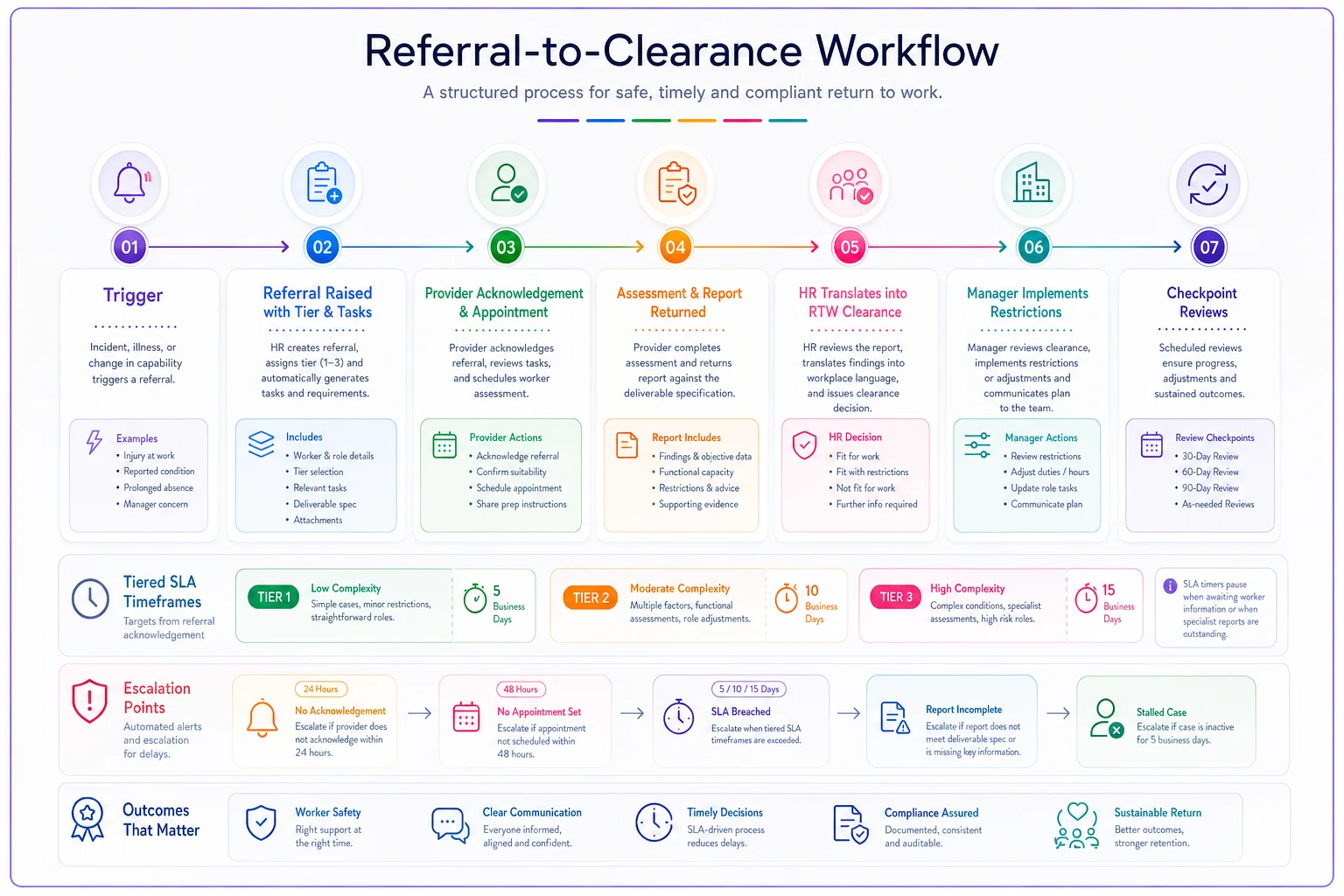
The step teams skip most is number 7. Restrictions get set and then never revisited, so an employee stays on "no lifting over 5kg" for eight months because nobody diarized the four-week review. That's lost capacity and, occasionally, a fairness complaint. Every restriction needs an owner and an expiry date.
This is one area where operational software earns its place quietly — not by making clinical decisions, but by holding the SLA clocks, flagging a referral that's past its tier deadline, and surfacing review dates before they lapse. The value isn't intelligence; it's that nothing falls through a handoff. When a priority referral hits day 6 with no acknowledgement, someone gets notified automatically instead of the team discovering it three weeks later.
When to formalize this — and when not to bother
When this makes sense: you're running more than a handful of occupational health referrals a month, you use an external provider, or you have roles with physical demands and meaningful injury exposure. The moment more than one person touches a case, undefined handoffs start costing you.
When it's overkill: a very small team with one referral a quarter and a provider you talk to directly probably doesn't need tiered SLAs. A shared form and a clear question gets you most of the value.
Who should not skip this: anyone in manufacturing, logistics, care, construction, or field services. In these environments a vague clearance isn't just slow — it's a safety and liability exposure. The cost of a delayed or ambiguous clearance dwarfs the effort of building the template.
A short real scenario
A mid-sized logistics operation — around 180 staff, mostly warehouse and drivers — was averaging roughly three weeks from referral to actionable clearance. Most of that wasn't clinical time; it was back-and-forth chasing on vague reports and restrictions the manager couldn't actually use.
They didn't change providers. They rebuilt the referral form to carry the specific tasks, defined exactly what the report had to contain, and tiered the SLA so blocked-return cases jumped the queue. They added a one-page clearance template that HR filled in from the provider's report before anything reached the supervisor.
Referral-to-clearance dropped to around 8–9 days on the priority tier. The less visible win: employees stopped sitting at home on full pay while a restriction got clarified, and supervisors stopped guessing. Over a few months that translated to somewhere in the range of several thousand in recovered productive time — most of it from cases that had previously stalled on ambiguity alone.
The takeaway
The occupational health referral workflow rarely fails because of medicine. It fails because the question was vague, the deliverable was undefined, and no one agreed how fast the answer was due.
Fix those three things — a task-specific referral form, a written deliverable spec, and a tiered SLA with real consequences — and the clinical part of the process was never the bottleneck to begin with.
The occupational health referral workflow rarely fails because of medicine. It fails because the question was vague, the deliverable was undefined, and no one agreed how fast the answer was due. Fix those three things — a task-specific referral form, a written deliverable spec, and a tiered SLA with real consequences — and the clinical part of the process was never the bottleneck to begin with.
Ready to optimize your workforce absence management?
Join 2,000+ HR teams using Absencely to reduce administrative burden, improve compliance, and boost employee satisfaction.