


Most absence programs fail quietly at the manager layer. The policies are fine. The SLAs exist on paper. Finance gets its reports. But when you dig into why coverage gaps keep happening, or why payroll is constantly fixing retroactive entries, the trail almost always leads back to a handful of managers who log things late, approve things they shouldn't, or sit on an escalation until it becomes a fire.
The frustrating part is that nobody can name those managers with any confidence. HR "feels" like certain teams are problematic, but when asked to prove it, there's no scorecard. No threshold. No number anyone would defend in a performance review.
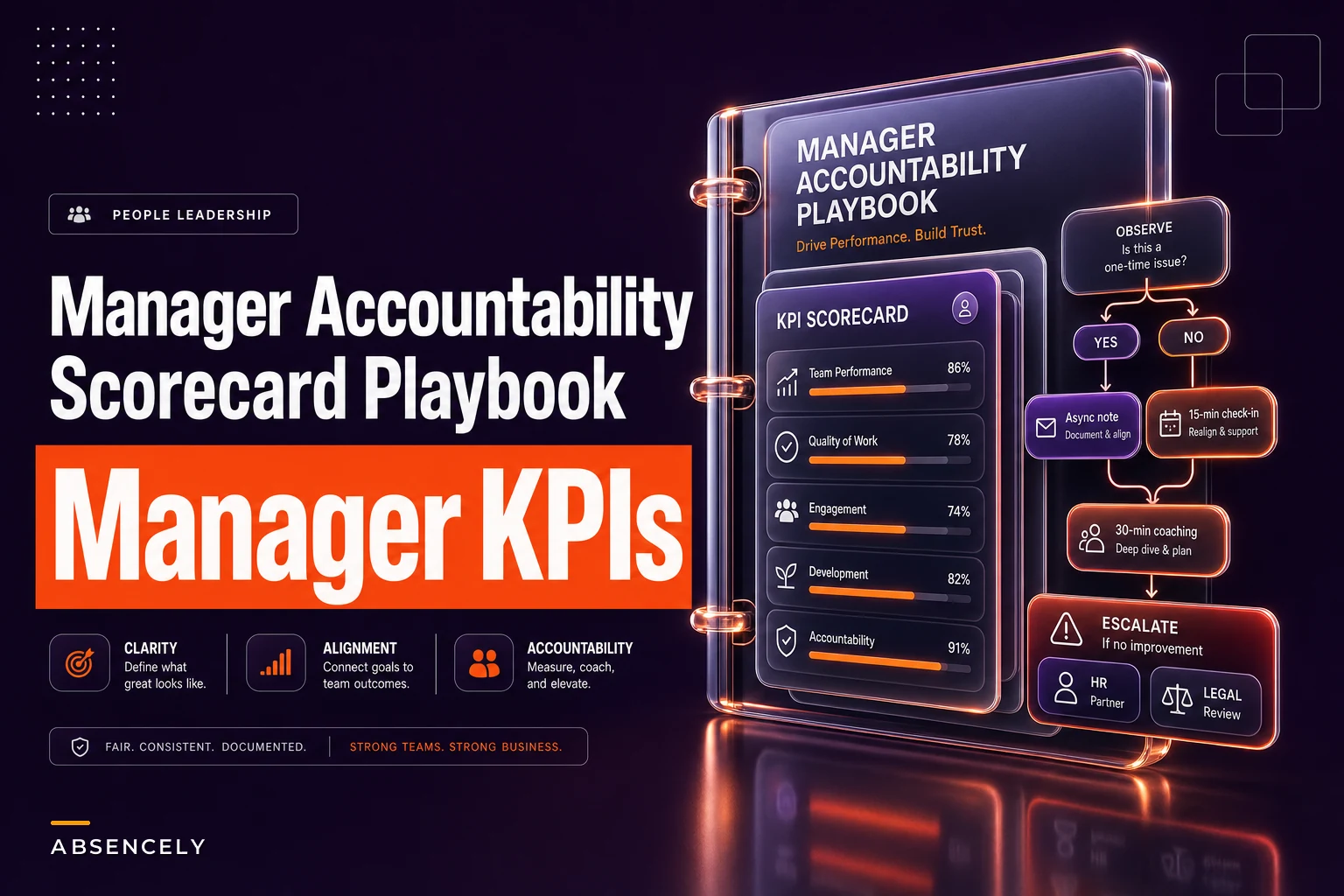
That's the gap this article is about. Not absence policy — manager accountability for absence execution. Specifically: how to build a manager absence scorecard with KPIs that's measurable, defensible, and tied to a coaching cadence that actually changes behavior instead of generating another ignored dashboard.
Why "the manager handled it badly" is almost never provable
Walk into most mid-sized companies and ask who's accountable when a sick call turns into an uncovered shift. You'll get a shrug or a vague "that's on the manager." But accountability without measurement is just blame waiting for a bad week.
The pattern tends to repeat: the absence process is documented reasonably well — there might even be a solid manager absence workflow playbook with SLAs and escalation triggers sitting in a shared drive somewhere. But nobody measures adherence to it per manager. So two things happen:
-
Good managers who document quickly and escalate early get no credit.
-
Weak managers who log a FMLA intermittent day four days late and never flag the pattern get no consequence.
The result is a flat accountability landscape. Everyone's treated the same because nobody's measured differently. And when you finally do need to coach or document a struggling manager, you have nothing but anecdote. A manager can honestly say "I didn't know I was behind" — and they'd be right, because you never showed them a number.
The fix isn't a lecture. It's a small, specific set of metrics that make manager behavior visible, plus a coaching rhythm that uses those metrics instead of gut feel.
The four metrics that actually matter
You can measure a dozen things about how managers handle absence. Most of it is noise. In practice, four categories separate the managers keeping operations stable from the ones quietly creating risk.
Stop managing absences manually.
Absencely simplifies leave requests, approvals, and absence monitoring for your entire workforce.
- Automated leave tracking
- Manager approval workflows
- Compliance & reporting tools
No credit card required
| KPI | What it measures | Suggested threshold (green) | Watch zone | Problem zone |
|---|---|---|---|---|
| Timely documentation rate | % of absence events logged within the SLA window (e.g. 24h) | ≥ 95% | 85–94% | < 85% |
| SLA adherence on escalations | % of qualifying events escalated within required time | ≥ 90% | 80–89% | < 80% |
| Coverage resolution time | Median hours from absence notice to confirmed coverage | ≤ 4h (frontline) | 4–8h | > 8h |
| Exception/rework rate | % of this manager's entries later corrected by HR/payroll | ≤ 5% | 6–10% | > 10% |
A few things worth noting about how these behave in real operations:
Timely documentation rate is the single most predictive metric. Managers who log late aren't just sloppy — late logging is where intermittent leave patterns get missed, where payroll gets the wrong hours, and where legal exposure quietly builds. If you only track one thing, track this.
Coverage resolution time needs context by role. A corporate analyst out sick might not need coverage at all, so you'd exclude non-coverage roles from this metric entirely. For a retail floor or a care facility, though, this number keeps the operation running.
Exception/rework rate is sneaky-valuable because it catches a different failure mode: the manager who is fast but consistently wrong. Fast-and-wrong looks great on documentation timeliness and terrible once payroll starts cleaning up after them every month.
One mistake worth avoiding: don't weight all four equally for every role. A warehouse shift lead lives and dies by coverage resolution. An office team lead's scorecard should lean harder on documentation accuracy. Flat weighting makes the scorecard feel unfair, and the moment a manager thinks a metric is unfair, the whole thing loses credibility.
Setting thresholds you can actually defend
The numbers in that table are starting points, not gospel. The real work is calibrating them to your baseline before attaching any consequence.
-
Measure silently for 30–60 days first. Pull the data without telling managers it's scored yet. You're looking for the current distribution, not catching anyone out.
-
Find the honest middle. If your median documentation rate is sitting at 78%, setting "green" at 95% on day one just labels everyone a failure. Set the first bar around the 60th–70th percentile of current performance.
-
Separate "can't" from "won't." A manager running a 40-person team with constant turnover will miss SLAs for structural reasons. A manager with a stable 8-person team missing the same SLA has a behavior problem. The threshold should account for span and volatility.
-
Publish the thresholds before you score. No surprises. Managers should know exactly what green, watch, and problem look like before the first scored month.
-
Review thresholds quarterly. As the baseline improves, the bar should rise. A scorecard frozen at year-one thresholds becomes meaningless by year two.
The biggest calibration error is setting thresholds based on what should happen in a perfect world. Scorecards launched at 99% documentation targets get abandoned within a couple months because every single manager lands in the red and nobody believes the numbers mean anything.
The monthly coaching cadence (this is where most programs die)
A scorecard with no cadence attached is just a report. The behavior change comes from a predictable, low-drama rhythm of conversations. The key word is predictable — managers should know the conversation is coming, so it never feels like an ambush.
-
First week of the month Scores publish. Each manager sees their own card plus the team median (not individual peer scores — that creates the wrong dynamic).
-
Green managers A single async note. "You're green across the board, nice work." That's it. Don't burn a meeting on someone who's performing.
-
Watch-zone managers A 15-minute check-in with their HR business partner or ops lead. Not disciplinary — diagnostic. "Your coverage resolution slipped to 7 hours this month, what changed?"
-
Problem-zone managers A structured 30-minute coaching session using a scripted micro-coaching unit (more on that below), plus a documented action with a specific metric target for next month.
The reason this works where annual reviews don't: absence behavior drifts slowly. A manager doesn't suddenly become bad at escalation — they get busier, cut one corner, then another. Monthly cadence catches the drift at the watch stage, before it becomes a problem-zone pattern that's hard to reverse.
If you're rolling this cadence out alongside new tooling, the sequencing matters. Pushing scorecards and new systems at managers simultaneously usually backfires. The change-management blueprint for absence automation rollouts covers that adoption timing in detail and is worth reading before you launch.
Here's a simple visual of that monthly coaching cadence.
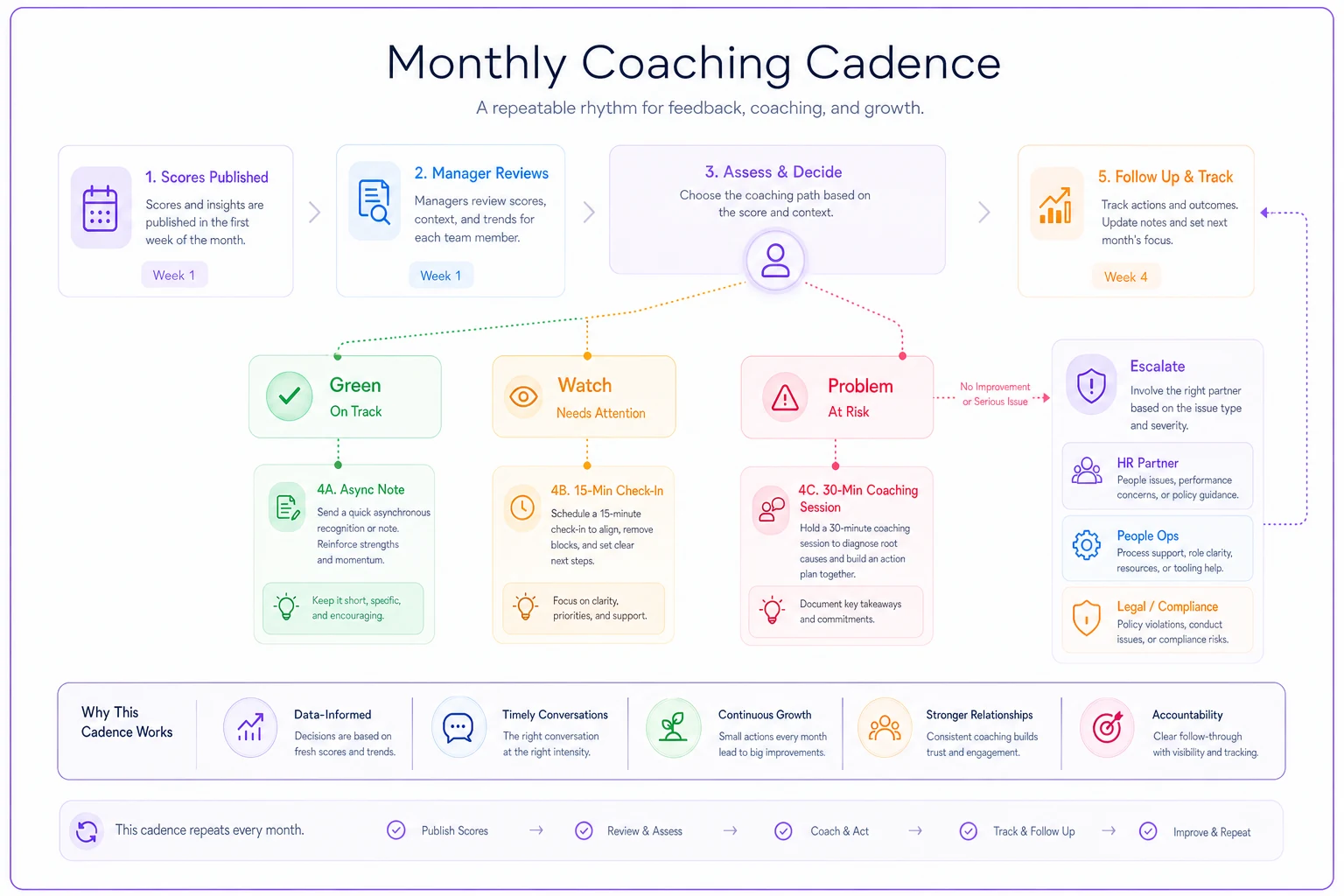
If you follow that rhythm, the conversations stop being surprises and start being predictable nudges toward improvement.
Scriptable micro-coaching units
The point of scripting coaching is consistency, not robotic conversation. When every HR partner improvises these sessions, you get wildly different quality — some managers get coached into defensiveness while others get let off easy. A short script gives everyone the same starting frame.
Each micro-coaching unit targets one metric and takes under ten minutes. Here's the structure for the most common one — late documentation:
-
Open with the number, not the judgment. "Your documentation-within-24h rate was 71% last month, down from 88%." State it flat.
-
Ask before you tell. "What's getting in the way of logging these same-day?" Nine times out of ten you'll learn something real — a broken workflow step, a mobile access issue, competing priorities.
-
Name the downstream cost once. "When it's late, payroll has to chase it, and we've missed two intermittent-leave patterns because the entries were scattered." Make it concrete, then stop. Don't pile on.
-
Agree on one change. Not five. One. "Log at end of shift instead of end of week."
-
Set the next checkpoint. "Let's see if that moves you back above 85% next month."
Build one of these for each KPI. Keep them short enough that an HR partner can run one without prep. The script isn't there to sound natural — it's there to make sure the uncomfortable parts (stating the number, naming the cost) actually happen instead of getting quietly skipped.
The escalation decision matrix
Separate from manager performance is the question of when HR steps in over the manager's head. This is where a lot of programs are inconsistent — one HR partner escalates aggressively, another lets things slide, and managers learn to game whoever's softer.
| Situation | Manager handles | HR partner steps in | Escalate to ops/legal |
|---|---|---|---|
| Single late entry, otherwise green | ✓ | ||
| Two consecutive watch-zone months | ✓ | ||
| Problem-zone on documentation + exception rate together | ✓ | ||
| Pattern of missed FMLA/intermittent logging | ✓ | ||
| Coverage gap caused a safety or compliance incident | ✓ | ||
| Manager disputes scorecard accuracy | ✓ |
The matrix does two things. It tells HR partners exactly when to intervene so you get consistent handling across teams. And it protects managers from arbitrary escalation — if the situation isn't in the "step in" column, it stays with the manager. That predictability is what makes the whole accountability system feel fair rather than punitive.
A real scenario: regional home-care agency
A home-care agency running about 140 field caregivers across four regional offices had a chronic coverage problem — roughly 12–15% of same-day call-outs were leaving a client visit uncovered. For home care, that's not just inconvenient; it's a care-quality and billing issue.
Leadership assumed it was a staffing-depth problem and kept pushing to hire more float staff. But when they started measuring per-office-manager, the picture shifted. Two of the four offices had coverage resolution times under three hours. One office was sitting around nine hours — and its manager had a documentation rate in the low 70s, meaning call-outs weren't even getting logged fast enough to trigger the coverage search.
It wasn't a headcount problem. It was one manager's workflow.
They put the scorecard in place, ran a silent baseline month, then started the monthly cadence. The lagging manager got the late-documentation micro-coaching unit and one specific change: log call-outs the moment they come in, not at end of day. Within about two months, that office's coverage resolution dropped from roughly nine hours to under five, and uncovered visits across the agency fell to around 6–7%. No new hires. The "staffing problem" was mostly a measurement-and-coaching problem.
When this makes sense — and when it doesn't
This makes sense when:
-
You have enough managers (roughly 8+) that gut-feel comparison stops working.
-
Absence handling has real downstream cost — coverage gaps, payroll rework, compliance exposure.
-
You already have a documented absence workflow; a scorecard without a defined process measures against nothing.
This is a bad idea when:
-
Your absence process itself is undefined or constantly changing. Fix the process first; scoring managers against a moving target just generates resentment.
-
You plan to use it punitively from day one. Scorecards launched as "gotcha" tools get quietly sabotaged — managers stop logging accurately to protect their numbers, which corrupts the very data you need.
-
You can't pull the underlying data cleanly. If documentation timestamps and exception corrections aren't captured reliably, the scores will be garbage and everyone will know it.
Who should NOT roll this out yet: teams where absence data lives in three disconnected systems and timestamps are entered manually. Get the data layer trustworthy first. A scorecard built on data people don't believe is worse than no scorecard, because it burns the credibility you'll need later.
Where the tooling actually helps
The metrics above are only as good as the data feeding them, and that's the honest limitation of manual approaches. Pulling per-manager documentation timeliness from spreadsheets every month is brutal, and by the time you've compiled it, the coaching window has half-closed.
Automate timestamps first so your monthly scorecard isn't an archaeology project.
This is the practical case for operational software with built-in automation: the system timestamps every absence event, flags SLA breaches as they happen, and rolls up per-manager scores without someone manually reconciling logs. The scorecard stops being a monthly archaeology project and becomes something that's just there on the first of the month. Automated nudges can also catch watch-zone drift early — a quiet reminder to a manager whose documentation rate slipped mid-month often prevents the problem-zone conversation entirely.
The tooling doesn't replace the coaching. A dashboard has never coached anyone into better behavior. But it removes the data grind that usually kills these programs before they get to the part that matters — the actual conversation about why a number moved and what one thing changes next month.
Getting started without boiling the ocean
Don't build all four KPIs, every threshold, every coaching script, and the full escalation matrix before launch. That's how these projects stall for six months.
-
Pick the one metric that maps to your biggest pain (usually documentation timeliness or coverage resolution).
-
Measure it silently for a month.
-
Share individual scores with no consequence attached — just visibility.
-
Add the monthly check-in cadence for watch and problem zones.
-
Expand to the second metric only once the first feels routine.
The managers who were quietly struggling will show up in the data immediately, and most of them improve just from seeing the number — before you've written a single coaching script. The measurement itself does a surprising amount of the work. The scorecard, cadence, and scripts just make sure the improvement sticks and that the handful of managers who don't respond are handled consistently and defensibly, rather than on whoever happens to be in the room that day.
The managers who were quietly struggling will show up in the data immediately, and most of them improve just from seeing the number — before you've written a single coaching script. The measurement itself does a surprising amount of the work. The scorecard, cadence, and scripts just make sure the improvement sticks and that the handful of managers who don't respond are handled consistently and defensibly, rather than on whoever happens to be in the room that day.
Ready to optimize your workforce absence management?
Join 2,000+ HR teams using Absencely to reduce administrative burden, improve compliance, and boost employee satisfaction.