
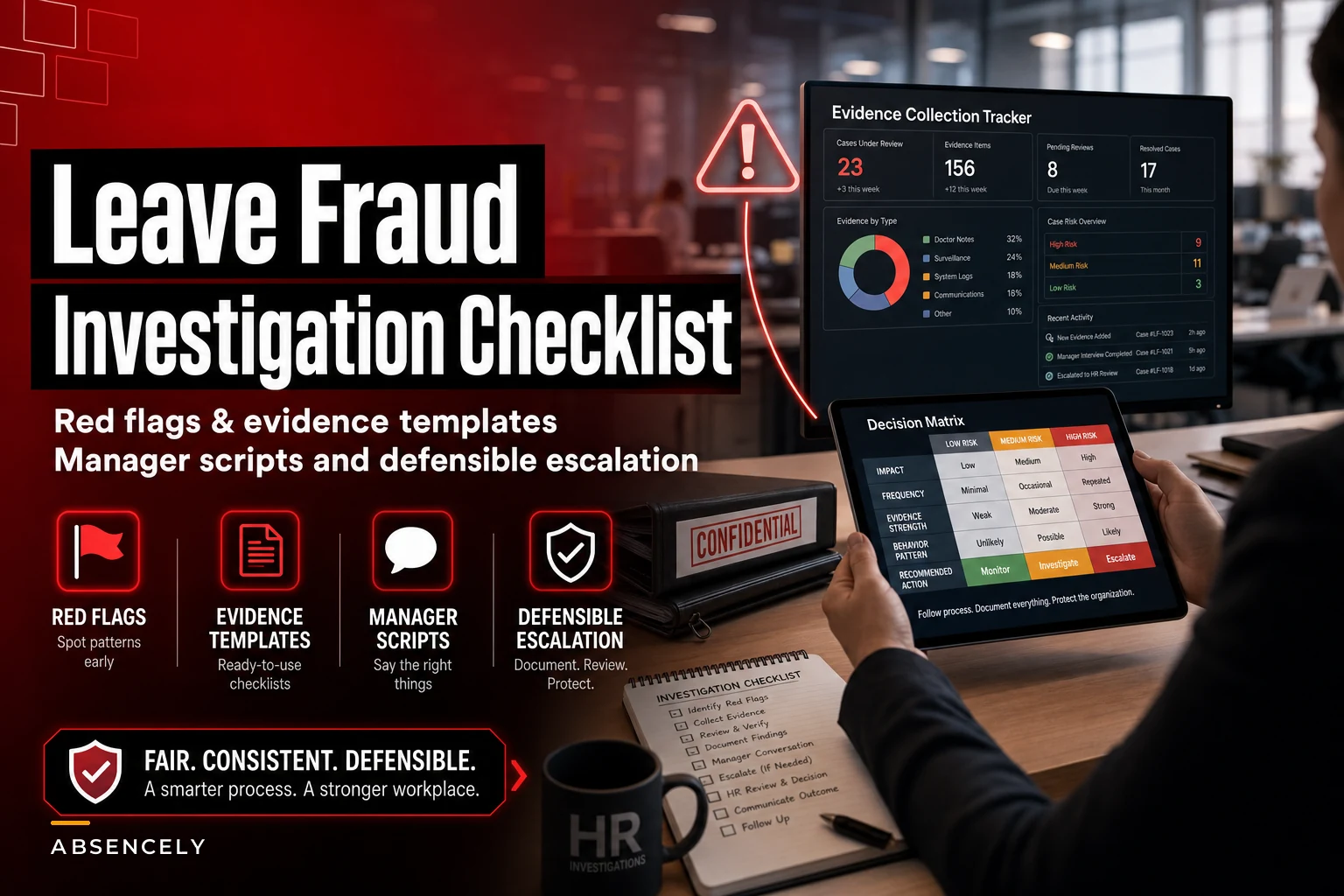

The hardest HR conversation starts like this: a manager walks into your office, closes the door, and says "I think one of my employees is faking their medical leave."
Now you're stuck. Move too fast, you risk a lawsuit. Move too slow, and other employees start gaming the system. Get it wrong either way, and you've damaged trust across the entire organization.
Leave fraud detection HR processes fail because they swing between two extremes — ignoring obvious red flags until the situation explodes, or launching aggressive investigations that create legal exposure and destroy morale. Neither approach works when you're managing real teams with real operational pressures.
The operational reality of leave fraud
Most HR teams don't discover potential leave fraud through sophisticated detection systems. They find out because operations break down. A warehouse supervisor notices their "injured" worker posting gym selfies. A retail manager spots their employee — the one who claimed stress leave — working a cash register at a competitor across town. An accounting lead gets forwarded screenshots of their direct report's vacation photos during supposed chemotherapy treatments.
These situations create immediate operational problems. Coverage gaps, overtime costs stacking up, team members growing resentful about picking up extra shifts. But the bigger challenge is navigating the investigation without creating legal liability or violating privacy regulations.
The numbers aren't comfortable. Suspected leave fraud cases run around 3-4% of total leave requests across the businesses we work with, but they consume somewhere closer to 40% of HR investigation time. A single mishandled case can trigger months of legal proceedings and five-figure settlements — and that's before you factor in the operational chaos when word spreads through your workforce.
Pattern recognition vs. legitimate concerns
Real leave fraud follows predictable patterns that experienced HR teams learn to recognize. But many legitimate medical situations can look suspicious on the surface, which is exactly where investigations go sideways.
Stop managing absences manually.
Absencely simplifies leave requests, approvals, and absence monitoring for your entire workforce.
- Automated leave tracking
- Manager approval workflows
- Compliance & reporting tools
No credit card required
Consider these actual scenarios from different industries:
Manufacturing facility: An assembly line worker claims back injury, gets cleared for light duty, then calls out sick every Monday for six weeks. Suspicious? Yes. But their medical documentation shows weekly epidural injections every Monday morning, with 24-hour recovery requirements.
Restaurant chain: A server goes on stress leave, but coworkers report seeing them bartending at another restaurant. Turns out they're working one shift weekly at their brother's place as occupational therapy — approved by their psychiatrist as part of a graduated return-to-work plan.
Logistics company: A driver on workers' comp for a shoulder injury posts photos from a fishing trip. Management wants immediate termination. The photos were from a previous year. Metadata proved it.
The operational impact varies significantly by pattern type:
| Pattern Type | Red Flag Indicators | Legitimate Explanations | Investigation Priority |
|---|---|---|---|
| Timing patterns | Leave requests around weekends/holidays, consistent Monday/Friday absences | Medical appointments scheduled on specific days, treatment side effects | Medium - gather data over 4-6 weeks |
| Activity inconsistencies | Social media showing physical activities, seen at entertainment venues | Old photos, therapeutic activities, partial recovery | High - document immediately |
| Documentation gaps | Delayed paperwork, vague diagnoses, switching doctors frequently | Specialist referral delays, privacy concerns, insurance complications | Low - follow standard timelines |
| Communication avoidance | Unreachable during leave, won't provide updates, hostile when questioned | Depression symptoms, medication effects, past trauma with employers | Medium - document attempts |
Pattern recognition helps prioritize investigations, but context matters for every case.
Building your evidence framework
The difference between a defensible investigation and a legal nightmare comes down to documentation structure — specifically, evidence collection that holds up under scrutiny while respecting employee privacy and medical confidentiality.
Start by establishing baseline documentation before any red flags appear. Clear leave policies, consistent communication protocols, standardized forms that capture essential information without overreaching. This groundwork matters more than most HR teams realize until they're already in trouble.
When suspicious patterns emerge, your evidence framework needs to separate observations from assumptions. A manager noting "Employee absent every Monday in March" is an observation. "Employee is obviously faking to get long weekends" is an assumption that will destroy your case.
Your evidence collection template needs these core components:
-
Factual timeline Specific dates, times, and objective observations. Who saw what, when, and under what circumstances. No interpretive language.
-
Policy references Which specific policies apply? What documentation was required versus provided? What deadlines were met or missed?
-
Communication record Every email, call log, text message, or verbal conversation related to the leave — including attempts to communicate, not just successful contacts.
-
Third-party information Social media screenshots with metadata, coworker observations with signed statements, customer reports with dates and details. Never actively surveil or ask others to spy. Only document what comes to you organically.
-
Medical documentation review Not the confidential details, but the administrative completeness. Did forms get signed? Were restrictions clearly stated? Did the certification match the leave request?
Here's what this looks like in practice. A retail manager suspects an employee is abusing intermittent FMLA leave for migraines. Instead of confronting the employee or denying leave, they document:
-
Specific dates and times of absences
-
Pattern analysis showing 87% of absences fall on Fridays or Mondays
-
Staffing impact measurements — overtime costs, coverage gaps
-
Customer complaints about understaffed departments
-
Required certification showing estimated frequency of 2-3 episodes monthly, but actual usage running 8-10 days monthly
That documentation creates a factual foundation without making medical judgments or violating privacy. It's also the kind of evidence that survives legal scrutiny.
Manager interview scripts that protect everyone
Managers often make or break leave fraud investigations through their initial response. Most receive zero training on how to handle these conversations without creating exposure.
The scripts below help managers gather information without stepping into legal landmines:
Initial concern conversation (Manager to HR): "I need to discuss some patterns I'm observing with [Employee]'s leave usage. I have documentation showing [specific facts]. Before I take any action, what's our process for addressing this?" Never say: "They're definitely faking" or "I know they're lying about being sick."
Information gathering (Manager to other team members): "I need to ensure we're handling [Employee]'s leave coverage appropriately. Can you confirm which shifts you've covered and any operational impacts you've noticed?" Never say: "Have you seen [Employee] doing anything suspicious?" or "Help me prove they're faking."
Check-in conversation (Manager to employee on leave): "I'm calling to check on your expected return date and see if you need any accommodation planning. Our current coverage plan runs through [date]. Do you have an updated timeline from your healthcare provider?" Never say: "I don't believe you're really sick" or "Other employees think you're faking."
Documentation request (Manager to employee): "Our leave policy requires updated certification when intermittent leave exceeds the originally estimated frequency. Please provide recertification by [date] so we can maintain compliance and appropriate coverage." Never say: "Prove you're really sick" or "I'm investigating your leave usage."
These scripts work because they stay focused on operational needs and policy compliance rather than accusations. They create documentation trails while maintaining professional boundaries.
Confidentiality framework during investigations
The fastest way to turn a legitimate investigation into a lawsuit is a confidentiality breach. Information leaks destroy trust, create hostile work environments, and hand legal challengers exactly what they need.
Limit investigation knowledge to essential personnel only. In most small businesses, that means one HR person, the direct manager, and potentially senior leadership. The investigated employee's coworkers — even those providing information — shouldn't know a formal investigation is underway.
Keep medical information completely separate from operational information. The investigation file should never contain actual medical records, diagnoses, or treatment details. Those belong in a separate locked medical file with restricted access. The investigation file only needs to verify that required documentation was provided, not what it says.
Code your communications to prevent accidental disclosure. Instead of email subjects like "John Smith FMLA Fraud Investigation," use something like "Confidential HR Matter #2024-047." Investigation codes prevent casual discovery while maintaining clear audit trails.
When gathering information from witnesses, frame requests operationally: "We're reviewing coverage patterns and need your input on schedule impacts." Don't reveal you're investigating potential fraud. If witnesses volunteer suspicious observations, document them — but don't encourage fishing expeditions.
Keep confidentiality front of mind at every step to avoid turning a defensible case into a costly settlement.
Escalation pathways and decision triggers
The escalation decision often determines whether you're defending your actions in court or resolving the situation quietly. Most organizations either escalate too early, creating legal exposure, or too late, after patterns have become entrenched.
Your escalation triggers should align with operational impact and evidence strength:
Level 1 - Monitoring phase (no escalation): Suspicious patterns identified but no policy violations documented, operational impact minimal (under $2,000 monthly in coverage costs), employee meeting basic documentation requirements, and pattern duration under 30 days. Action: Manager tracks patterns using standard documentation. HR reviews weekly but doesn't intervene.
Level 2 - Administrative review (HR escalation): Clear policy violations documented (missed deadlines, incomplete forms), operational impact moderate ($2,000–5,000 monthly in coverage/overtime), conflicting information between documentation and observed behavior, and pattern duration between 30–60 days. Action: HR initiates formal documentation review, requests recertification, implements standard verification procedures.
Level 3 - Formal investigation (Legal consultation): Evidence of potential falsification (forged documents, impossible timelines), operational impact severe (over $5,000 monthly, safety risks, team revolt), multiple credible witnesses reporting incompatible activities, and a previous warning or similar incident already in the personnel file. Action: Consult employment attorney, initiate formal investigation with written notice, consider suspension pending investigation.
Level 4 - Termination proceedings (Full legal involvement): Clear evidence of fraud (admission, verified falsification, impossible contradictions), investigation complete with documented findings, legal counsel approves termination, and operational necessity regardless of investigation outcome. Action: Follow termination procedures with full documentation package, prepare for potential legal challenge.
Having clear thresholds before situations arise matters more than most teams realize. When managers know exactly when to escalate, they're less likely to act impulsively or look the other way.
Defensible termination vs. accommodation pivot
Sometimes investigations reveal something unexpected — the employee isn't committing fraud, but their legitimate medical condition makes their current role unsustainable. This creates an operational crossroads that many HR teams handle badly.
Consider this distribution center scenario: a picker/packer develops chronic fatigue syndrome and starts taking intermittent FMLA leave 2-3 days weekly. Investigation finds no fraud — the condition is real, documented, and debilitating. But the operational impact is severe. Their team is constantly short-staffed, overtime costs are climbing, and other workers are burning out from the coverage load.
Terminating for fraud (there isn't any) isn't the answer. Neither is indefinite accommodation that's actively destroying operations. The defensible path is an interactive accommodation process:
-
Document the essential functions of the current role that can't be performed
-
Identify potential alternative positions that match their restrictions
-
Offer reasonable accommodations — schedule modification, role restructuring, or transfer
-
If no accommodation enables essential function performance, document the undue hardship
-
Provide clear timelines and options, including voluntary resignation with benefits continuation
This approach protects both parties. The employee isn't falsely accused of fraud. The employer isn't forced into an unsustainable operational situation indefinitely.
Technology integration without the surveillance trap
Thoughtful use of absence management software can transform these investigations from adversarial witch hunts into data-driven operational reviews. The difference is approach — you're not surveilling employees, you're identifying patterns that need operational attention.
Modern absence tracking platforms flag statistical anomalies without human bias. When someone's leave pattern shifts from random distribution to Monday/Friday concentration, the system surfaces it for HR review. When intermittent leave usage exceeds medical certification estimates by a significant margin, automated workflows trigger recertification requests.
The real value is removing emotion from initial detection. A manager frustrated by coverage gaps might see fraud everywhere. An automated system just identifies mathematical patterns that deviate from baselines. That objectivity protects both employees and employers from reactive decisions.
The operational data also strengthens your investigation framework. Instead of "it feels like they're always gone," you have "absences increased 340% in the past quarter, concentrated on days adjacent to holidays, resulting in roughly $4,700 in overtime costs and three customer service complaints about understaffing."
Common investigation mistakes that destroy cases
Even with solid evidence of leave fraud, organizations regularly destroy their own cases through procedural errors. These mistakes turn clear-cut situations into expensive settlements:
Rushing the timeline: A restaurant manager discovers their "sick" server working at another restaurant and terminates them immediately. The server sues, claiming they were never given an opportunity to explain the therapeutic work arrangement. Settlement: $35,000 plus reinstatement.
Overreaching in evidence collection: An office manager hires a private investigator to follow an employee on workers' comp. The investigation confirms fraud, but the surveillance tactics violate state privacy laws. The criminal fraud case proceeds, but the company pays $75,000 in civil damages.
Inconsistent enforcement: A construction company terminates a laborer for leave fraud after documenting multiple violations. The laborer's attorney demonstrates that two office workers with similar violations received warnings only. Discrimination settlement: $50,000.
Breaking confidentiality: An HR manager mentions the investigation to a department head who wasn't involved. Word spreads. The investigated employee claims hostile work environment and retaliation. Even though fraud was proven, the company settles for $40,000 to avoid trial.
Failing to document contemporaneously: A manufacturing company tries to terminate an employee for leave fraud based on incidents from six months prior. Without contemporaneous documentation, their case relies on memory and reconstructed timelines. The termination gets reversed in arbitration.
Every one of these follows the same pattern — good intentions undermined by poor execution. The investigation framework isn't just about catching fraud; it's about protecting your organization when you do.
Building your investigation template library
Standardized templates ensure consistency and completeness across all investigations. Your library needs five core documents:
-
Initial Concern Report One-page form for managers to document observations that trigger review. Includes date/time fields, specific observation checkboxes, a pattern identification section, and operational impact assessment.
-
Evidence Collection Tracker Spreadsheet template organizing all documentation by date, type, source, and relevance. Separate tabs for timeline events, policy references, communications, witness statements, and medical documentation status.
-
Interview Guide Structured question sets for different interview types — manager, witness, subject employee. Questions stay focused on facts and observations, avoiding medical inquiries or accusations.
-
Decision Matrix Flowchart linking evidence types to recommended actions. Helps ensure consistent responses to similar situations while still accounting for individual circumstances.
-
Case Summary Template Standardized format for presenting findings to decision-makers. Includes executive summary, detailed timeline, evidence inventory, policy analysis, risk assessment, and recommended action with alternatives.
These templates function as an investigation system rather than standalone documents. The Initial Concern Report triggers the Evidence Collection Tracker. The Interview Guide populates the tracker with consistent information. The Decision Matrix guides next steps based on what the tracker reveals. The Case Summary Template packages everything for final decision-making.
Here's a simple visual of how the templates and workflows connect.
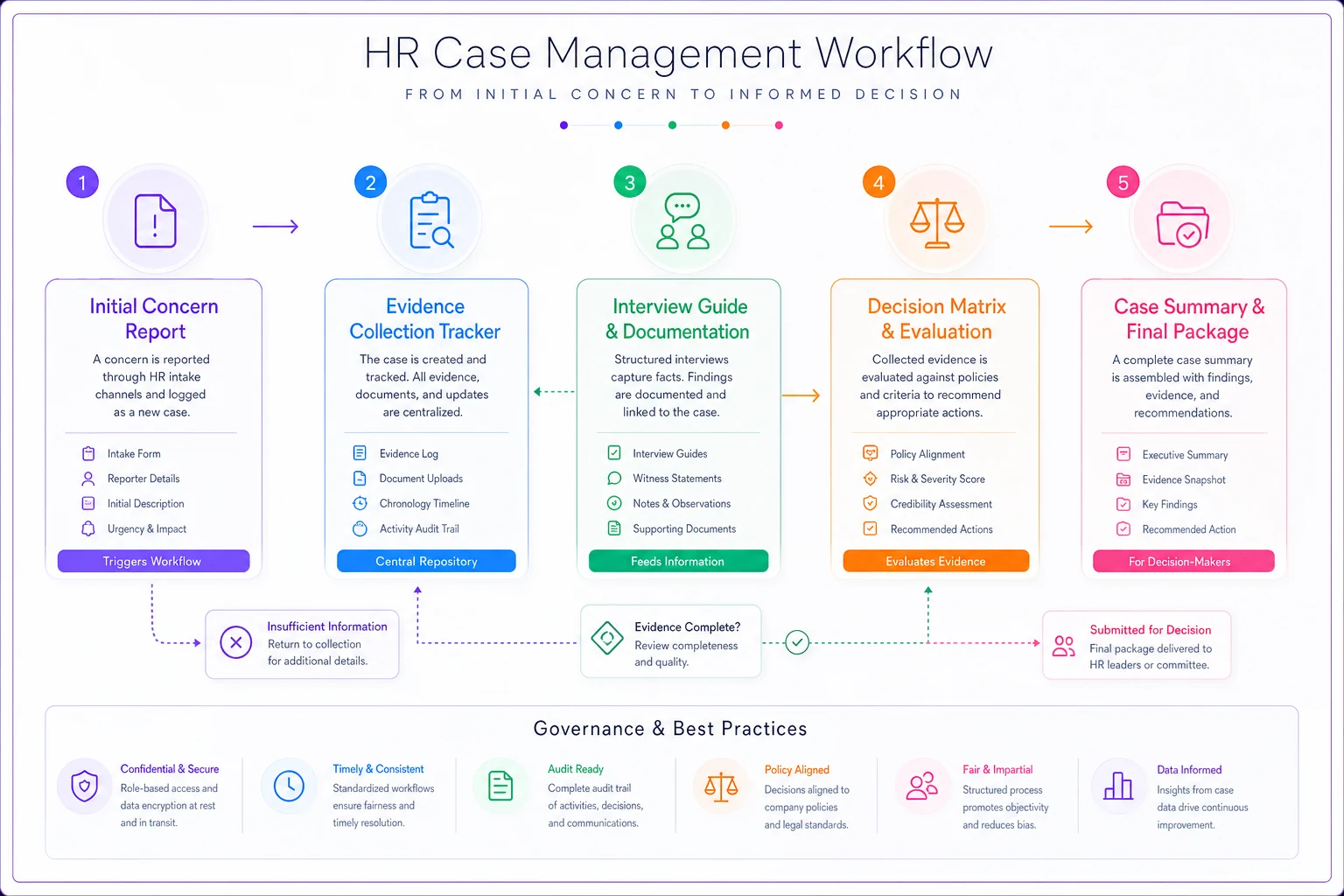
The diagram above maps each template to the next operational step so reviewers can follow the chain of custody for evidence.
Use consistent file naming and a unique investigation code across all templates to make audits and attorney reviews faster.
Standardization reduces mistakes, ensures completeness, and speeds decision-making when investigations matter most.
Leave fraud detection processes will never be comfortable, but they can be consistent, defensible, and fair. The framework here protects legitimate employees while addressing real fraud that damages operations and morale.
The key is preparation before problems arise. Build your templates now. Train your managers on proper documentation. Establish clear escalation triggers. Implement objective pattern detection. Create confidentiality protocols that everyone understands.
Every investigation has three potential outcomes: confirmed fraud requiring termination, legitimate leave requiring continued accommodation, or something in between requiring creative problem-solving. Your framework needs to handle all three with equal professionalism — not just the clean-cut cases.
The companies that handle these situations well share a few things in common. They document everything but investigate judiciously. They protect confidentiality while gathering necessary information. They focus on operational impact rather than moral judgments. They use data to identify patterns but rely on human judgment for decisions.
When that manager walks into your office with concerns about potential leave fraud, you'll be ready — not because you've become suspicious of all leave requests, but because you've built a framework that protects everyone. The employee who might be struggling with real health issues. The manager dealing with operational disruption. The coworkers picking up extra shifts. The organization that needs sustainable operations to function.
The goal isn't catching more fraud. It's handling suspected fraud professionally when it arises, protecting your organization while respecting your employees. With the right framework, documentation, and approach, you can navigate these situations without creating a whole new set of problems in the process.
Ready to optimize your workforce absence management?
Join 2,000+ HR teams using Absencely to reduce administrative burden, improve compliance, and boost employee satisfaction.