


The messiest payroll corrections almost never come from domestic employees. They come from the engineer who spent 14 months in Singapore, took statutory annual leave under local rules, then transferred back to the UK mid-accrual-year — and nobody mapped what carried, what reset, and what got paid out.
That single move can generate three or four payroll adjustment journals across two payroll systems, two tax jurisdictions, and a shadow payroll nobody told finance about. Get the mapping wrong and you're either overpaying a balance that should have been forfeited, or you're shortchanging a statutory entitlement and creating a compliance exposure in the host country.
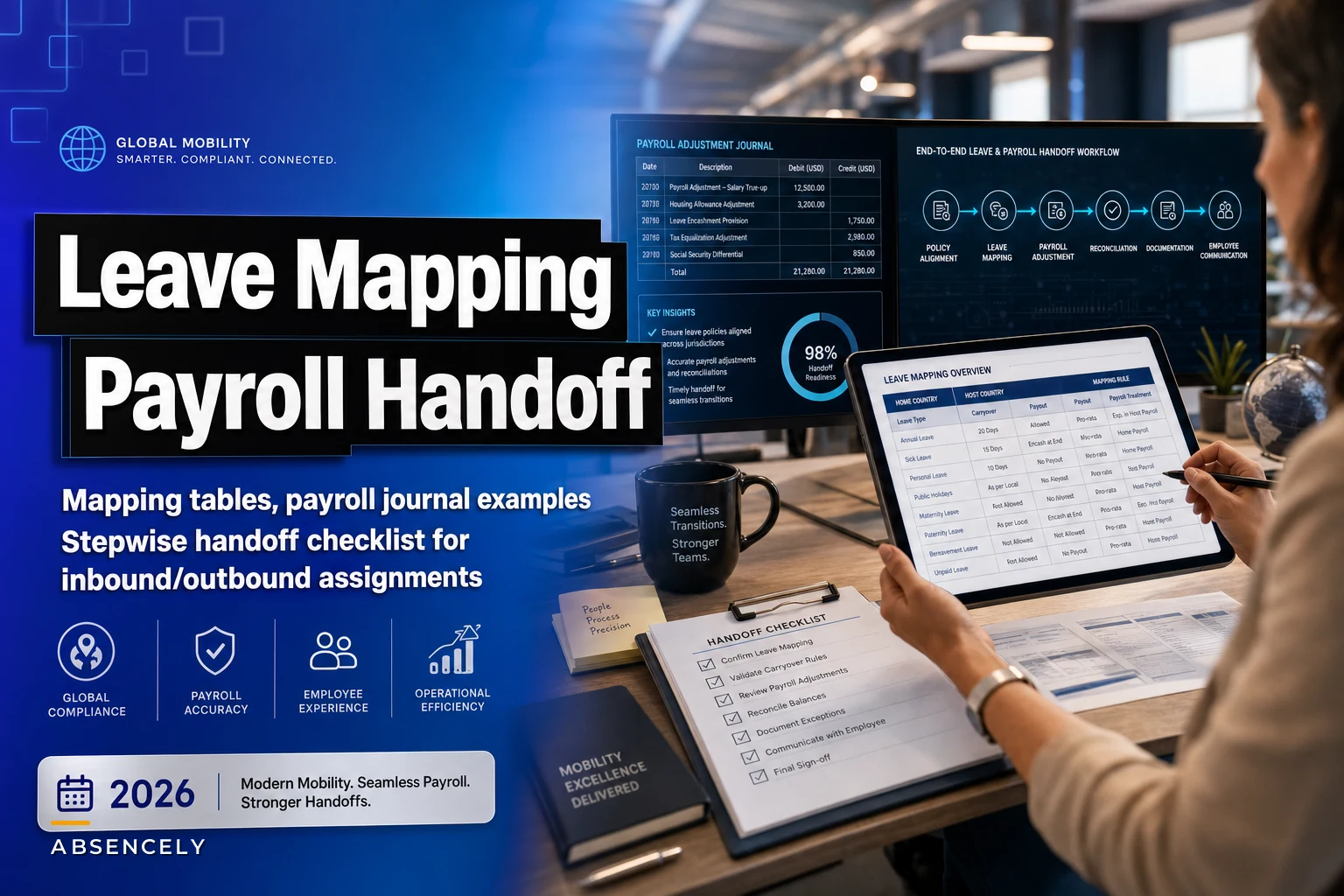
This post is narrow on purpose. It covers the mapping table you need between home-country and host-country leave types, the payroll adjustment journals that come out of it, and the stepwise handoff checklist for inbound and outbound assignments. No broad expat HR theory — just the operational piece that keeps balances and payroll aligned.
Why assignee leave mapping breaks (and it's not the people)
Most teams track leave in whatever the local HRIS calls it. "Annual leave" in Australia is not the same thing as "congés payés" in France, and neither maps cleanly onto US "PTO." When someone crosses a border mid-assignment, the question isn't just how many days do they have — it's under whose rules were those days earned, and what happens to them now?
-
Entitlement basis mismatch. The home policy accrues monthly; the host statutory minimum is a flat annual grant. Nobody decides which one governs during the assignment.
-
Carryover and forfeiture rules differ. Germany's statutory leave has strict carryover limits with expiry; a US-style "use it or lose it by Dec 31" policy expires on a different cadence entirely. When the assignment ends mid-cycle, both clocks are running.
-
Shadow payroll invisibility. The host-country shadow payroll calculates tax on imputed income, but the leave payout or accrual adjustment often lives only in the home payroll. The two never reconcile because no one owns the bridge entry.
The leave data itself is usually fine in isolation. Each country's record is internally consistent. The problem is the translation layer — the point where a day earned under one regime becomes a liability or payout under another. That translation almost never gets written down, so it gets re-improvised every time someone transfers.
The mapping table approach
The fix is boring and it works: a single mapping table that defines, for every home/host pairing you actually use, how each leave type translates. You don't need every country combination on earth — you need the lanes your people actually move through.
Stop managing absences manually.
Absencely simplifies leave requests, approvals, and absence monitoring for your entire workforce.
- Automated leave tracking
- Manager approval workflows
- Compliance & reporting tools
No credit card required
Here's the structure of a working mapping table. Treat each row as one leave type in one direction of movement.
| Field | What it captures | Example value |
|---|---|---|
| Home leave type | Source-country category | US PTO (combined) |
| Host leave type | Destination-country equivalent | UK Annual Leave + Statutory Sick |
| Governing rule during assignment | Which regime controls accrual | Host statutory minimum, home policy if greater |
| Accrual basis | How days are earned | Host: 28 days/yr pro-rata; Home: 15 days/yr accrued monthly |
| Carryover treatment | What survives the transfer | Home balance frozen, not accruing; host accrues fresh |
| Payout trigger | When a balance converts to cash | Outbound: unused host statutory leave paid at host rate |
| Payroll owner | Who books the adjustment | Host payroll for host leave; home payroll for frozen balance |
| Shadow payroll flag | Does this create imputed income | Yes — payout taxable in host during assignment |
The discipline is that every assignee movement gets resolved against this table instead of a one-off email thread between HR and two payroll teams. When a new lane appears — say your first transfer into Japan — you add the rows once, get them reviewed, and every future Japan transfer uses the same logic.
One field worth flagging specifically: "governing rule during assignment" is where most disputes get settled before they happen. Pick a default — usually the greater of home policy or host statutory minimum — and document the exceptions. Without that one decision recorded somewhere, each transfer reopens the same debate.
If you're building this across several countries, it works best sitting on top of the kind of policy-and-data-flow mapping described in a systems blueprint for multi-jurisdiction absence management. The leave mapping table is essentially the payroll-facing layer of that broader system.
Pick a default — usually the greater of home policy or host statutory minimum — and document the exceptions.
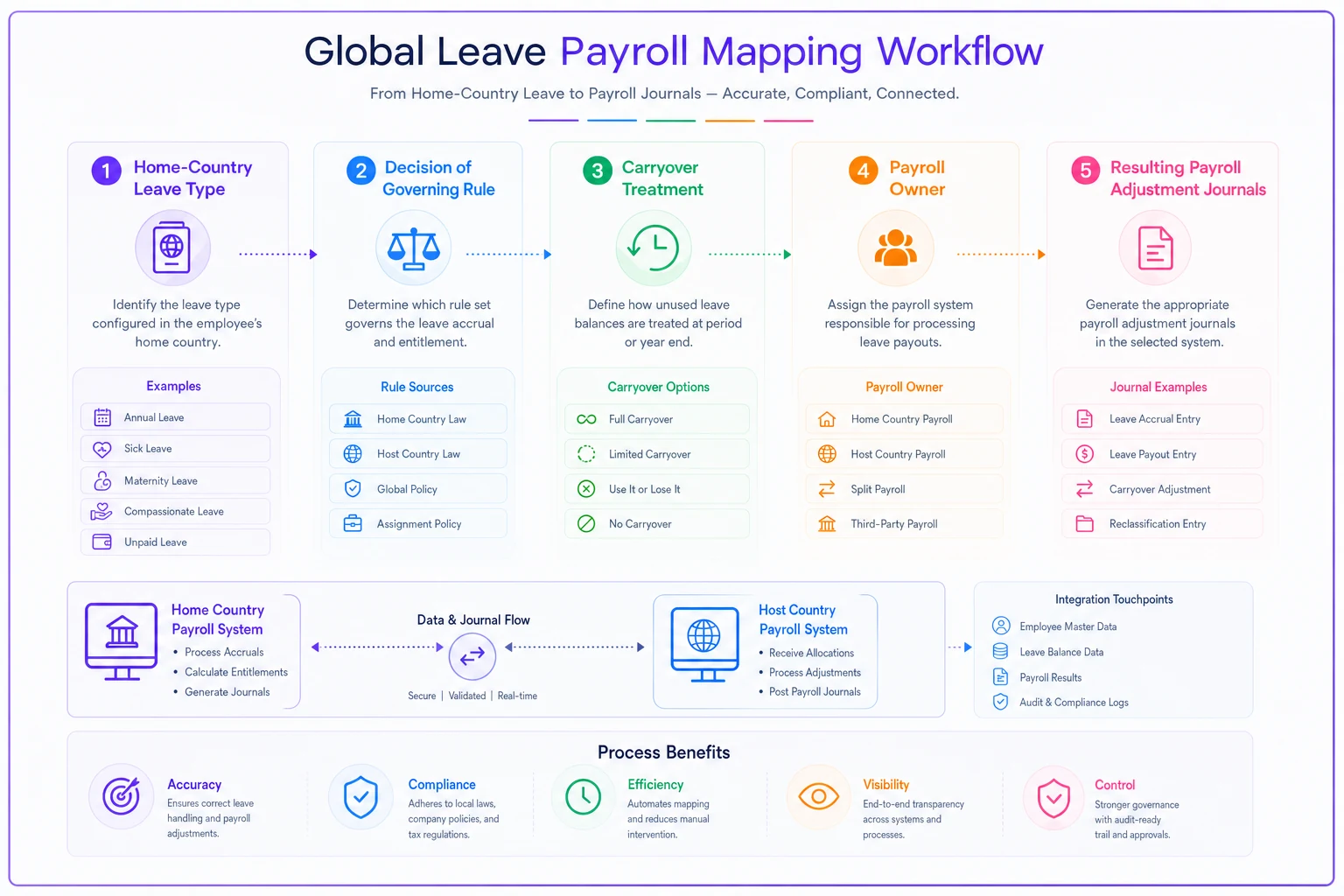
This diagram shows the mapping flow and decision points between home and host leave types.
Payroll adjustment journal examples
The mapping table tells you what happens. The adjustment journals are how it hits the books. Here are three worked examples tied to realistic movements.
Example 1 — Outbound US → UK, mid-year transfer, frozen home balance
An employee transfers from the US to the UK on July 1. They had roughly 9 days of accrued US PTO at transfer. Decision: the US balance freezes (stops accruing), UK statutory leave accrues fresh pro-rata for the remaining 6 months (~14 days). The frozen US balance isn't paid out — it's held as a liability until assignment end. But you still need an accrual reclass so the liability sits in the right cost center:
DR US PTO Liability (home entity) $2,850 CR Assignment Suspense — PTO (home) $2,850 (freeze 9 days accrued PTO at ~$317/day; no further accrual during assignment)
Then the UK side starts its own accrual as normal under host payroll. Two ledgers, two owners, one mapping row connecting them.
Example 2 — Host statutory leave payout at assignment end
Same employee returns after 14 months. They have 4 days of unused UK statutory leave that must be paid out under UK rules — statutory leave can't simply vanish. UK day rate works out to roughly £180/day.
DR Leave Payout Expense (host entity) £720 CR Net Pay / Payroll Clearing (host) £720 (4 days unused UK statutory leave, paid at host day rate) Shadow payroll: flag £720 as taxable host income for the period.
The mistake that keeps coming up here: the payout gets processed in the home payroll by default because that's where the employee "really" belongs, which understates host taxable income and overstates home. The mapping table's "payroll owner" field is what prevents that.
Example 3 — Unfreezing and reconciling the home balance on return
Back home, the 9 frozen US days unfreeze. If the US policy caps carryover at 5 days into the new accrual year, 4 days forfeit.
DR Assignment Suspense — PTO (home) $2,850 CR US PTO Liability (home entity) $1,585 (5 days retained) CR PTO Forfeiture / Benefit Expense $1,265 (4 days forfeited) (unfreeze on return; apply home carryover cap of 5 days)
Three movements, one person, cleanly tied back to the mapping rows. The point of showing the journals is that the mapping table isn't an HR nicety — it's what makes these entries deterministic instead of negotiated every time.
Stepwise handoff checklist: inbound assignments
Inbound (someone arriving into a host country you run) carries a different risk profile than outbound. The main danger is the host payroll starting the person on local defaults before anyone confirms what carries from home. Run this in order before the first host payroll cycle:
-
Confirm the mapping rows exist for this home/host lane. If they don't, build and review them first — don't improvise the first cycle.
-
Snapshot the home leave balance as of the transfer date, with the accrual-to-date figure signed off by home payroll.
-
Decide and record the governing rule (host statutory, home policy, or greater-of) in the assignee's record — not just in email.
-
Freeze or transfer the home balance per the mapping table and book the reclass journal.
-
Set host accrual start date and basis so the person doesn't double-accrue or start from zero incorrectly.
-
Flag shadow payroll items — any leave payout or imputed income the host tax calc needs to see.
-
Lock access boundaries so only the right roles can view and edit cross-border balances. This is exactly where defensible leave-data governance for cross-border teams matters, because a transfer touches data in two jurisdictions with different privacy rules.
-
Confirm reconciliation owner for month-end — one named person who checks that home and host ledgers agree.
The step people consistently skip is #2, the signed snapshot. Without a frozen, agreed starting balance, every later adjustment becomes a dispute about what the number should have been at transfer.
Stepwise handoff checklist: outbound assignments
Outbound — whether someone is leaving your home country for an assignment or returning from one — is where payout and forfeiture mistakes cluster most heavily. The checklist:
-
Determine payout obligations in the host country before departure or return. Some statutory leave must be paid out; some can carry; some forfeits. Don't assume.
-
Identify which entity owns each payout and confirm the payroll owner field matches reality.
-
Calculate the day rate correctly — host rate for host leave, home rate for home leave. Mixing these is a common and expensive error.
-
Apply carryover caps on return using the home policy, and book the forfeiture explicitly rather than letting it silently disappear.
-
Reverse any suspense/freeze entries so no balance stays stranded in a clearing account.
-
Run a final cross-ledger reconciliation confirming total days paid + days retained + days forfeited equals days earned across both regimes.
That last reconciliation is the single check that catches most leakage. If it doesn't balance, something crossed a border without being mapped.
A short real scenario
A mid-sized engineering firm — roughly 400 employees with around 20 people on international assignment at any time — kept hitting the same problem at year-end. Returning assignees either showed leave balances that made no sense or triggered retroactive payroll corrections two or three months after return.
The root cause was predictable: each transfer was handled by email, and the "what carries over" decision got made fresh every time, usually by whoever was least busy. In one case, an employee returning from Germany was paid out for leave that should have forfeited under home policy — a few thousand euros that finance only caught during the annual audit.
They built a mapping table covering their five actual assignment lanes — nothing more — plus the two handoff checklists above. It took a couple of weeks of back-and-forth with the host payroll providers to nail down the governing rules per lane. After that, transfers stopped generating surprise corrections. The year-end close stopped surfacing assignee leave as a recurring exception, and the audit findings on expat leave cleared.
The lesson wasn't that better software caught errors. It was that deciding the rules once and writing them in a table removed the improvisation that caused the errors in the first place.
When this mapping effort is worth it (and when it isn't)
When it makes sense: You have recurring assignment lanes — the same two or three country pairs showing up every year. Repeatable movement is exactly what a mapping table is built for, and the setup cost amortizes quickly.
When it's overkill: If you've moved exactly one person internationally and have no pipeline of more, a full mapping table is more structure than you need. Handle it as a documented one-off with a clear snapshot and sign-off, and revisit if the pattern repeats.
Who should not do this alone: HR building the mapping table without host-country payroll and tax input will get the governing rules and shadow payroll flags wrong. These rows need a payroll owner and a tax reviewer per lane. The table is a cross-functional artifact, not an HR document.
Bringing it together
International assignee leave mapping fails when the translation between regimes lives in people's heads and email threads instead of a reviewed table. Build the mapping for the lanes you actually use, derive your payroll adjustment journals directly from it, and run the inbound and outbound handoffs as checklists with named owners and a cross-ledger reconciliation at the end.
The entries stop being negotiated and start being deterministic. That's the whole point — not clever automation, just a clear decision made once and applied consistently every time someone crosses a border.
Ready to optimize your workforce absence management?
Join 2,000+ HR teams using Absencely to reduce administrative burden, improve compliance, and boost employee satisfaction.