


Most absence programs get the operational side right and the financial side completely wrong. You can have perfect intermittent-leave logging, clean payroll bridges, and a return-to-work process that would survive an audit — and still be carrying absence exposure on your balance sheet that nobody has actually priced. The numbers show up in benefits costs, temp spend, and overtime, but no one has mapped which of those exposures should sit with an insurer, which should be self-funded, and which should be absorbed through contingency reserves.
That gap is where this breaks. Finance treats absence as a cost line to forecast. HR treats it as an operational workflow to run. Neither owns the question of risk transfer — who eats the loss when absence spikes past plan. And when a bad quarter hits, the conversation turns into finger-pointing instead of a decision that was made on purpose months earlier.
This framework is for making those decisions deliberately. It covers how to map absence exposures to insurance versus stop-loss versus self-funding, how to size contingency when you self-fund, which contract levers actually transfer risk (and which just look like they do), and a risk-register structure HR and Finance can share without constantly translating between two different languages.
Start by separating frequency from severity
The most common mistake is treating all absence exposure as one bucket. It isn't. The financial behavior of a workforce of 2,000 people taking occasional sick days looks nothing like a handful of long-term disability claims running 18 months each.
| Exposure type | Frequency | Severity | Default funding approach |
|---|---|---|---|
| Routine sick days, short PTO | High | Low | Self-fund + budget line |
| Seasonal surge absence | Medium | Medium | Self-fund + contingency reserve |
| Short-term disability clusters | Medium | Medium–High | Self-fund or insure depending on headcount |
| Long-term disability / catastrophic | Low | Very High | Insure / stop-loss transfer |
High-frequency, low-severity events are predictable — you know roughly how many sick days a 1,500-person workforce burns per quarter, so you fund them directly and forecast them. Insuring them makes no sense; you'd just be paying an insurer's margin to process costs you can already anticipate.
Low-frequency, high-severity events are the opposite. A single long-term disability claim on a senior employee can run six figures over its life. You can't budget for "maybe one, maybe three" in a year without either over-reserving or getting blown up. That's exactly what insurance exists for — trading a known premium for protection against an unknown, large, rare loss.
The interesting decisions live in the middle, and that's where headcount, cash position, and risk appetite actually matter.
Where self-funding stops making sense
Self-funding absence-related costs — paying short-term disability out of operating cash instead of buying a fully-insured policy — can be a genuinely good deal at scale. You keep the insurer's risk margin and administrative load, you keep the float, and you get cleaner data because you're not filtered through a carrier's adjudication lens.
Stop managing absences manually.
Absencely simplifies leave requests, approvals, and absence monitoring for your entire workforce.
- Automated leave tracking
- Manager approval workflows
- Compliance & reporting tools
No credit card required
But it only works if your population is large enough to be statistically stable. At 200 employees, your STD claims experience swings wildly year to year — one bad flu season or two simultaneous surgeries can double your spend. At 5,000 employees, that same volatility averages out into something you can actually plan around. The law of large numbers isn't a cliché here; it's the whole basis for whether self-funding is responsible or reckless.
When self-funding actually makes sense
-
Your covered population is large enough that claim frequency is stable quarter to quarter (generally several thousand lives for STD-type exposure)
-
You have cash reserves or a credit line that can absorb a worse-than-expected year without disrupting operations
-
You have the administrative capacity — or a TPA — to adjudicate and track claims accurately
-
Your historical claims data is clean enough to price the exposure with confidence
When self-funding is a bad idea
-
Small or volatile headcount where a few large claims distort the whole year
-
Thin cash reserves, where a bad quarter forces you to choose between paying claims and paying for other priorities
-
No reliable historical data, so you're effectively guessing at your expected loss
-
Heavy concentration of high-severity risk (older workforce, physically demanding roles) without stop-loss protection
Who should not do this at all
If you're a single-site business under a few hundred employees with no appetite for cash volatility, skip the self-funding debate entirely. Buy the policy. The premium you pay is the price of not having a bad month wreck your quarter, and at that size the margin you'd "save" isn't worth the variance you'd take on.
Stop-loss is the lever everyone forgets
Self-funding and insurance aren't binary. Stop-loss sits in between, and it's the piece most mid-size employers underuse.
The idea: you self-fund the predictable layer and buy insurance only for the catastrophic tail. Two flavors matter.
Specific stop-loss caps your exposure on any single claim. You self-fund STD claims up to, say, $50k each, and the stop-loss carrier picks up anything above that on an individual claimant. This protects you from the one brutal case without paying to insure the hundreds of ordinary ones.
Aggregate stop-loss caps your total annual exposure across all claims. You self-fund normally, but if your combined absence-related claims blow past a defined ceiling for the year — usually set at 120–125% of expected — the carrier covers the overage. This is your protection against a systemically bad year rather than one bad claim.
In practice, the smart structure is usually both: specific stop-loss to handle the individual catastrophic case, aggregate to handle the year where everything goes wrong at once. You end up self-funding the bulk of predictable cost, keeping the margin, and transferring only the genuinely dangerous tail. The art is in where you set the attachment points — set them too low and you're overpaying for coverage you rarely use; set them too high and the protection doesn't trigger until the damage is already done.
Sizing contingency when you self-fund
Once you've decided what to self-fund, you have to reserve for the part of it that won't follow the forecast. This is where most finance teams either under-reserve and get surprised, or over-reserve and get chewed out for tying up cash.
-
Establish your expected annual loss. Take two to three years of actual absence-related spend for the exposures you're self-funding — STD payouts, temp coverage, overtime attributable to absence. Average it, adjusted for any headcount change. This is your baseline, not your reserve.
-
Measure the volatility, not just the average. Look at how much the worst year deviated from the average. If your STD spend averaged roughly $1.4M but the worst of the last three years hit $1.9M, your downside swing is around $500k. The average tells you what to budget; the swing tells you what to reserve.
-
Size contingency to the realistic bad year, not the catastrophic one. The catastrophic tail is what stop-loss is for. Your contingency reserve should cover a plausible-but-bad year — typically the 80th–90th percentile of your historical range. Reserving for the absolute worst-case on top of carrying stop-loss means you're paying twice for the same risk.
-
Adjust for concentration and correlation. If a large share of your exposure sits in one site, one function, or one demographic, your real volatility is higher than the raw numbers suggest, because those claims tend to move together. A single plant with an aging workforce doesn't give you the diversification a spread-out population does. Pad the reserve accordingly.
-
Re-baseline annually. Absence exposure drifts with headcount, workforce age, policy changes, and benefit redesigns. A reserve sized three years ago against a different workforce is a reserve sized against a company that no longer exists.
A quick worked example: a company self-funding STD for roughly 3,000 employees sees average annual claims of about $1.3M, with the bad year around $1.75M. Expected loss goes in the budget at $1.3M. Contingency gets sized near the $450k gap to the bad year. Aggregate stop-loss attaches somewhere above that — say $2.2M — so the genuinely catastrophic year transfers out. Budget, reserve, and transfer each cover a different layer, and nothing's double-counted.
Contract levers that actually transfer risk
A lot of programs think they've transferred risk and haven't. A contract with a carrier, TPA, or temp agency only moves risk if the language creates a real financial consequence for the other party when things go wrong. Much of the "risk transfer" language you'll see in standard contracts is decorative.
-
Stop-loss attachment points and lasering clauses. Carriers sometimes "laser" a known high-risk claimant — excluding them or setting a higher individual attachment. Catch this at renewal. A laser quietly shifts a big chunk of exposure back onto you.
-
Performance guarantees with teeth. A TPA SLA that promises fast adjudication is worthless unless missing it costs the TPA money. Fee-at-risk clauses — where a percentage of their fee is forfeited for missed turnaround or error rates — are what actually change behavior.
-
Run-in / run-out provisions. When you switch carriers or TPAs, who's liable for claims incurred before the switch but paid after? Ambiguity here is where six-figure surprises live. Nail down the terminal liability explicitly.
-
Temp and staffing coverage guarantees. If you're transferring coverage-gap risk to a staffing partner, the contract needs replacement-time SLAs tied to credits, not just best-effort promises.
-
Renewal rate caps. For insured layers, negotiating a cap on year-over-year premium increases transfers some of the pricing volatility back to the carrier.
The pattern across all of these: risk only transfers where money moves when the risk materializes. If the counterparty bears no cost when they fail, you still own the exposure regardless of what the contract says. Getting this wrong is a recurring theme in vendor lifecycle governance for absence systems — the exposure comes back to you precisely at the handoff points nobody wrote down.
A shared risk register HR and Finance can both use
The reason these decisions fall through the cracks is that HR and Finance keep the information in different places, in different formats, measured different ways. A shared register fixes that — one artifact, updated on a cadence, that both functions read the same way.
Each row is one exposure. The columns that make it usable:
| Field | What it captures |
|---|---|
| Exposure ID | Unique reference for tracking over time |
| Exposure description | e.g. "STD claims, manufacturing division" |
| Owner (HR / Finance) | Single named owner, not a committee |
| Frequency rating | High / Medium / Low, based on actuals |
| Severity rating | Est. cost per event or per year |
| Expected annual loss | Baseline budget figure |
| Volatility / downside swing | Gap from average to bad-year |
| Current funding treatment | Self-fund / insure / stop-loss / reserve |
| Transfer mechanism | Policy, stop-loss attachment, SLA credit |
| Residual risk retained | What you still own after transfer |
| Review date | When this gets re-baselined |
The column that forces the hard conversation is residual risk retained. It's the one most registers skip, and it's the whole point. After you've bought the policy and signed the SLA, what's left on your plate? If that field is blank, nobody has actually thought the exposure through — they've just filed it under "handled."
Schedule the register reconciliation on the same day each quarter to avoid drift.
Here's a simple workflow for maintaining the register.
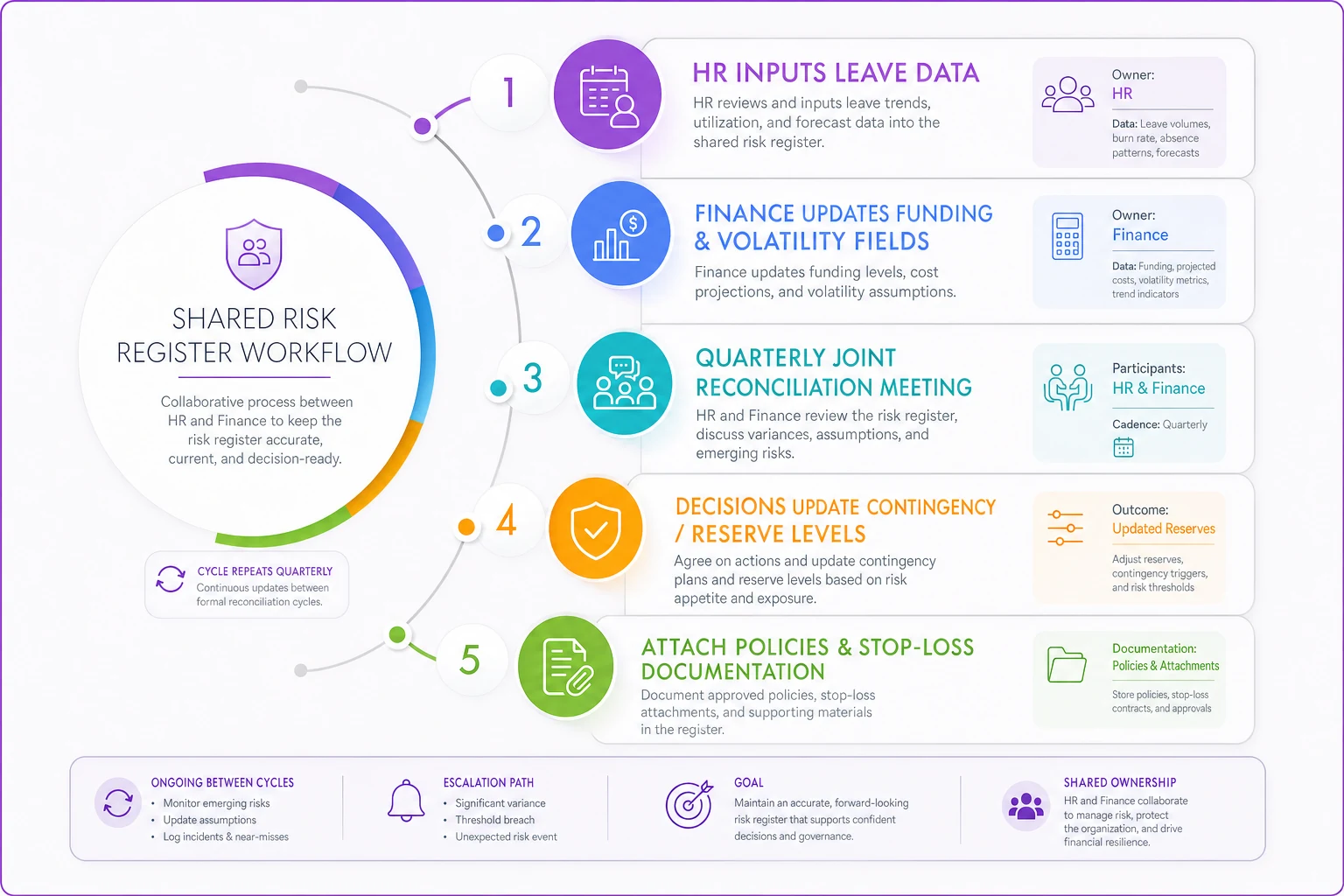
A practical cadence: HR owns frequency and operational columns because they live in the leave data; Finance owns the funding, volatility, and residual columns because they own the balance sheet consequences. Quarterly, both sit with the register and reconcile. The cost inputs feeding the expected-loss column should come straight from your absence cost-allocation and showback framework, so the register isn't running on numbers that disagree with what Finance already reports.
A real scenario
A regional logistics operator with around 2,600 employees had been fully insuring short-term disability for years, treating it as a fixed cost. Premiums had crept up roughly 9–11% annually for three straight renewals, driven partly by one high-cost claim the carrier never let them forget at renewal time.
When they actually pulled three years of claims data, the picture was clear: their frequency was stable and their average loss was well inside what the premiums implied. They were paying the carrier's risk margin on a population large enough to self-fund the predictable layer safely.
They restructured. Self-funded STD up to a specific stop-loss attachment, bought aggregate stop-loss above a ceiling set near their bad-year number, and sized a contingency reserve against the gap between expected and bad-year spend. The residual risk — the predictable middle — they now owned on purpose, with a reserve behind it.
The result wasn't dramatic in the way a sales deck would want. Net absence-related spend came down somewhere in the low-to-mid six figures annually versus the fully-insured arrangement, and more importantly the volatility was now their decision rather than the carrier's pricing. The year after, when they had a slightly worse claims run, the contingency reserve absorbed it exactly as designed. Nobody had an emergency conversation about it — and that absence of a crisis meeting was the real win.
Where the system tends to break at scale
As headcount grows and operations spread across sites and jurisdictions, the framework doesn't change but the failure points multiply. A few worth watching:
-
Correlation sneaks in. A single-site business has naturally diversified risk across functions. A multi-site business with one dominant high-risk location re-concentrates it, and the reserve sized on blended numbers is suddenly too thin.
-
Data drift breaks the baseline. Expected-loss figures are only as good as the underlying absence data. When record definitions vary by region or system, your register runs on numbers that quietly stopped being accurate.
-
Contract terms fossilize. Stop-loss attachments and SLA credits set at one headcount become mis-sized as you grow, but renewals happen on autopilot and nobody re-derives whether the attachment point still matches the risk.
-
Ownership blurs. At small scale, one person holds both the operational and financial picture. At enterprise scale those split, and the residual-risk column is exactly where the two sides assume the other one has it covered.
At small scale, one person holds both the operational and financial picture. At enterprise scale those split, and the residual-risk column is exactly where the two sides assume the other one has it covered.
Bringing it together
The point of all this isn't to find the cheapest funding arrangement. It's to make the retain-versus-transfer decision on purpose, layer by layer, and then hold a shared artifact that keeps HR and Finance honest about who actually owns what when a bad quarter arrives.
Most organizations already have the operational discipline — the logging, the payroll bridges, the return-to-work flow. What they're missing is a deliberate answer to a simpler question: of all this absence exposure, which part are we choosing to keep, which part are we paying someone else to carry, and have we set aside enough to cover the part we kept? Answer that explicitly, write it down where both functions can see it, and re-check it on a cadence — and the next bad quarter becomes a reserve drawdown instead of a surprise.
Most organizations already have the operational discipline — the logging, the payroll bridges, the return-to-work flow. What they're missing is a deliberate answer to a simpler question: of all this absence exposure, which part are we choosing to keep, which part are we paying someone else to carry, and have we set aside enough to cover the part we kept? Answer that explicitly, write it down where both functions can see it, and re-check it on a cadence — and the next bad quarter becomes a reserve drawdown instead of a surprise.
Ready to optimize your workforce absence management?
Join 2,000+ HR teams using Absencely to reduce administrative burden, improve compliance, and boost employee satisfaction.