

Most companies treat contingent labor as flexible on paper and rigid in practice. The whole point of hiring temps, agency staff, and freelancers is that they absorb the swings your permanent headcount can't. But absence planning for these workers usually lives in nobody's head. Permanent employees have PTO policies, leave adjudication, return-to-work interviews — the whole machine. Contingent workers get a shrug and a text message when they don't show.
That gap is where the money leaks out. A missing warehouse temp on a Monday peak doesn't cost you one person's wage — it costs you the throughput of a whole shift line, plus the overtime you pay permanent staff to cover, plus the agency markup on the replacement you scramble to find. And unlike a salaried employee's absence, you often don't even find out until the person is already late.
This blueprint is about treating contingent worker absence management as a real system — one that connects sourcing, payroll, and forecasting instead of letting each of them react in isolation. The failure is almost never one no-show. It's that when the no-show happens, three different teams find out at three different times and none of them own the fix.
Why contingent absence breaks differently than permanent absence
Permanent employee absence is a known quantity. You have accruals, you have carriers, you have adjudication paths. Contingent absence is messier for reasons that are structural, not behavioral.
First, the reporting chain is broken by design. A staffing agency worker technically reports to the agency but functionally works under your supervisor. When they call out, do they call the agency, the on-site manager, or nobody? In most operations, the answer is "whoever they happened to have a phone number for." That ambiguity alone accounts for a huge share of coverage gaps that could've been filled with two hours' notice.
Second, there's no shared record. Your HRIS tracks employees. Your agency tracks their people in their own system. Your payroll runs off timesheets that may not surface an absence until the pay period closes. The same absence event exists in fragments across three systems, and no single view tells you "this role is uncovered right now."
Third — and this one quietly wrecks forecasting — contingent absence data rarely feeds back into planning. When a permanent employee has a pattern of Friday absences, someone eventually notices. When a rotating pool of agency temps has a 20%+ Monday no-show rate, nobody's aggregating it because each individual only worked a few shifts. The pattern is invisible unless you're deliberately capturing it at the role level.
The result is that contingent labor, which was supposed to be your shock absorber, becomes a second source of shocks.
Start with classification: not all contingent workers need the same coverage response
The single biggest mistake is applying one absence protocol to every contingent worker. A specialized contract engineer and a seasonal retail associate both count as "contingent," but the operational consequence of their absence is completely different, and so is your realistic ability to replace them.
Stop managing absences manually.
Absencely simplifies leave requests, approvals, and absence monitoring for your entire workforce.
- Automated leave tracking
- Manager approval workflows
- Compliance & reporting tools
No credit card required
Before you build any SLA, you need a classification decision tree. Here's the logic to work through for each role:
-
Is this role individually critical or pooled? Can the work be done by any qualified person, or does it depend on this specific individual's knowledge or relationships? A pooled picker is replaceable in hours. A contract systems integrator who knows your undocumented environment is not.
-
Is the skill scarce or abundant in your labor market? Abundant means the agency can backfill same-day. Scarce means replacement is measured in days or weeks, and your real lever is prevention, not replacement.
-
Is the coverage window time-sensitive? A shift with a hard start time — loading dock, call center queue, clinical floor — fails immediately on a no-show. Project work with a deadline three weeks out can absorb a day.
-
Who holds the contract? Agency-sourced, direct freelance, or platform/gig? This determines who you even call and what your contractual remedies are.
Running each role through those four questions gives you a worker type. And each worker type earns its own SLA and replacement expectation.
The SLA / replacement matrix per worker type
Once roles are classified, you assign each type a service level: how fast an absence must be reported, how fast a replacement is expected, and what the fallback is when replacement fails. This is where a lot of teams get vague, and vagueness is what agencies exploit. "We'll try to fill it" is not an SLA.
| Worker type | Report-by (notice required) | Replacement SLA | Fallback if unfilled | Who owns the call |
|---|---|---|---|---|
| Pooled shift labor (agency) | 2 hrs before shift | Same-day, ≤3 hrs | Overtime authorization for permanent staff | On-site supervisor → Agency |
| Skilled hourly (agency) | 4 hrs before shift | Same-day, ≤6 hrs | Cross-train backup from bench | Ops manager → Agency |
| Specialized contract (direct) | 24 hrs where possible | 3–5 business days | Deadline renegotiation / scope split | Project lead → Procurement |
| Seasonal / surge pool | 1 hr before shift | Draw from standby roster | Reduce line capacity for shift | Shift lead |
| Platform / gig | Per-shift, real-time | Repost to marketplace | Accept partial fill | Auto/manager |
Two things worth calling out here. The report-by column is often more valuable than the replacement column. If you can move the notice window from "shows up as a no-show" to "two hours' warning," you convert an emergency into a routine backfill. Most of your fixable losses live in that shift.
The fallback column is the part everyone skips. Assume replacement will sometimes fail — because it will. A matrix that only describes the happy path isn't a plan; it's a wish. If your fallback for a critical shift is overtime for permanent staff, that has a payroll cost you should be forecasting, not discovering. This connects directly to how you'd build surge rosters and hiring triggers for genuinely critical roles — the fallback for a contingent absence should feed the same standby capacity you'd use for a permanent one.
Contract clauses that make the SLA enforceable
An SLA you can't enforce is a document, not a control. The leverage sits in the contract with your staffing agency or the terms with your direct contractor. Most of these contracts are written to protect the agency's flexibility, and unless you push back, absence risk sits entirely on you.
Notice and reporting clause. Require that the agency notify your designated on-site contact within a defined window of learning about an absence — not just "as soon as practical." Tie a small credit or penalty to missed notification. The goal isn't the penalty revenue. It's forcing the agency to build a habit of calling you fast, because the notification lead time is what actually saves your shift.
Top-up / no-fill remedy clause. Define what happens when the agency can't fill a covered shift. A common structure: if the agency fails to provide a replacement within the SLA window, they either waive the markup on that shift's coverage or absorb a defined portion of your overtime cost. This aligns their incentive with your actual pain. Without it, the agency has no financial reason to hustle on a Sunday morning.
Substitution quality clause. Replacements must meet the same qualification bar as the original worker. Otherwise you get a warm body who can't do the job, which is worse than an empty seat because now you've paid and still have the gap.
Data-sharing clause. Require the agency to report absence and no-show events in a format and cadence you can actually ingest. This is the clause almost nobody writes, and it's the one that fixes your forecasting problem. If you can't see agency absence data, you can't plan around it.
Chronic no-show removal clause. Give yourself the right to request removal of a specific worker from your account after a defined number of no-shows, without penalty. Protects pool quality over time.
If you're setting these terms up from scratch, it's worth reading them alongside the SLA triggers and onboarding shortcuts in the temp agency activation playbook — the same contract you use to activate an agency fast should also carry your absence remedies, so you're not renegotiating mid-crisis.
The coordination problem: why you need a RACI
This is the part that separates companies that handle contingent absence well from the ones that don't. It's not the matrix and it's not the clauses. It's that sourcing, payroll, and forecasting each hold a piece of the problem and none of them talk during an actual absence event.
Walk through what happens when an agency picker no-shows on a peak Monday:
-
The shift supervisor notices the gap and starts scrambling for cover.
-
Sourcing/procurement owns the agency relationship but often doesn't hear about the no-show until much later, so the SLA breach goes unlogged.
-
Payroll processes whatever timesheet arrives and may pay the no-show worker or mis-pay the overtime replacement, because nobody flagged the swap.
-
Forecasting/planning never sees the event at all, so next Monday's plan assumes full coverage again.
Every one of those handoffs is a place where money or accuracy leaks. The fix is a RACI that assigns clear ownership across the absence lifecycle. Here's a workable version:
| Activity | Sourcing / Procurement | Payroll | Forecasting / Planning | Line Manager |
|---|---|---|---|---|
| Receive & log absence notice | A | I | I | R |
| Trigger replacement per SLA | R | I | I | A |
| Authorize/track fallback cost (OT etc.) | C | R | C | A |
| Enforce contract remedy on breach | A/R | C | I | I |
| Feed absence event into forecast | I | C | A/R | C |
| Review absence patterns monthly | C | C | A/R | C |
(R = Responsible, A = Accountable, C = Consulted, I = Informed)
Here's a simple workflow showing how an absence event flows through functions and who is notified at each step.
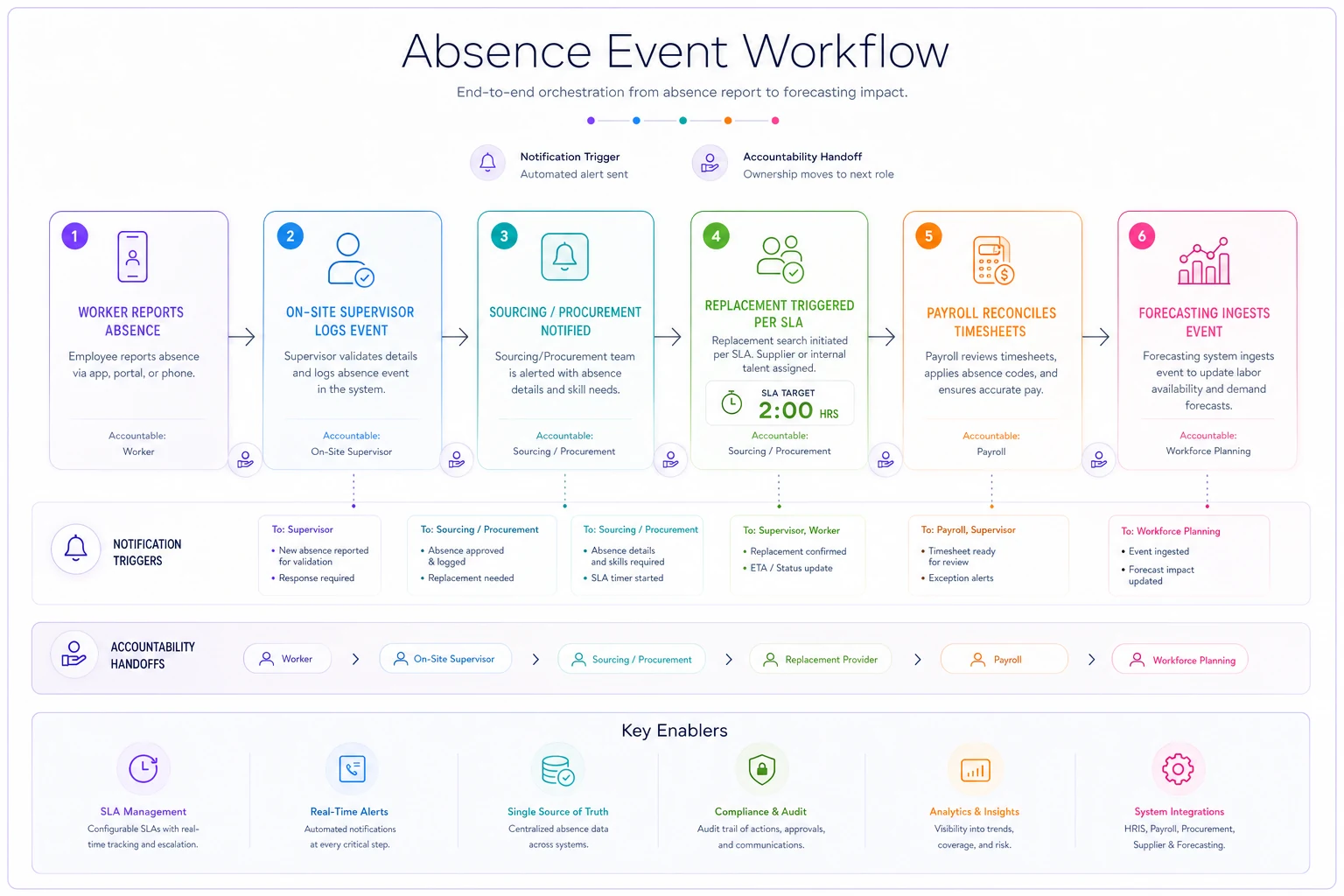
The critical rows are the last two. Somebody has to be accountable for making sure every contingent absence event lands in the forecasting model, and somebody has to own the monthly pattern review. In most organizations, those two rows are effectively blank — which is exactly why the same no-show pattern repeats every peak season.
Once the RACI is agreed on, print it and put it somewhere the shift lead can actually see it. A RACI that lives in a shared drive nobody opens is the same as no RACI.
A real scenario: the Monday peak that kept failing
A mid-sized regional 3PL running a distribution center leaned on an agency for roughly 40–50 contingent pickers and loaders on top of their permanent crew. Their Monday and post-holiday peaks were consistently short-staffed, and they'd been blaming the agency's reliability for the better part of a year.
When they actually pulled the numbers, the story was different. No-show rates weren't wildly high overall — somewhere in the 8–10% range on average — but they clustered hard on Mondays and the day after any long weekend, spiking closer to 20%. And because no one was logging notification times, they had no idea the agency was often learning about absences early but not calling the DC until the shift had already started.
-
They classified their contingent roles and set a 2-hour report-by SLA with a top-up remedy in the renewed agency contract.
-
They named the on-site shift lead as Accountable for logging every absence event the moment it was known.
-
They started feeding those events into their weekly staffing forecast, which meant Mondays got pre-loaded with a slightly larger requested headcount to absorb the known pattern.
Within about two quarters, the effective coverage gap on peak Mondays dropped by more than half. They didn't eliminate no-shows — you never do — but they stopped being surprised by them, and the overtime spend they'd been quietly eating shrank into something they could actually budget for. The biggest single change wasn't any one control; it was that all three functions were finally looking at the same event.
Where the right systems quietly help
You can run all of this on spreadsheets and shared inboxes when you have one site and one agency. It stops working the moment you scale — multiple locations, multiple agencies, a mix of gig platforms and direct contractors. At that point the manual coordination between sourcing, payroll, and forecasting becomes the bottleneck, not the labor itself.
This is where operational software with sensible automation earns its place. Not as a magic fix, but as connective tissue: a single place where an absence event is logged once, automatically notifies the right owner per the RACI, checks it against the SLA clock, flags a contract breach when the replacement window blows past, and drops the event into the data feeding your forecast — without three people re-keying it into three systems.
Pro-tip: prioritize automating the single-source absence log first—accurate inputs make SLA clocks and forecast feeds useful.
AI-assisted alerting is genuinely useful for surfacing patterns humans miss, like a specific agency's creeping Monday no-show rate, before it turns into a quarter of missed peaks. The point isn't to remove judgment from the process. It's to make sure the absence event doesn't fall through the cracks between functions, which is where nearly all the cost actually hides.
When this level of structure makes sense — and when it doesn't
When it's worth building the full blueprint: You rely on contingent labor for time-sensitive or throughput-critical work, you use more than one agency or platform, or your contingent no-shows regularly trigger overtime or missed SLAs of your own. If a single no-show can cascade into a shift-level failure, you need the matrix, the clauses, and the RACI.
When it's overkill: If your contingent use is a handful of project contractors with soft deadlines and no shift-critical coverage, a full SLA matrix is more process than the risk justifies. A simple notice expectation and a named backup are enough.
Who should not attempt this yet: If you don't currently have a reliable way to even know when a contingent worker is absent, start there. Building enforcement mechanisms on top of a broken detection layer just gives you precise documentation of chaos. Get the report-by discipline working first, then layer on the remedies and the forecasting feedback.
Pulling it together
Contingent worker absence isn't really a staffing problem — it's a coordination problem wearing a staffing costume. The absences themselves are inevitable. The damage comes from the fact that the report never reaches the right person fast enough, the contract has no teeth, and the event never makes it back into the plan.
Classify your worker types so you're not applying one response to every situation. Attach an enforceable SLA and replacement expectation to each type, backed by contract clauses that put real financial weight behind the notice window and the no-fill remedy. Then wire sourcing, payroll, and forecasting together with a RACI so the same event doesn't get discovered three separate times and acted on by no one.
Contingent worker absence isn't really a staffing problem — it's a coordination problem wearing a staffing costume. The absences themselves are inevitable. The damage comes from the fact that the report never reaches the right person fast enough, the contract has no teeth, and the event never makes it back into the plan.
Classify your worker types so you're not applying one response to every situation. Attach an enforceable SLA and replacement expectation to each type, backed by contract clauses that put real financial weight behind the notice window and the no-fill remedy. Then wire sourcing, payroll, and forecasting together with a RACI so the same event doesn't get discovered three separate times and acted on by no one.
Ready to optimize your workforce absence management?
Join 2,000+ HR teams using Absencely to reduce administrative burden, improve compliance, and boost employee satisfaction.