

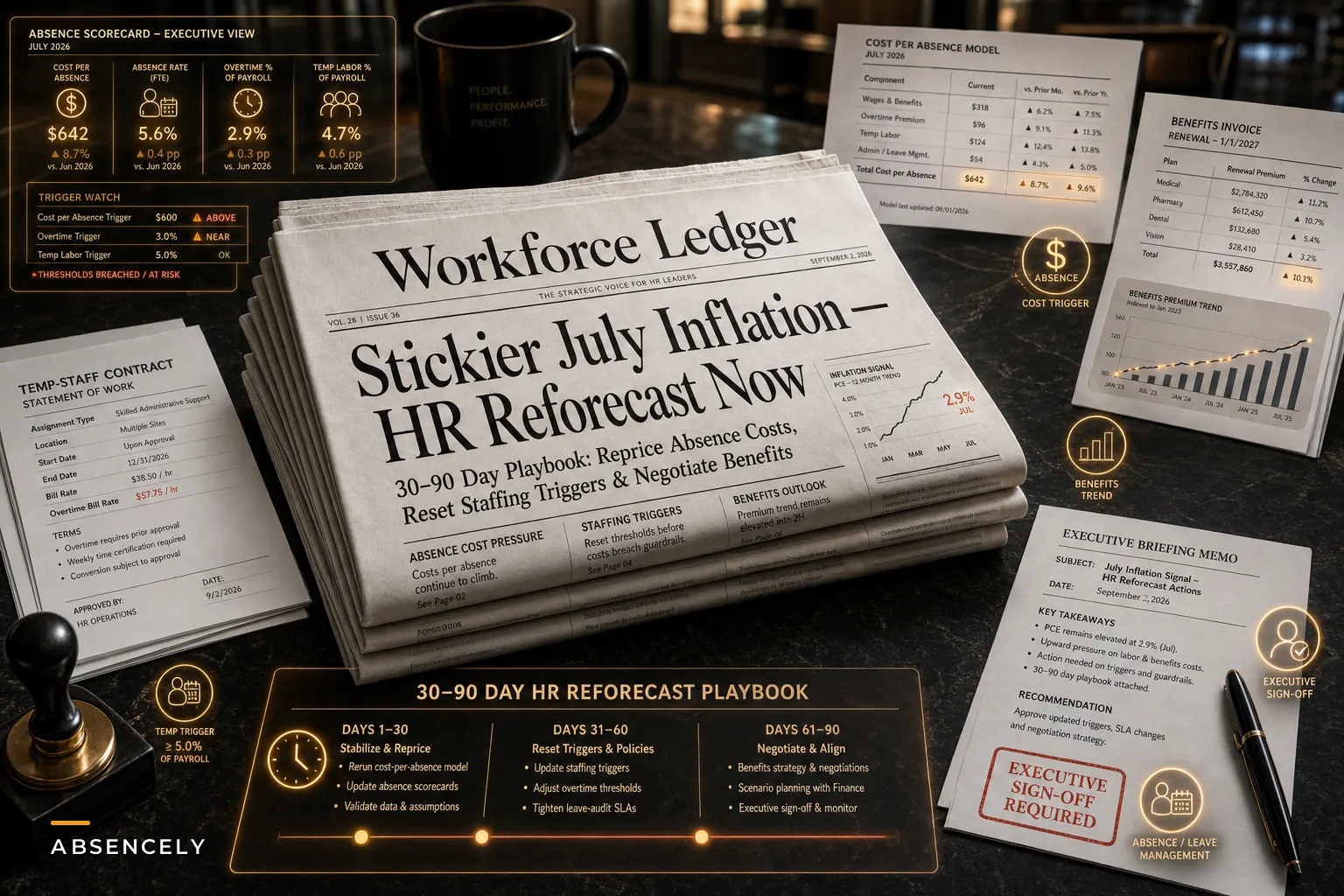

The July PCE print didn't shock anyone, but it quietly broke a lot of HR budgets built on an assumption of cooling. Headline PCE rose 0.2% for the month and 3.7% year over year, while core PCE—the one the Fed actually watches—came in at 3.3% annually. As a CNBC report on the Fed's preferred inflation gauge noted, that's a stickier reading than most planners baked in, sitting comfortably above the 2% target with no real sign of breaking soon.
For finance, that's a rate-path story. For HR, it's more immediate and more annoying: every absence you cover next quarter costs more than the number sitting in your model right now. Backfill wages, temp markups, overtime premiums, benefits continuation during leave—those all move with the same inflation that just refused to cool. If your cost-per-absence assumptions were locked in during spring planning, they're stale. And the gap compounds every month you don't touch them.
This isn't about panic-cutting headcount. It's a disciplined 30–90 day reforecast so your absence budget reflects what it actually costs to cover people, not last cycle's optimism.
Why sticky inflation quietly wrecks absence budgets
Most absence budgets fail in a pretty boring way. Not because someone made a big error—because the inputs drifted while nobody was watching.
When you build a cost-per-absence figure, you're stacking a few things: the loaded wage of the absent employee, the cost of whoever covers (overtime, temp, or spread across the team), and benefits that keep running during certain leave types. Every one of those line items is inflation-sensitive. Overtime is wage-linked. Temp agency bill rates reset with the market. Benefits continuation tracks premium inflation, which, as the Reuters coverage of the July data makes clear, isn't easing back to plan anytime soon.
Reforecasting absence budgets under inflation requires separating three questions that usually get mashed together:
-
Did the number of absences change?
-
Did the cost per absence change?
-
Did the mix of absence types shift toward the expensive ones—paid leave, benefits-continuing leave?
A budget miss can come from any of those, and the fix is different for each. Most teams only track the first one.
The 30-day pass: repricing what you already have
The first 30 days aren't about forecasting the future. They're about correcting the present. Your existing absence data is fine—the cost assumptions attached to it are not.
Stop managing absences manually.
Absencely simplifies leave requests, approvals, and absence monitoring for your entire workforce.
- Automated leave tracking
- Manager approval workflows
- Compliance & reporting tools
No credit card required
Pull your last two quarters of actual absence records and re-run them against current cover costs, not the ones baked in during your last planning cycle. You're not changing behavior yet. You're just asking: if everything that happened last quarter happened at today's backfill prices, what would it have cost? That delta is your inflation exposure, and it's usually bigger than expected.
A realistic pattern: a mid-size operator running a distribution and light-manufacturing floor had budgeted around $410 as the fully-loaded cost of covering a single absent shift. Rerunning against current overtime rates and the temp agency's mid-year bill-rate reset pushed the real figure closer to $470–$490. Volume hadn't moved. But across roughly 1,900 covered shifts a year, that $70-ish drift added up to a six-figure hole nobody had flagged, because the monthly variance looked small enough to wave off each time.
Your 30-day repricing checklist:
-
Update loaded wage rates for every role that regularly needs backfill
-
Pull current temp agency bill rates, including any mid-year escalators buried in the contract
-
Recalculate overtime premiums against the new base wages
-
Refresh benefits-continuation costs for leave types where coverage keeps running
-
Re-run cost-per-absence for your top 3–4 highest-volume roles first
-
Flag the variance between old assumptions and new reality—that number is your headline finding
If you already maintain a proper cost-per-absence model, this is a repricing exercise, not a rebuild. If you don't have one, this is the moment it stops being optional.
The 30–60 day window: fixing the assumptions inside the forecast
Once the present is repriced, you can look forward without lying to yourself.
The common mistake here is applying a single flat inflation number across the whole absence budget. It feels tidy—"add 4% to everything"—but it hides the fact that different absence costs inflate at different speeds. Temp markups and overtime tend to run hotter than base wages during tight labor conditions. Benefits continuation moves with premium inflation, which is on its own trajectory. Bundling them into one blended rate smooths over exactly the exposure you're trying to see.
Build your forward assumptions in layers instead:
| Cost component | Typical inflation behavior | Reforecast approach |
|---|---|---|
| Base backfill wages | Moves with general wage growth | Apply current wage-growth rate, role-specific |
| Overtime premiums | Amplified—tracks base but at 1.5x | Recalculate off updated base, not last year's |
| Temp agency bill rates | Often outpaces internal wages | Use quoted current rates + known escalators |
| Benefits continuation | Tracks premium inflation separately | Pull renewal figures, don't estimate |
| Paid-leave mix shift | Not price—volume/composition | Model separately from cost inflation |
This layered view usually surfaces something worth knowing: the biggest driver of variance isn't the line item you assumed. Teams walk in convinced overtime is killing them and walk out realizing temp bill-rate escalators and benefits continuation are the real pressure. That changes what you actually do about it.
This is also where sticky inflation connects to a longer-horizon problem worth getting ahead of now. The same premium pressure hitting your leave-continuation costs feeds directly into next year's benefits budgeting. If you're already staring at rising renewal quotes, the broader recalibration of absence budgets against rising employer health costs for 2027 is worth working through now—because the July print isn't a one-quarter blip. It's the leading edge of the number your benefits broker is about to hand you.
The 60–90 day window: resetting triggers and getting executives aligned
By this point you've repriced the present and rebuilt the forward assumptions. The last stretch is operational: making sure the systems that react to absence are calibrated to the new cost reality.
The most overlooked piece is trigger thresholds. Temp-activation rules, overtime-approval gates, escalation triggers—most of these were set against old cost assumptions. When a covered shift cost $410, letting managers approve overtime up to a certain dollar point made sense. At $480, that same threshold quietly authorizes more spend than leadership thinks it did. Every dollar-denominated trigger in your absence workflow needs a second look after a repricing.
A visual workflow for the trigger-reset sequence:
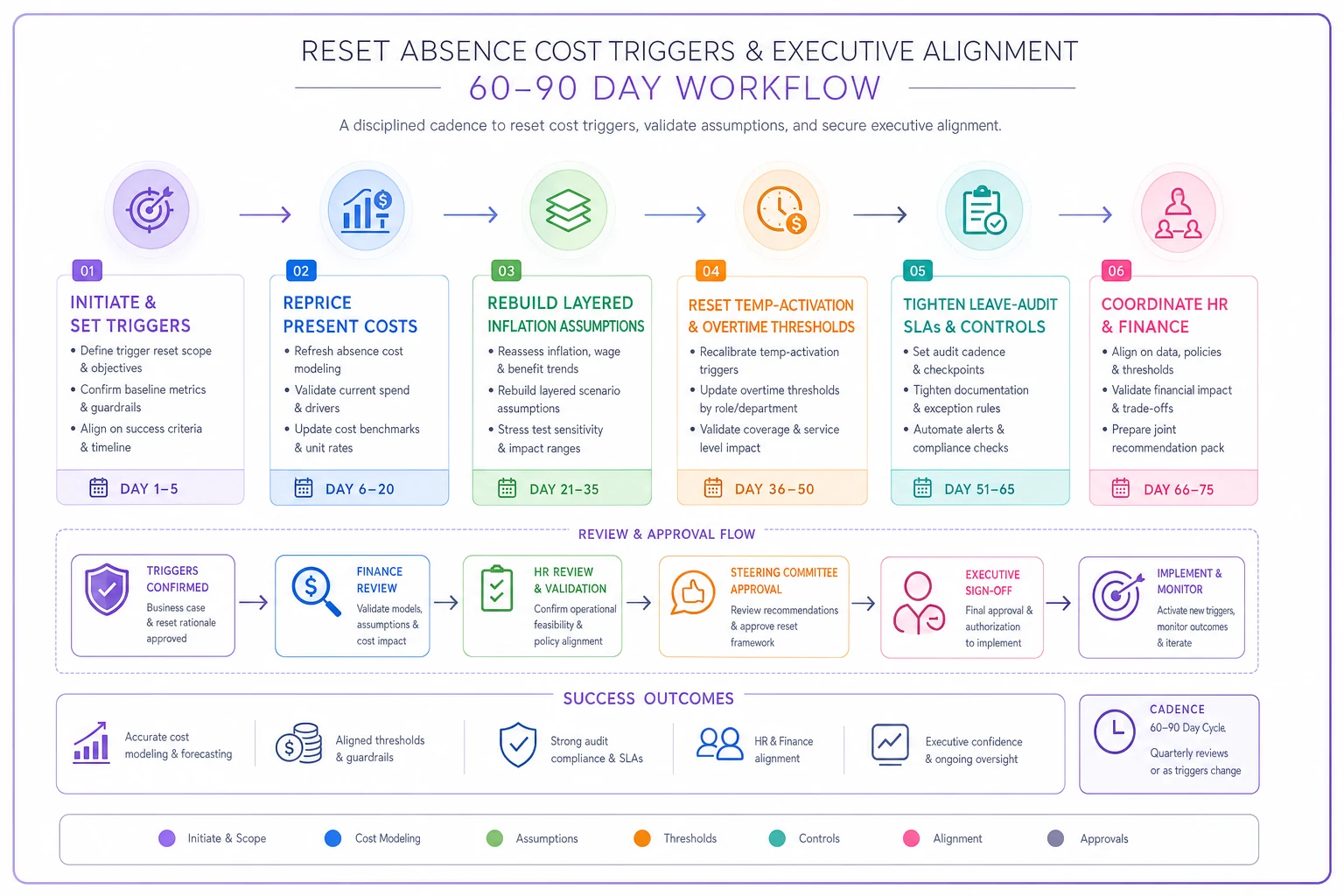
A clean 60–90 day sequence:
-
Reset temp-activation cost triggers against updated bill rates so activation decisions reflect real economics
-
Re-tier which roles justify overtime versus temp versus spreading coverage—inflation may have flipped the cheapest option
-
Tighten leave-audit SLAs, because when each absence costs more, the payback on catching misclassified or preventable leave goes up
-
Rebuild your executive absence view around cost variance, not just absence counts
-
Bring finance into a shared reforecast conversation before the number is final, so benefits-versus-headcount tradeoffs get discussed once, not litigated twice
That last point matters more than it sounds. When HR reforecasts absence costs in a vacuum and hands finance a bigger number, it reads like overspending. When both teams walk through the inflation math together, it reads like disciplined planning. Same number, completely different reception.
When a full reforecast makes sense—and when it's overkill
-
Do the full 90-day pass if backfill and temp costs are a meaningful line item, if you had material absence-budget variance last quarter, or if benefits renewals are landing soon.
-
Do a lighter repricing only if your absence volume is low, coverage is mostly absorbed internally without overtime, and your last variance was inside a couple of points.
-
Skip the trigger reset only if your activation thresholds are already percentage-based rather than dollar-based—those adjust automatically and don't drift the same way.
The teams that get burned are usually the ones that assume they're in the second category when they're actually in the first, because they never separated cost drift from volume in the first place.
Your model is only as fresh as its inputs
The July inflation number is the hook, but the real lesson has a longer shelf life. Absence budgets don't go wrong all at once—they degrade quietly as their inputs age. Sticky inflation just makes the degradation faster and harder to ignore.
Most teams treat cost-per-absence as a set-and-forget figure built once a year. In a stable-price environment you can get away with that. When core prices are running above 3% and refusing to cool, a once-a-year model is wrong for eleven of those twelve months. The organizations that stay ahead aren't the ones with fancier forecasting—they're the ones that made repricing a routine rather than an annual event, and who keep their cost inputs somewhere that updating a wage rate or a temp bill rate automatically flows through every downstream trigger and report.
That's the real operational upgrade hiding inside this news cycle. Not a smarter forecast—a living one, where assumptions get refreshed on a cadence, variance gets attributed to the right cause, and the number in front of your executives actually reflects what covering an absence costs today, not what it cost when you last opened the spreadsheet.
Run the 30–90 day pass now. The next print probably won't be dramatically cooler, and the gap between your assumptions and reality only grows the longer you leave it.
Ready to optimize your workforce absence management?
Join 2,000+ HR teams using Absencely to reduce administrative burden, improve compliance, and boost employee satisfaction.