

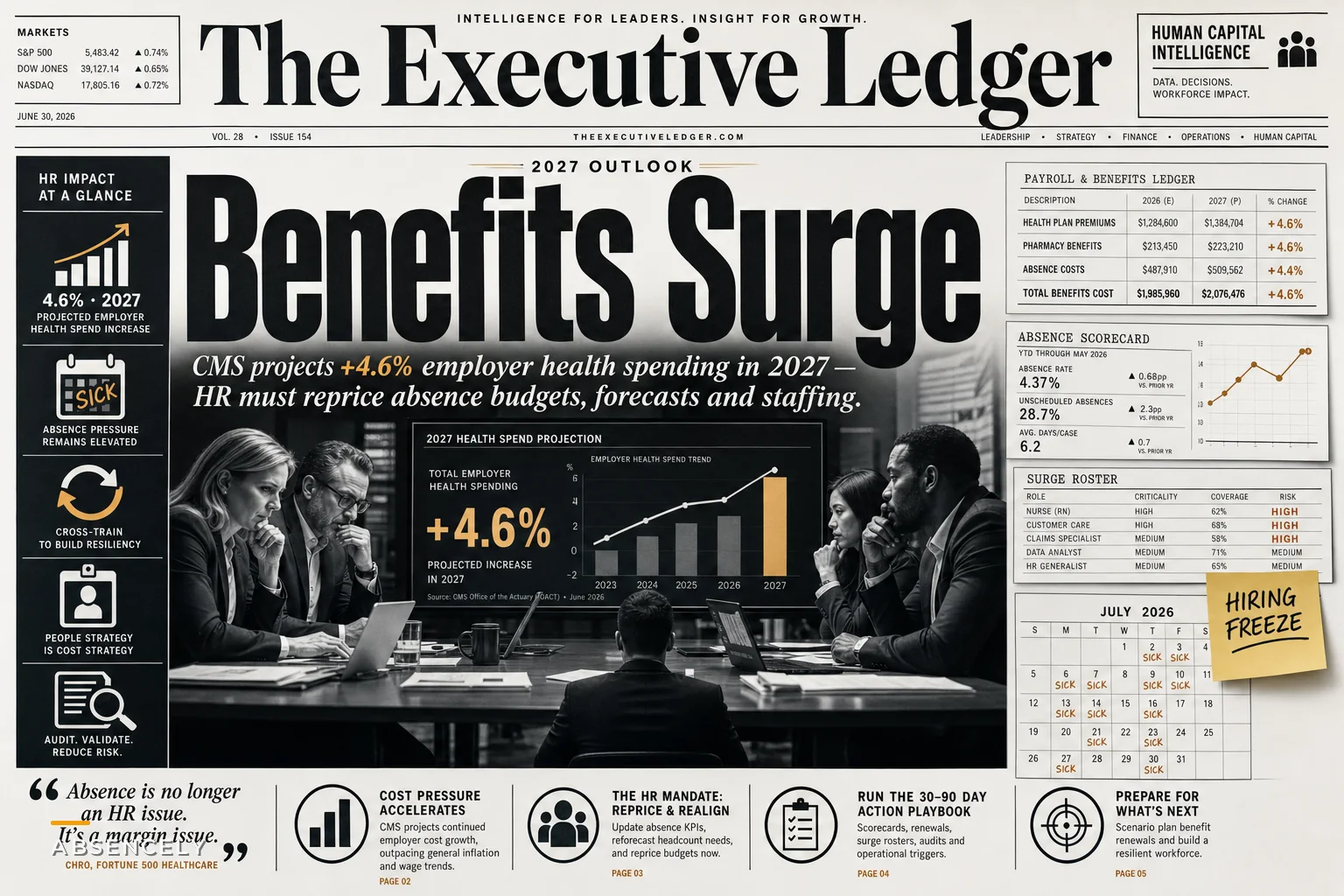

Last week, I watched an HR director stare at her laptop screen for a solid thirty seconds after pulling up the latest CMS projections. The federal actuaries just published their updated forecasts, showing employer health premiums climbing toward $9,627 per employee by 2027—a 4.6% jump from this year. She wasn't shocked by the number itself. She was mentally calculating what that meant for her absence budget, overtime costs, and whether she'd still be able to fill that third warehouse supervisor position they'd been planning. That's the conversation happening everywhere right now. Not about the headline number, but about everything downstream from it. When your health benefit line item grows by several hundred thousand dollars, something else has to give—and that "something else" usually shows up first in how you handle absences, coverage gaps, and staffing buffers.
The real budget squeeze nobody talks about
Most CFOs treat rising health premiums as a straightforward benefits problem. Negotiate harder with carriers, shift more costs to employees, maybe switch to a high-deductible plan. Standard playbook.
But when premiums spike, companies start making invisible cuts to their absence management infrastructure. They delay hiring the floater for the customer service team. They quietly reduce the overtime budget that covers unexpected sick days. They push managers to "make do" instead of bringing in temporary coverage.
This pattern showed up repeatedly during the 2008–2010 premium surge. A manufacturing client kept their health benefits intact but cut their pool of on-call workers who handled absences. Within six months, overtime costs had blown past what they'd saved—and they lost two major accounts when flu season hit and they couldn't maintain production schedules.
The math gets particularly brutal for companies with 75–200 employees. Too big for small group plans, too small to self-insure effectively. A 4.6% increase on employer health premiums for 2027 means finding an extra $35,000 to $70,000 just to maintain current benefit levels. That's essentially a full-time position worth of budget that evaporates.
Where the money actually comes from
Budget reallocation follows predictable patterns when health costs spike. The typical progression goes something like this.
Stop managing absences manually.
Absencely simplifies leave requests, approvals, and absence monitoring for your entire workforce.
- Automated leave tracking
- Manager approval workflows
- Compliance & reporting tools
No credit card required
First, companies freeze "nice to have" positions. The part-time admin for the warehouse, the receptionist covering lunches—on hold. These seem like easy cuts until you realize those roles were quietly preventing absence-related disruptions.
Second, they tighten PTO approval. Requesting time off suddenly requires more documentation, longer advance notice, stricter blackout periods. Managers get unofficial pressure to deny overlapping requests. This doesn't reduce absences—it just makes them less predictable when employees call in sick instead of scheduling time off properly.
Third, overtime budgets get slashed. Finance sees overtime as a variable cost they can control. But when someone's unexpectedly absent and you can't authorize coverage, work either doesn't get done or gets done poorly by whoever's available.
The hidden damage shows up in morale and retention. When a company pays rising premiums but simultaneously makes work-life balance worse through restrictive absence policies, employees feel squeezed from both directions. They're paying more for health benefits while having less flexibility to actually use them.
Rethinking absence costs under new premium pressures
Traditional absence costing models break when health premiums jump significantly. Most companies run a simple calculation: employee's daily rate plus replacement worker cost plus productivity loss.
Rising employer health premiums for 2027 force a more complicated picture. You also need to factor in:
Coverage quality degradation costs: When you can't afford proper absence coverage, mistakes increase. A distribution center tracked this directly—error rates jumped 23% after they eliminated their flex coverage pool to offset premium increases.
Cascade scheduling costs: Without buffer capacity, one absence triggers multiple schedule changes. Each change costs roughly 45 minutes of manager time plus the productivity hit from last-minute reassignments.
Retention impact costs: Restrictive absence policies implemented to save money often trigger turnover. Replacing an experienced employee runs anywhere from $4,000 for entry-level roles to $15,000+ for specialized positions—far exceeding whatever you saved by tightening the policy.
Customer service degradation: This is the killer for small businesses. When absence coverage gets cut, customer-facing roles suffer first. One retailer tracked a 12% drop in repeat customer visits after eliminating overlap shifts that covered breaks and unexpected absences.
These costs don't show up cleanly on a budget spreadsheet, which is exactly why they keep getting ignored until the damage is already done.
Building a strategic absence reserve
Smart operators are creating dedicated budget allocations to protect operational continuity when someone's out. This isn't just about having substitute workers on call—it's about building financial flexibility into your absence management system before premium increases force your hand.
Start by calculating your true absence exposure. Take your average monthly unplanned absences—typically around 3–4% of total work days—and multiply by 1.5x your average hourly loaded labor cost. That's your baseline coverage need. Add 20% for cascade effects: the additional disruption from last-minute scheduling changes. For a 100-person company with average wages around $25/hour, you're looking at roughly $30,000–$40,000 annually in real absence coverage costs. That sounds like a lot until you compare it to blown deadlines, lost customers, or burned-out employees carrying colleagues they shouldn't have to.
``
[Identify Absence Risk] → [Calculate True Exposure] → [Allocate Reserve Budget] → [Deploy: Cross-training / Staffing Relationships / Scheduling Tech] → [Monitor and Adjust]
``
-
Cross-training investments that create internal flexibility
-
Relationships with staffing agencies for predictable surge needs
-
Technology that helps predict absence patterns before they create crises
-
Clear escalation protocols that prevent small gaps from becoming major disruptions
None of this is complicated in concept. The execution is where most companies fall short because they wait until they're already under pressure to build these systems.
Here's a quick visual of the recommended flow.
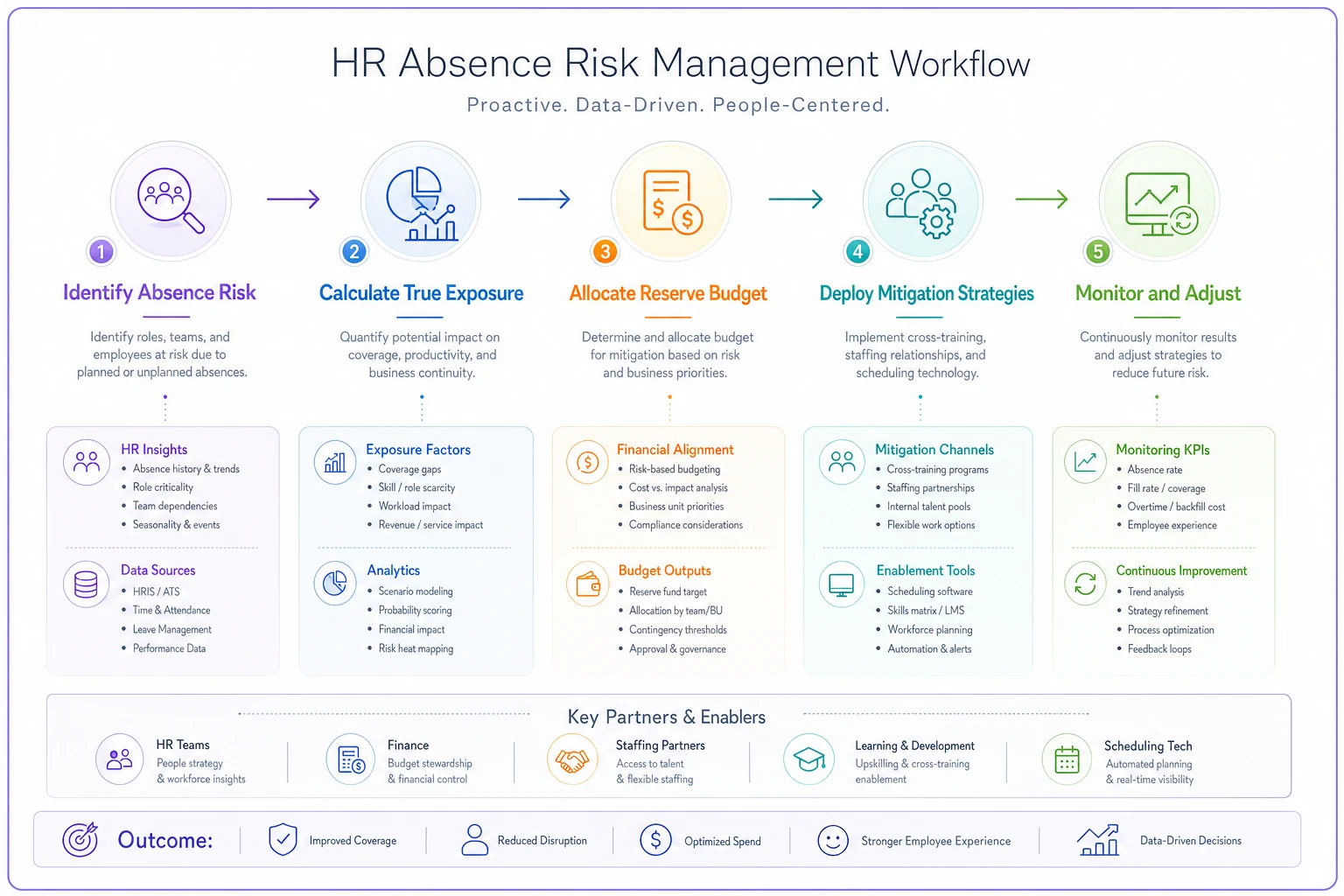
Use the workflow to align stakeholders on who owns each step and the timing for reserve allocation.
The forecasting adjustment nobody's making
Most workforce planning models use historical absence rates to project future staffing needs. But when employer health premiums jump significantly, absence patterns shift in ways that aren't obvious until you're already dealing with them.
Employees facing higher health insurance contributions often delay preventive care, which leads to more severe illnesses later. A regional bank saw this directly—after shifting to high-deductible plans to control premium costs, their average sick leave duration increased from 2.3 days to 3.1 days within 18 months.
Mental health absences also spike when financial pressure increases. The combination of higher costs and tighter policies creates stress that shows up as more FMLA claims, more stress-related sick days, and presenteeism—employees showing up but working at reduced capacity.
Your forecasting models need these adjustment factors built in:
| Traditional Factor | 2027 Adjustment Needed |
|---|---|
| Historical absence rate | +15–20% for delayed care impact |
| Average absence duration | +0.5–1 day per instance |
| FMLA/stress leave claims | +25–30% increase likely |
| Presenteeism productivity loss | 10–15% capacity reduction |
| Coverage complexity | 2x coordination time needed |
These aren't precise predictions—every organization is different. But ignoring these adjustments means your 2027 staffing plans will be off from day one. Build in the buffer now, revisit it in Q2, and adjust based on what you're actually seeing.
Creating coverage plays for different budget scenarios
The smartest response to rising premiums isn't choosing between benefits and staffing. It's building operational flexibility that works across multiple budget scenarios.
Scenario A: Absorb the full premium increase If you're eating the entire 4.6% increase, you need maximum operational efficiency elsewhere. Tighter absence approval processes, stricter documentation requirements, absence tracking systems that catch patterns early. You're trading flexibility for cost control.
Scenario B: Cost-shift to employees Pushing premium increases to employees seems like the easy path, but it changes absence patterns you'll need to prepare for. Expect more unplanned absences as employees skip preventive care, longer recovery times when they do get sick, and increased turnover in your lowest-paid positions where the increase hits hardest proportionally.
Scenario C: Hybrid approach with operational offsets This is where most mid-sized companies land—absorbing part of the increase while finding operational savings elsewhere. The key is identifying which cuts actually save money versus which ones just defer costs.
Eliminating a floater position might save $40,000 annually, but if it results in just two lost customers due to service gaps, you've probably lost money overall. Better to keep the floater and find savings through process automation or vendor consolidation.
Technology leverage points when budgets tighten
When premium increases squeeze budgets, the instinct is to cut technology spending. That's usually the wrong call.
Manual absence management costs the average 100-person company roughly 15 hours weekly in administrative time—calling around for coverage, updating schedules, notifying affected teams. That's $30,000+ annually in hidden labor costs that most companies never bother to calculate.
Modern absence management platforms handle these workflows automatically. When someone requests time off, the system checks coverage requirements, identifies qualified substitutes, sends notifications, and updates affected schedules. The coordination that used to take hours happens in minutes.
AI-powered operational software can also surface absence patterns before they become problems—flagging when requests cluster in problematic ways, identifying early burnout signals, suggesting coverage arrangements that minimize disruption. This isn't about replacing manager judgment. It's about giving managers better information to work with before they're already in crisis mode.
The ROI math is pretty straightforward. If automation prevents just two emergency overtime shifts monthly (saving roughly $500) and cuts administrative time by 10 hours weekly (saving another $500 or so), you're looking at around $12,000 in annual savings. Real money when you're trying to offset a premium increase.
Prioritize automation that reduces weekly administrative hours first—those savings compound quickly.
Real money when you're trying to offset a premium increase.
The compliance wild card
Rising premiums create compliance risks most companies don't anticipate. When budgets tighten, companies implement absence policies that inadvertently cross lines under FMLA, ADA, or state leave laws.
The pattern repeats: company faces premium increase, rolls out an "attendance improvement program," accidentally disciplines an employee for FMLA-protected absences, faces a lawsuit that costs ten times what they saved.
Dangerous moves to avoid:
-
Blanket attendance policies that don't account for protected leave. You can't treat FMLA absence the same as unexcused absence, regardless of budget pressure.
-
Reducing headcount to eliminate coverage needs. Laying off employees, then denying leave requests because you're "short-staffed," can trigger retaliation claims.
-
Informal pressure tactics. Managers subtly discouraging leave through scheduling punishment or unfavorable assignments opens serious liability.
-
Documentation shortcuts. When you're stretched thin, documentation suffers—and poor absence documentation is what loses lawsuits.
Build compliance into your budget response from the start. Yes, it costs more upfront to properly track intermittent leave and maintain solid documentation. It costs far less than the alternative.
Making the executive case
Your CFO and CEO need to understand that employer health premiums for 2027 and absence costs aren't separate line items—they're interconnected operational expenses requiring coordinated planning.
Frame the conversation around total workforce cost, not individual budget lines. According to BenefitsPro's analysis, the average employer will spend nearly $10,000 per employee on health benefits alone by 2027. Add absence costs, overtime coverage, and administrative overhead, and total workforce costs can swing 15–20% based on how well you manage the interconnections.
Present three scenarios with clear financial impact:
-
Status quo
Absorb premium increases, maintain current absence policies, accept operational degradation - Cost: Premium increase + 10–15% productivity loss - Risk: High turnover, compliance exposure
-
Aggressive cost control
Shift costs to employees, tighten absence policies, reduce coverage staffing - Cost: Reduced premium impact but increased operational friction - Risk: Morale crisis, customer service degradation
-
Strategic optimization
Selective cost sharing, invested absence management, automated coordination - Cost: Moderate premium impact + technology investment - Risk: Implementation complexity
Most executives move toward option 3 once they see the full picture. The key is connecting health premium decisions to operational outcomes leadership actually cares about: customer satisfaction, retention, and sustainable growth.
This is also where your executive absence scorecard matters. When you can show leadership exactly how absence patterns affect revenue, customer metrics, and operational efficiency, the budget conversation shifts from cost-cutting to investment optimization.
Moving forward with realistic expectations
The 4.6% increase heading into 2027 isn't catastrophic, but it's enough to force hard choices. Companies that handle this well won't be the ones that simply absorb the cost or slash benefits—they'll be the ones that recognized the operational implications early and adjusted their entire absence management approach before open enrollment arrived.
Start with an honest assessment of your current absence costs. Not just the obvious ones, but the hidden coordination, coverage, and quality impacts. Then model how different premium response strategies affect those costs. You'll likely find that investing in better absence management infrastructure pays for itself through reduced disruption, even as premiums climb.
The timeline matters here. Open enrollment for 2027 starts in a few months for most companies. Waiting until premium notices land means making reactive decisions under pressure. Build your absence contingency plans now, while there's still time to evaluate options properly.
Employees are also watching how leadership handles this. They know premiums are rising—they see it in their own paychecks. What they're paying attention to is whether leadership responds thoughtfully or just pushes costs downstream. Companies that maintain operational flexibility while managing costs carefully will keep their best people. Those that squeeze employees from multiple directions will face expensive turnover at exactly the wrong time.
Update your absence forecasting models, build strategic reserves where possible, use technology to reduce administrative burden, and keep compliance front and center. Treat rising health premiums and absence management as connected challenges—because that's exactly what they are. The companies that come out ahead won't necessarily have the biggest budgets. They'll be the ones that planned early, understood the interconnections, and made deliberate choices rather than reactive ones.
Ready to optimize your workforce absence management?
Join 2,000+ HR teams using Absencely to reduce administrative burden, improve compliance, and boost employee satisfaction.