

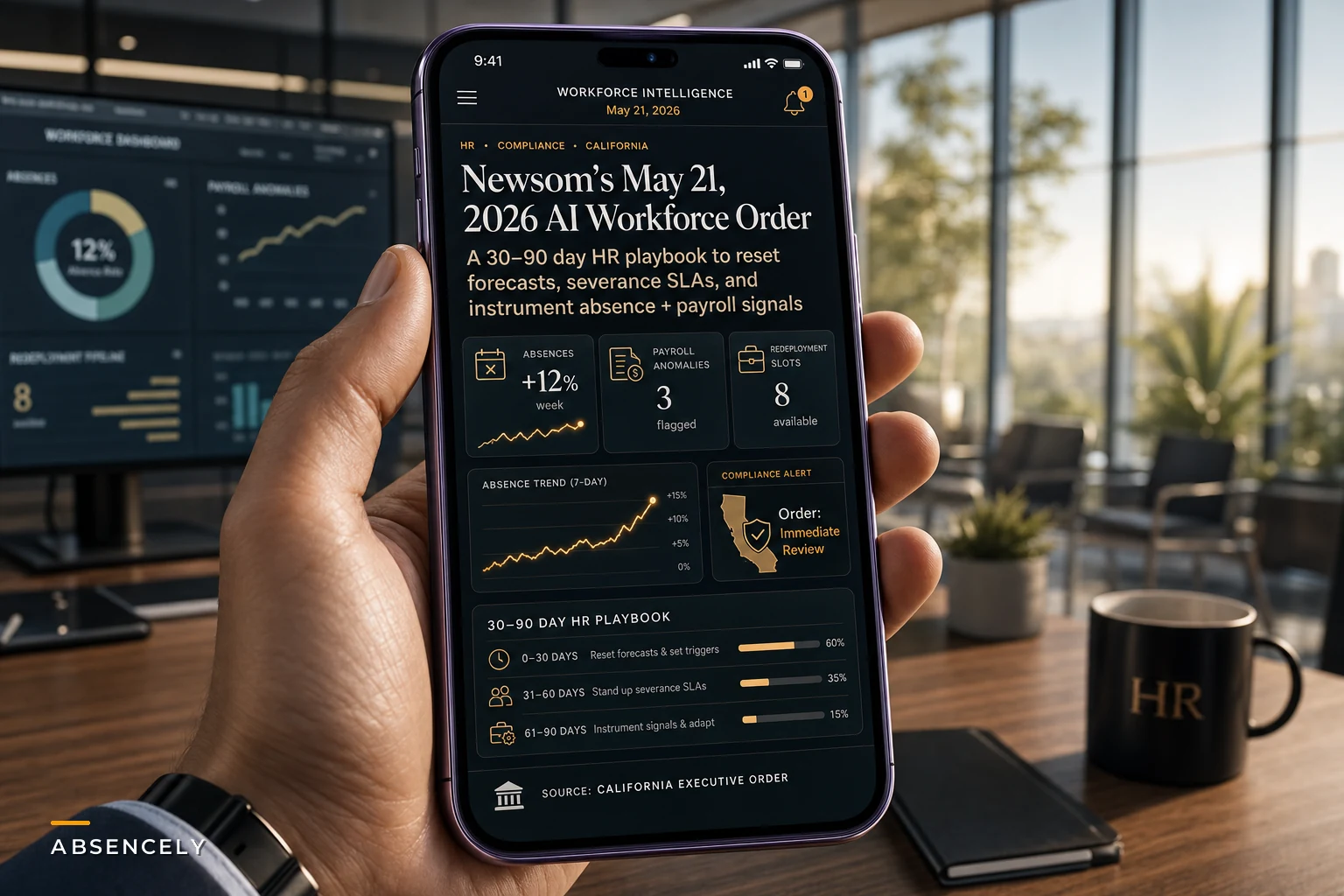

Last week California dropped something that made every HR director I know stop mid-coffee. Governor Newsom signed an executive order directing state agencies to prepare for AI-driven workforce disruption—including developing severance standards, monitoring workforce shifts, and creating early warning systems for job displacement.
This isn't another tech regulation. California basically said "AI displacement is happening faster than you think, and we're tracking it now."
This changes everything about how you plan staffing for 2027 and beyond. Not because California sets your policies, but because when California starts requiring workforce disruption reporting, other states follow within 18 months. Pay transparency laws, sick leave mandates, contractor classification rules—same pattern.
The order specifically mentions creating "early warning indicators" and "workforce transition assistance programs." Companies will need documented proof they saw changes coming and had plans in place. Your absence patterns, attrition data, and staffing forecasts just became compliance documents.
Why traditional staffing models break when AI enters the picture
Most HR departments still forecast staffing based on historical patterns—you lose 3% monthly in customer service, 2% in operations, maybe 5% in sales. Plan backfills accordingly. Math that's worked since the 1980s.
AI displacement doesn't follow those patterns.
When a company implements AI for document processing, they don't gradually reduce headcount over six months. They identify 40% redundancy in one department while simultaneously needing 20% more people elsewhere to manage the new systems. The transitions happen in waves, not trickles.
A mid-sized insurance company went through this last year. Their claims processing team of 85 people seemed stable—normal 2-3% monthly turnover, standard absence rates around 8%. Then they rolled out an AI claims review system. Within four months, they'd reassigned 35 processors but needed 15 new "claims automation specialists" who understood both business logic and AI tools.
Their HR team had zero framework for this. No playbook for mass reskilling. No early indicators that entire job categories were shifting. They watched their staffing models explode.
Reading the early signals before displacement hits
AI displacement shows up in your absence data months before layoffs become necessary.
Stop managing absences manually.
Absencely simplifies leave requests, approvals, and absence monitoring for your entire workforce.
- Automated leave tracking
- Manager approval workflows
- Compliance & reporting tools
No credit card required
Voluntary absence spikes in targeted departments
People unconsciously disengage when they feel their role diminishing. A packaging company saw Friday absences jump from 6% to 14% in their inventory team three months before announcing an automated warehouse system.
Training participation drops off a cliff
Employees stop signing up for professional development in roles they sense are disappearing. When Excel training attendance drops below 20% for admin staff, they've usually figured out automation is coming.
Lateral transfer requests surge
Smart employees start positioning for moves. If transfer requests from one department triple in a quarter, that's not coincidence. That's collective intelligence.
Overtime volunteers disappear
People stop fighting for extra hours in roles they expect to vanish. When a normally competitive overtime list sits empty, your workforce knows something you might not.
Track training enrollment and transfer requests weekly to spot role risk before spikes in unplanned absence.
The California order mentions "early warning indicators" explicitly. These behavioral shifts ARE your early warning system—if you're tracking them.
Building displacement‑ready staffing models
Traditional workforce planning assumes stability. AI-era planning assumes constant reorganization.
Instead of planning for 10% annual turnover evenly distributed, you need to model scenario-based disruption. A logistics company might face:
-
60% reduction in dispatch coordinators over 18 months
-
30% increase in route optimization analysts
-
40% of remaining dispatchers needing new skills
-
6-month overlap period requiring 120% staffing
This isn't headcount math anymore. It's transformation planning.
Start with role vulnerability assessments. Not the generic "will AI replace accountants" stuff, but specific task analysis. In payroll processing:
| Task | Automatable |
|---|---|
| Data entry | 80% automatable now |
| Exception handling | 40% automatable within two years |
| Compliance interpretation | 10% automatable |
| Employee consultation | Not automatable |
Map that against your actual headcount. If you have 12 payroll specialists spending 70% of their time on data entry and basic processing, you're looking at 8-9 role restructures within 24 months.
Reskilling velocity becomes your new KPI
California's order emphasizes "workforce transition assistance." In practice, that means proving you gave employees legitimate paths forward before displacement.
Most companies can't reskill fast enough.
A typical reskilling program moves people from Role A to Role B in 6-12 months. But AI implementation timelines are compressing to 3-4 months. You need employees productive in new roles before their old roles fully disappear.
-
Parallel pathing during transition Employees spend 60% time in current role, 40% learning new responsibilities. Seems inefficient until you realize the alternative is either rushed layoffs or carrying dead weight.
-
Skills-first reorganization Stop thinking about roles entirely. Map skills to tasks, tasks to outcomes. A customer service rep who's great at de-escalation might become an AI training specialist for conversation flows. The skill transfers even if the role title completely changes.
These transitions aren't clean or easy. But they're manageable with proper planning and documentation.
The compliance documentation you'll wish you'd started yesterday
When states start requiring displacement reporting—and they will—they'll want evidence of proactive planning. California's framework hints at what's coming:
Displacement impact assessments Before implementing AI systems, document which roles are affected, what percentage of tasks are automated, and what transition options exist. This isn't a one-page memo. It's a full workforce analysis.
Reskilling opportunity documentation Every displaced employee needs a paper trail showing what retraining was offered, when it was offered, and why they did or didn't participate. "We posted training opportunities on the intranet" won't cut it.
Absence and attrition correlation data Connecting absence patterns to workforce changes becomes critical for showing you identified issues early. If absence rates spiked 40% in a department three months before layoffs, regulators will ask why you didn't intervene sooner.
Severance standardization records California specifically mentions developing severance standards. That means documenting not just what you paid, but why. Different packages for similar roles will trigger scrutiny.
The documentation burden is real, but so is the legal protection it provides when displacement decisions get challenged.
What happened when a healthcare staffing firm saw this coming
A medical staffing company started preparing for AI displacement 18 months ago, well before any mandates. They managed around 3,400 contractors across clinics and hospitals.
Their scheduling coordinators—28 people managing shift assignments—were obvious automation targets. Instead of waiting, they mapped every task schedulers performed (197 discrete tasks), identified which were automatable (142 within 18 months), found adjacent needs (compliance monitoring, credential verification, relationship management), and started cross-training immediately.
When they rolled out AI-assisted scheduling nine months later, 23 of 28 coordinators transitioned to new roles. The five who left received enhanced severance and job placement help.
They documented everything. Task analyses, training attendance, individual transition plans, exit interview summaries. When California-style mandates hit their state, they'll be ready.
The documentation process also helped them identify skills gaps they hadn't noticed before—several coordinators had developed expertise in vendor relationships that became valuable in new roles.
The AI staffing paradox nobody talks about
You often need MORE people during AI implementation, not fewer.
An accounting firm discovered this the hard way. They implemented AI for tax preparation, expecting to need fewer preparers. Instead, they needed AI trainers to teach the system their specific processes, quality reviewers to catch AI errors, client communicators to explain AI-assisted filings, and compliance specialists for AI audit trails.
For six months, they ran at 130% staffing just to enable the automation that would eventually reduce headcount by 25%.
This creates brutal planning challenges. You're hiring people to implement systems that eliminate jobs, often including their own. The ethical complexities alone could fill another article.
Building your 90‑day displacement readiness plan
Waiting for official mandates means you're already behind.
-
Week 1-2
Baseline your vulnerability
Pull task-level data for every role. Not job descriptions—actual time allocations. Survey managers on what percentage of each task could be automated with current technology. -
Week 3-4
Map your absence patterns
Look for departments with rising unplanned absence, declining overtime uptake, or surging transfer requests. These are your canaries in the coal mine. -
Week 5-6
Design transition pathways
For every vulnerable role, identify two potential transition paths. Don't promise anything yet—just map possibilities. -
Week 7-8
Create documentation frameworks
Build templates for displacement assessments, reskilling offers, and transition plans. You'll need these fast when changes accelerate. -
Week 9-12
Pilot with one department
Pick your most AI-ready department and run a full displacement planning exercise. Document everything. This becomes your template for broader rollouts.
The pilot phase often reveals assumptions that don't hold up under scrutiny, so build in time for adjustments.
Here's a concise visual of the 90-day process if you want a single reference point.
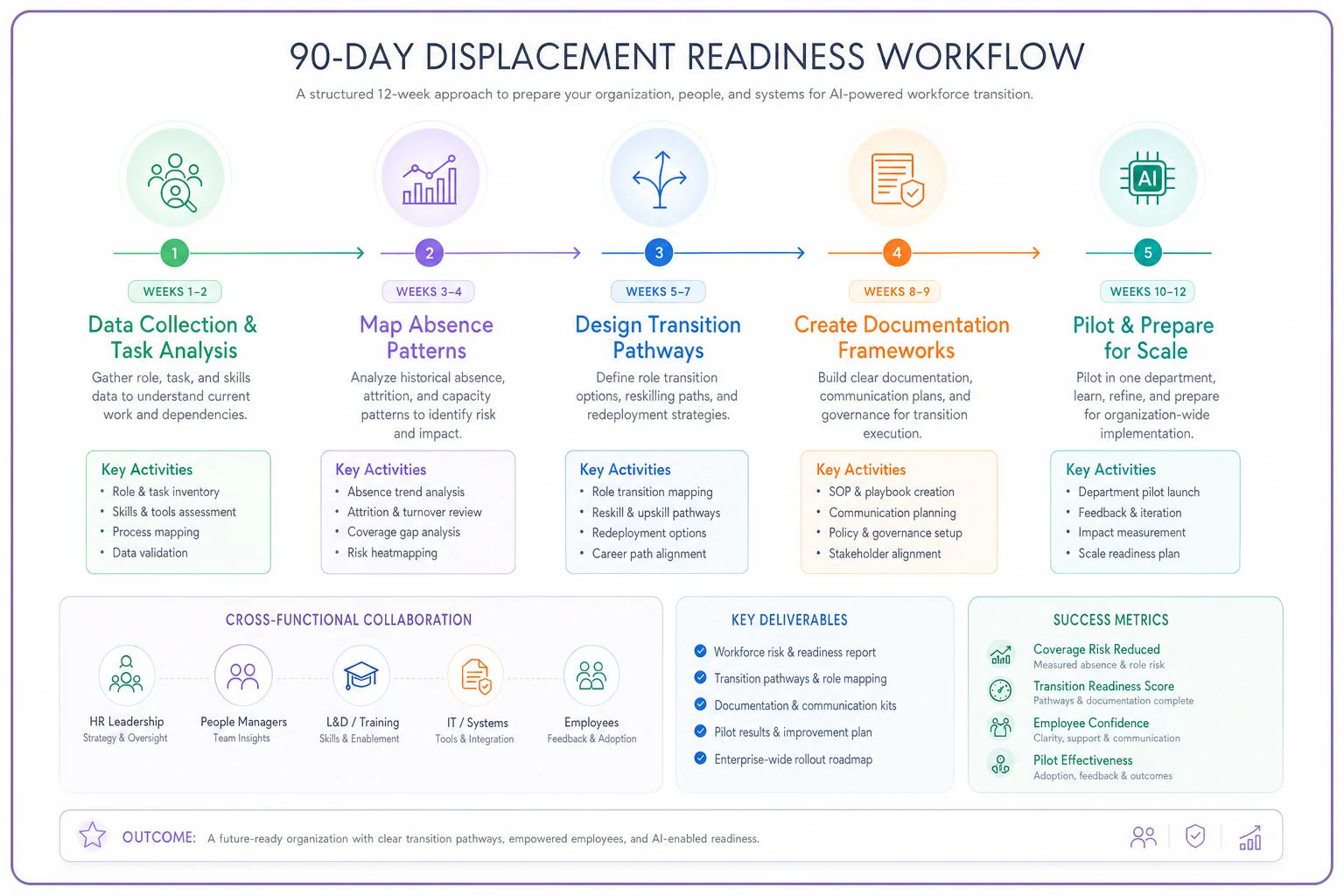
Use the visual as a checklist during your pilot so nothing gets missed.
Why speed matters more than perfection
The California order signals something bigger than just state compliance. It's acknowledgment that AI displacement is happening whether we're ready or not.
Companies treating this as a future problem are already losing talent. Your best employees—the ones who could successfully transition—are also the ones with options. They won't wait around to see if you have a plan.
An HR director lost three top data analysts last month because rumors spread about AI implementation. The company actually had solid reskilling plans, but hadn't communicated them. By the time they announced their "AI transformation with full employee support," the damage was done.
Start with the behavioral signals hiding in your absence data. Map the vulnerabilities in your workforce. Build transition pathways before you need them. Document everything like compliance auditors are already watching—because soon enough, they will be.
If you're still forecasting staffing like it's 2019, with simple turnover percentages and historical patterns, you're planning for a workforce reality that no longer exists. The California AI executive order isn't just about HR staffing in California—it's the starting gun for a compliance race that every state will eventually join.
Ready to optimize your workforce absence management?
Join 2,000+ HR teams using Absencely to reduce administrative burden, improve compliance, and boost employee satisfaction.