

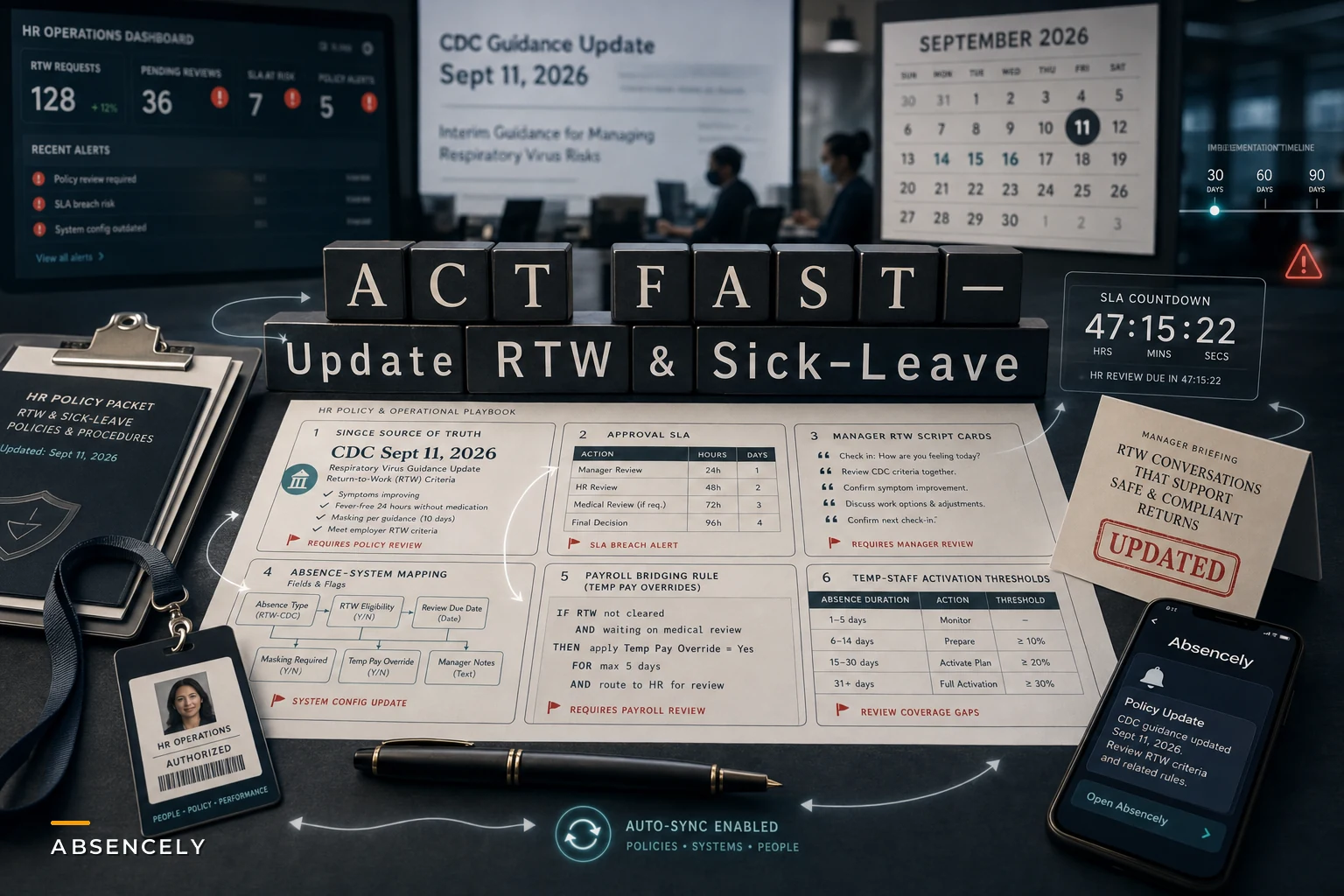

The CDC quietly moved the goalposts on September 11, 2026. Its updated Viral Respiratory Infections guidance for healthcare personnel streamlined both exposure handling and return‑to‑work criteria. Asymptomatic exposures generally no longer trigger work restriction — you move to source control and symptom monitoring through day 5. For symptomatic or test‑positive staff, the return threshold is now "at least 3 days, fever‑free for 24 hours, symptoms improving, and feeling well enough to work," with source control continuing through day 7.
On paper, that reads like a minor clinical tweak. In practice, if your absence policies, manager scripts, and payroll bridging rules were built around older, longer exclusion windows, every one of those assumptions just shifted underneath you. And the ripple doesn't stay in healthcare — plenty of non‑clinical employers anchor their sick‑leave logic to CDC language, either by habit or because their legal team cited it years ago and nobody ever went back to check.
This isn't really about the guidance itself. It's about what the guidance exposes: most absence programs are hard‑coded to a specific set of day‑count assumptions, and when those assumptions change, the whole machine quietly starts producing wrong answers.
The real problem: your policies are hard‑coded to numbers that just moved
Most absence programs don't actually encode principles — something like "return when no longer a transmission risk and well enough to work." They encode specific numbers. A 5‑day exclusion, a 10‑day window, whatever got written into the handbook during a prior respiratory season.
Those numbers live in a dozen disconnected places:
-
The employee handbook PDF
-
Manager quick‑reference cards
-
The absence system's approval logic and auto‑expiry rules
-
Payroll's sick‑pay bridging formulas
-
Occupational health clearance templates
-
Temp‑agency activation thresholds tied to expected absence length
When the CDC changes its criteria, HR usually updates the handbook and maybe sends a manager email. The other five places keep running the old math. That gap is where compliance exposure and payroll leakage actually live.
A Michigan Health & Hospital Association summary of the streamlined return‑to‑work guidance made the operational point clearly: shorter exclusion windows change expected absence durations, which is exactly the input your staffing and cost models depend on. If your model assumes a 7‑day average respiratory absence and reality is now closer to 3–4 days, surge triggers fire too late and cost forecasts run high.
Where the old assumptions quietly break
Below are the actual failure points, because "update your policy" is useless advice without knowing where the breakage happens.
Stop managing absences manually.
Absencely simplifies leave requests, approvals, and absence monitoring for your entire workforce.
- Automated leave tracking
- Manager approval workflows
- Compliance & reporting tools
No credit card required
Absence system auto‑expiry logic. Many systems auto‑close a respiratory absence case after a fixed number of days and prompt a return‑to‑work step. If that counter is still set to the old window, you'll either hold people out longer than necessary — paying for absence you didn't owe — or you'll have cases expiring on a schedule that has nothing to do with the actual clinical criteria.
Payroll sick‑pay bridging. This one costs real money. If your bridging rules assume a certain minimum absence duration before STD or extended sick pay kicks in, and typical durations shorten, you can end up with mismatched eligibility — paying extended benefits on absences that resolve before the bridge was ever supposed to activate.
Manager judgment at the return conversation. The new criteria are conditional, not fixed. "Symptoms improving and feels well enough to work" requires a manager to make a call, not just count days on a calendar. That's a harder conversation, and most managers were trained for the day‑count version, not the judgment version.
Temp activation thresholds. If your contingent‑coverage trigger is "absence expected to exceed X days," and absences now routinely come in under that threshold, you'll either over‑activate temps for short gaps or under‑plan for the volume of shorter, more frequent absences that cluster during respiratory season.
Old assumption vs. new reality
| Operational element | Built around (old) | What the new guidance implies |
|---|---|---|
| Expected respiratory absence length | ~7–10 days | Often 3–5 days if criteria met |
| Asymptomatic exposure handling | Work restriction / exclusion | Source control + monitoring, usually no restriction |
| Return decision basis | Fixed day count | Conditional: fever‑free 24h + improving + well enough |
| Source control end point | Often undefined | Through day 7 |
| Temp activation logic | Triggered on long absences | More short absences, different clustering |
The uncomfortable part is visible in that table: almost every element moved from a fixed rule to a conditional one. Fixed rules are easy to automate. Conditional rules require someone — or something — to evaluate criteria against each specific case.
A real scenario: the regional clinic group paying for phantom days
Consider a regional outpatient clinic group, roughly 240 staff across six sites. During the prior respiratory season, their absence system auto‑held any test‑positive clinical staff member for a flat window before allowing return. Payroll bridged those days through a sick‑pay pool.
When the criteria shortened, their handbook got updated within a week. The absence system's auto‑expiry stayed at the old count for almost two months into the next season. Staff who met return criteria on day 4 were still showing as "out" in the system until the old counter cleared — and a handful of managers kept them home because the system said so.
The leakage wasn't dramatic per case. A few extra paid days here and there. But across a busy stretch of respiratory season, it added up to somewhere around 60–90 avoidable paid absence days, plus the harder‑to‑quantify cost of covering shifts that didn't actually need covering. The fix wasn't complicated. It was just invisible until someone reconciled the system logic against the new criteria.
That's the whole lesson. The expensive mistakes here aren't bad decisions — they're un‑updated defaults.
What to change, in order
Don't try to fix everything at once. Sequence it so the highest‑risk gaps close first.
-
Reconcile every place a day‑count lives. Before touching the handbook, inventory where exclusion windows are hard‑coded: absence system rules, payroll formulas, occupational health templates, temp triggers. You can't update what you haven't found.
-
Rewrite return criteria as conditions, not counts. Shift the language from "out for N days" to the actual decision gates: fever‑free 24 hours, improving symptoms, well enough to work, source control through day 7.
-
Update absence system auto‑expiry and approval SLAs to reflect shorter typical durations, and add a flag for cases that need a conditional manager review rather than an automatic close.
-
Adjust payroll bridging eligibility so shortened absences don't mis‑trigger extended benefits or create reconciliation headaches at month end.
-
Reset temp‑activation and surge thresholds for the new absence shape — more frequent, shorter gaps rather than fewer long ones.
-
Refresh short‑term staffing forecasts and the executive scorecard so leadership isn't planning against stale duration assumptions.
A quick manager‑readiness checklist
-
- [ ] Do I know the current return criteria without digging through the handbook?
-
- [ ] Do I understand this is a judgment call, not just a day count?
-
- [ ] Do I know how to document "symptoms improving / well enough to work" defensibly?
-
- [ ] Do I know when source control still applies after return?
-
- [ ] Do I know who to escalate to when a case is ambiguous?
-
- [ ] Do I log the return decision consistently so payroll and HR stay aligned?
If managers can't clear that list, policy updates on paper won't translate into consistent practice on the floor.
The harder part: conditional criteria need a real conversation
The biggest shift here isn't the shorter window — it's that returning is now explicitly conditional. "Feels well enough to work" is a judgment, and judgments get made inconsistently across managers unless you give them structure.
When the criteria were a fixed day count, the manager's job was basically clerical. Now they're assessing whether symptoms are genuinely improving and whether someone can actually function — and doing it in a way that holds up as consistent, fair, and documented. That's a different skill, and most managers weren't asked to develop it under the old rules.
If you haven't already standardized this, it's worth borrowing from a structured approach to return‑to‑work interviews and phased reintegration plans. The scripting and documentation fields that framework uses map almost directly onto the new conditional criteria — you're just swapping the day‑count checkpoint for a symptom‑and‑readiness checkpoint. The structure keeps managers from improvising, which is where fairness complaints and documentation gaps tend to start.
When to move fast — and when not to over‑correct
Move fast if you're in healthcare or any setting that references CDC language in policy, you're heading into respiratory season, or your absence system uses fixed auto‑expiry windows. These are the environments where stale defaults cause the most leakage and the most coverage misfires.
Be more deliberate if your jurisdiction's sick‑leave law sets its own minimums that differ from the CDC criteria. Shorter return windows don't override statutory leave entitlements, and in some places local ordinances will be the binding constraint. Don't let a federal clinical update accidentally shrink a protected leave right.
Don't over‑correct by gutting source‑control expectations just because exclusion windows shortened. The guidance pairs faster return with continued source control through day 7. Dropping the second half to simplify things is how you trade a coverage win for a transmission problem that ends up costing you far more absences later in the season.
Where good tooling actually helps
The reason these updates fall through the cracks isn't laziness — it's that day‑count assumptions are scattered across systems that don't talk to each other. When exclusion criteria change, you're manually hunting through handbooks, approval rules, payroll logic, and manager reference cards to find every place the old number is hiding.
An absence platform that centralizes return‑to‑work criteria — where you update the rule once and it propagates to approval SLAs, auto‑expiry logic, manager prompts, and payroll eligibility — turns a two‑month drift problem into a same‑day fix. AI‑assisted absence workflows add a useful layer on top: flagging cases where conditional criteria need a human review instead of auto‑closing, and surfacing when actual absence durations start diverging from forecast assumptions. That's the kind of automation that cuts manual reconciliation without pretending to make clinical judgments it shouldn't.
If your system supports flags, mark cases that meet conditional return criteria early so managers receive prompts to perform the judgment call.
Visualizing how a single rule update propagates across systems helps stakeholders see what to update and why.
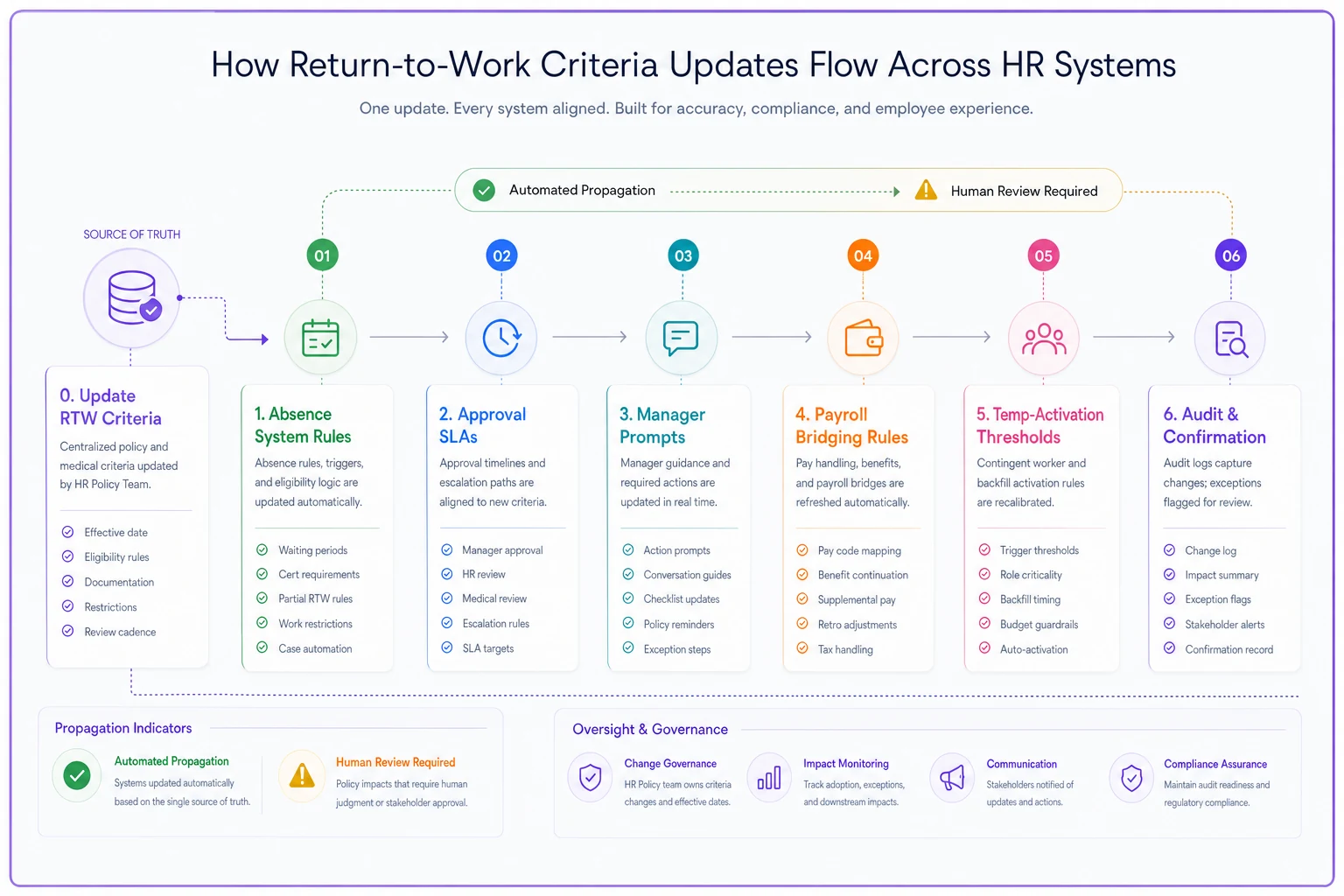
The point isn't to automate the return decision. It's to make sure that when the rules change, every downstream system changes with them — so a manager on day 4 of someone's absence isn't working from a counter that expired two seasons ago.
Closing thought
The CDC update is a small clinical change with an outsized operational footprint. The organizations that handle it well won't be the ones with the best handbook language. They'll be the ones who treated return‑to‑work criteria as a single source of truth instead of a number copy‑pasted into six different systems. Find every place a day‑count is hiding, convert the fixed rules to conditional ones, and make sure your managers are ready for a judgment call they weren't making last year. Do that before the season peaks, and the rest of your absence program stays honest.
Ready to optimize your workforce absence management?
Join 2,000+ HR teams using Absencely to reduce administrative burden, improve compliance, and boost employee satisfaction.