


Finding out three months after the fact that payroll calculated intermittent leave wrong is every HR manager's nightmare. Someone forgot to log Tuesday afternoon's 4-hour absence correctly, and now you're dealing with an angry employee and a potential wage claim.
Intermittent leave tracking breaks down at the handoff points. Your manager scribbles "left early" in their notebook. HR enters "partial day absence" in the system. Payroll sees nothing because the email got buried under fifty other messages.
The damage shows up weeks later when an employee opens their pay stub and realizes they've been docked for time that should've been protected leave. Now you're scrambling through three different systems trying to figure out what actually happened on March 14th at 2:30 PM.
The three-layer tracking breakdown
Most businesses think they have an intermittent leave process. They actually have three separate processes that sometimes talk to each other.
Your frontline manager sees the employee leave and makes a mental note. Maybe writes something down. They're managing 12 other people and dealing with customer issues - recording exact leave times isn't exactly their top priority.
HR gets some version of this information days later. They translate "John wasn't here Tuesday afternoon" into whatever fields their HRIS requires. But was that 2 hours? 4 hours? Did it start at noon or 1 PM? Nobody remembers.
Payroll processes what they receive, which might be a forwarded email saying "Please adjust John's time for FMLA." They make their best guess, run the numbers, and hope nobody notices if it's slightly off.
Each layer thinks they're doing it right. Within their own system, they are. The problem is these systems don't actually align.
Day 1: When absence happens (Manager's checklist)
The moment an employee takes intermittent leave, your manager needs five pieces of information. Not tomorrow. Not "when they get back to their desk." Right then.
Stop managing absences manually.
Absencely simplifies leave requests, approvals, and absence monitoring for your entire workforce.
- Automated leave tracking
- Manager approval workflows
- Compliance & reporting tools
No credit card required
Required fields for initial capture:
-
Employee name and ID
-
Date and exact start time (2
15 PM, not "afternoon")
-
Expected return time or actual return if already back
-
Leave type code (FMLA continuous, FMLA intermittent, state leave)
-
Coverage arrangement (who's handling their work)
When Maria calls at 10:45 AM saying she needs to leave for her approved intermittent FMLA, this is what the documentation looks like:
``
Employee: Maria Rodriguez (ID: 3847)
Date: 11/12/2024
Left: 11:00 AM
Returned: [Blank - did not return same day]
Code: FMLA-I (intermittent)
Coverage: Tasks redistributed to James and Anita
Notes: Migraine episode - approved condition
``
The manager enters this into whatever they're using - spreadsheet, form, notebook - but it has to be consistent every time. Same format. Same fields. Every occurrence.
Day 2: The HR translation point
Within 24 hours, this information needs to reach HR in a format they can actually process. Not a week later when memories have faded. Not through verbal handoff where details disappear.
HR verification points:
-
Match against approved leave certification
-
Confirm within frequency limits (like 2 days per week max)
-
Calculate hours/days used against entitlement
-
Update running balance
-
Check pattern for potential abuse indicators
-
Document in employee file
The critical piece here is translation. When the manager's note says Maria left at 11 AM, HR needs to know: Does that count as a full day? Half day? 5 hours?
-
Less than 2 hours = 0.25 day
-
2-4 hours = 0.5 day
-
More than 4 hours = 1.0 day
Or track by exact hours if your leave allotment works that way. But everyone needs the same rulebook.
The payroll preparation handoff
This is where most intermittent leave tracking completely falls apart. Payroll often gets a summary that looks like "Maria used 2.5 days FMLA this period." That's not enough.
Payroll adjustment record:
``
Period: 11/11/2024 - 11/24/2024
Employee: Maria Rodriguez (3847)

11/12 (Tue): FMLA 5 hours (11 AM - end of shift)
11/15 (Fri): FMLA 8 hours (full day)
11/21 (Thu): FMLA 3 hours (1 PM - 4 PM)

Total FMLA hours: 16
Regular hours: 64
Total paid: 80
``
Notice the specificity. Not "about 2 days of leave." Exactly 16 hours, broken down by occurrence. This prevents the nightmare where payroll thinks Maria took 24 hours of leave and shorts her paycheck.
Here's a quick visual of the handoff workflow to keep everyone aligned.
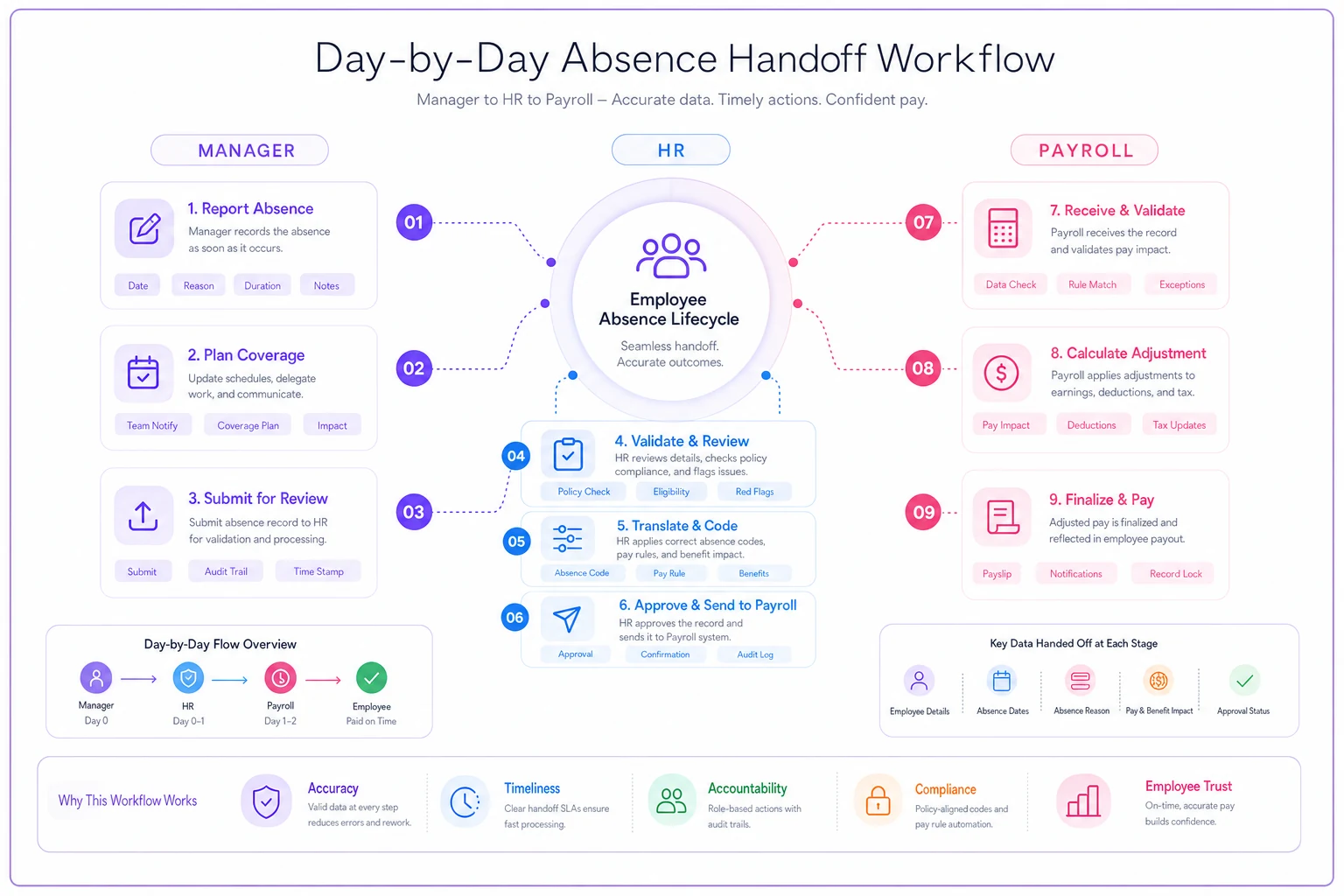
Keep the workflow simple: capture exact times, validate within 24 hours, and hand off a day-by-day record to payroll.
Building the audit trail
Every piece of this documentation serves a purpose beyond just tracking time. You're building evidence for the inevitable audit or dispute.
A solid audit trail for one employee's intermittent leave contains:
Manager level:
-
Daily absence log with timestamps
-
Coverage documentation
-
Any performance or attendance concerns noted separately
HR level:
-
Initial certification and approval
-
Running balance tracker
-
Each occurrence matched to certification
-
Pattern analysis (clustering, frequency changes)
-
Communication log with employee
Payroll level:
-
Period-by-period adjustment records
-
Pay stub notations showing FMLA time
-
Reconciliation between hours worked and leave taken
-
Benefits impact documentation (if applicable)
| Level | Documentation Items |
|---|---|
| Manager level | Daily absence log with timestamps; Coverage documentation; Any performance or attendance concerns noted separately |
| HR level | Initial certification and approval; Running balance tracker; Each occurrence matched to certification; Pattern analysis (clustering, frequency changes); Communication log with employee |
| Payroll level | Period-by-period adjustment records; Pay stub notations showing FMLA time; Reconciliation between hours worked and leave taken; Benefits impact documentation (if applicable) |
When an employee questions their pay six months later, or the DOL comes knocking, you can pull this file and show exactly what happened, when, and how it was processed.
Real scenario: Manufacturing company's $47,000 mistake
A small manufacturing company with 75 employees learned this lesson the hard way. They had an employee, Robert, approved for intermittent FMLA for chronic back issues - up to 3 days per month.
Their "system" was the floor supervisor texting HR whenever Robert left early. HR would make a note. Payroll would occasionally get an email saying "adjust for FMLA."
-
Manager's texts showed 19 partial-day absences
-
HR's records showed 14 instances
-
Payroll had adjusted for 11
Robert filed a complaint when he realized he'd been docked vacation time for FMLA-protected absences. The investigation revealed he'd lost about $3,400 in wages and benefits. But that wasn't even the expensive part. The DOL audit that followed found similar issues with 6 other employees using intermittent leave. Total penalties and back wages: $47,000. Plus the cost of implementing a real tracking system they should've had from the start.
Warning signs your handoffs are breaking
Before you hit a crisis, these patterns indicate your intermittent leave tracking is failing:
-
Employees regularly question their pay stubs about leave-related deductions. If this happens monthly, your documentation isn't reaching payroll correctly.
-
Managers can't tell you how much leave their team members have used this month. They should know because they should be tracking it.
-
HR spends hours every pay period "figuring out" leave adjustments. This means they're reconstructing information instead of simply passing along what was documented.
-
Your payroll team makes assumptions. "I think this means..." or "Usually when this happens..." indicates missing information.
-
Different departments have different numbers for the same employee's leave usage. Run a spot check - if the numbers don't match, your handoffs are broken.
Run a spot check - if the numbers don't match, your handoffs are broken.
The technology gap and realistic solutions
Most small businesses can't afford comprehensive absence management systems that automatically flow from manager to HR to payroll. Those platforms start around $15,000 annually for a 50-person company.
But you also can't keep using sticky notes and memory. The middle ground is building consistent processes with the tools you have.
A shared spreadsheet with controlled access can work if:
-
Managers input daily
-
HR reviews and validates weekly
-
Payroll pulls directly from the validated data
-
Everyone uses the same format and definitions
The key is removing interpretation. When payroll opens the tracker, they should see exactly what to enter, not clues about what might have happened.
Some organizations use form builders to create simple intake forms that feed a central database. Manager clicks a link, fills out five fields, submits. HR gets notified immediately. Payroll sees a clean report. This kind of basic automation removes the failure points without requiring enterprise software.
Build a simple intake form that captures the five required manager fields to reduce downstream errors.
The key is removing interpretation. When payroll opens the tracker, they should see exactly what to enter, not clues about what might have happened.
When intermittent patterns reveal bigger problems
Accurate intermittent leave tracking sometimes reveals patterns you didn't expect. Like discovering that 80% of intermittent leave happens on Mondays and Fridays. Or that certain departments have 3x the intermittent leave usage of others.
These patterns matter for two reasons. First, they might indicate abuse that needs addressing. Second, they might reveal operational issues causing legitimate health impacts.
One retail company noticed their warehouse team's intermittent leave spiked after they changed shift schedules. The new 4x10 schedule was aggravating chronic conditions for several employees. The tracking data led them to offer flexible scheduling options that reduced leave usage by about 40%.
You can't manage what you don't measure accurately. But measuring accurately means everyone has to measure the same way.
The compliance reality check
Under FMLA, employees can take leave in increments as small as your payroll system tracks. If you track time in 15-minute increments, that's your minimum FMLA increment. This granularity makes accurate documentation essential.
The Department of Labor doesn't care that your manager was busy when Sarah left for her treatment. They care whether you can prove Sarah's absence was properly designated as FMLA, properly tracked, and properly reflected in her pay and benefits.
Your documentation is your defense. But only if it tells a consistent story across all three levels - management, HR, and payroll.
Making the handoff system stick
The best tracking system fails if people don't use it consistently. Here's what makes the difference between a policy that exists and a process that actually works:
-
Train managers on why precision matters. Not just "log the absence" but "if you write 'left early' instead of '2:15 PM,' payroll might dock them for a full afternoon instead of 2 hours, and we'll have a wage claim."
-
Make the handoff automatic, not optional. Manager logs absence by end of shift. HR reviews within 24 hours. Payroll gets clean data before processing starts. Build these into job expectations.
-
Create feedback loops. When payroll finds discrepancies, they flag them immediately, not after paychecks go out. When HR notices patterns, they alert managers before problems escalate.
Test your system with a complex case. Take an employee with intermittent leave and trace their documentation through a full pay period. Every gap you find is a future dispute waiting to happen.
Intermittent leave tracking isn't about complex software or perfect systems. It's about getting specific information from the point of absence to the paycheck without losing critical details.
Your managers need to capture exact times and dates. HR needs to validate and categorize properly. Payroll needs clear, specific adjustment instructions. Each handoff point needs defined fields, specific deadlines, and no room for interpretation.
The companies that handle intermittent leave well aren't necessarily the ones with expensive technology. They're the ones where everyone understands their piece of the documentation chain and executes it consistently.
Start with one employee using intermittent leave. Document their next absence using the checklists above. Follow that documentation through your system. Fix the gaps you find. Then scale it to everyone.
The cost of fixing your tracking system is nothing compared to the cost of defending a system that doesn't track anything accurately.
Ready to optimize your workforce absence management?
Join 2,000+ HR teams using Absencely to reduce administrative burden, improve compliance, and boost employee satisfaction.