


Sarah's payroll team discovered their mistake three months too late. A senior developer who switched from hourly contractor to salaried employee had been accruing PTO at both rates simultaneously — the system never stopped the hourly accrual when his status changed. By the time they caught it, he'd taken two weeks of vacation using phantom hours, and four other transitioning employees had the same problem.
This wasn't a software glitch. It was a calculation oversight that happens when companies run mixed hourly and salaried teams without understanding how leave accrual hourly vs salaried actually compounds across different scenarios. The fix took 40 hours of manual recalculation and awkward conversations about clawing back unearned time.
Most companies handle basic PTO math fine when employees stay in their lane. Full-time salary at 80 hours per year? Easy. Hourly at 0.05 per hour worked? No problem. Real workforces don't stay that clean though. People switch classifications, work variable schedules, take unpaid leave, get promoted mid-cycle. That's where expensive mistakes hide.
Why standard accrual formulas break with mixed teams
The textbook formulas everyone uses assume employees fit into neat boxes. They don't account for the messy middle where most small businesses actually operate.
-
Double-dipping scenarios
Employee works 45 hours, gets overtime pay, and the system counts those extra 5 hours toward PTO accrual even though they're already compensated at time-and-a-half.
-
Classification lag
Employee gets promoted from hourly to salary on the 15th. System keeps calculating hourly accruals through month-end because nobody updated the classification until next payroll cycle.
-
Part-time confusion
Employee works 30 hours per week but gets prorated salary. System calculates PTO based on full-time equivalent instead of actual hours, creating a 25% variance in earned time.
-
Unpaid leave gaps
Employee takes two weeks unpaid leave. Salaried accrual continues unchanged while hourly employees in the same situation earn nothing, creating perceived inequity and actual policy violations.
Take the standard hourly accrual calculation: Hours Worked × Accrual Rate = PTO Earned. Seems bulletproof until you realize "Hours Worked" means different things across your systems. Does it include overtime? What about on-call hours? Training time? Different departments answer differently, and your warehouse team ends up earning PTO at 1.5x the rate of customer service reps doing the same base hours.
For salaried employees, the formula looks simpler: Annual Entitlement ÷ Pay Periods = Per-Period Accrual. This assumes perfect attendance though. Miss three weeks for medical leave? Most systems keep accruing anyway unless someone manually intervenes. Now you've got employees with negative PTO balances or entitled to more time than policy allows.
The real killer is when employees straddle both worlds. Restaurant managers often work guaranteed salary plus overtime. Nurses might be salaried but pick up hourly shifts. Tech consultants bounce between project-based contracts and regular employment. Each transition creates a calculation boundary where standard formulas fail.
The formulas that actually work (with edge cases built in)
For pure hourly employees: Base Accrual = (Regular Hours Worked × Base Rate) + (Overtime Hours × 0)
Stop managing absences manually.
Absencely simplifies leave requests, approvals, and absence monitoring for your entire workforce.
- Automated leave tracking
- Manager approval workflows
- Compliance & reporting tools
No credit card required
Notice we explicitly exclude overtime from accrual. This prevents the double-dipping problem while keeping calculations consistent. If your policy includes overtime in accrual (some union contracts require this), use a separate rate:
Overtime-Inclusive Accrual = (Regular Hours × Base Rate) + (OT Hours × Base Rate × 0.5)
For salaried employees with attendance variations: Adjusted Accrual = (Base Annual Entitlement ÷ 260) × Actual Days Worked
Instead of dividing by pay periods, we use standard working days (260 annually) then multiply by actual days present. This automatically adjusts for unpaid leave, partial months, and mid-period changes.
For employees transitioning between classifications: Split-Period Accrual = (Hourly Days × Hourly Rate × Hours Worked) + (Salary Days × Daily Salary Accrual)
Calculate each portion separately based on actual days in each classification, not pay period percentages. An employee who switches on the 20th of a 30-day month gets 20 days of hourly accrual plus 10 days of salary accrual, not 66% and 33%.
For mixed-classification employees (salary plus hourly): Hybrid Accrual = Base Salary Accrual + (Additional Hourly Work × Hourly Rate × 0.75)
The 0.75 modifier prevents salaried employees who pick up extra shifts from out-earning pure hourly staff. Adjust based on your policy goals.
Real calculation walkthrough: Tech company with mixed team
Let me walk through a scenario from a 50-person software company that nearly failed a wage audit because of accrual errors.
-
Junior developers
$35/hour, accrue 0.05 hours PTO per hour worked
-
Senior developers
$95,000 salary, 120 hours PTO annually
-
Contract-to-hire developers
Start hourly, convert to salary after 90 days
| Type | Rate/Salary | Accrual |
|---|---|---|
| Junior developers | $35/hour | accrue 0.05 hours PTO per hour worked |
| Senior developers | $95,000 salary | 120 hours PTO annually |
| Contract-to-hire developers | Start hourly, convert to salary after 90 days |
Scenario 1: The converting contractor Marcus started January 1st at $40/hour, converted to $85,000 salary on April 1st.
-
January through March (hourly)
- Worked 520 hours total (including 40 hours overtime) - Standard calculation would give: 520 × 0.05 = 26 hours PTO - Corrected calculation: 480 × 0.05 = 24 hours PTO - Difference: 2 hours over-accrued
-
April through December (salary)
- 9 months remaining = 75% of year - Annual entitlement: 120 hours - Prorated entitlement: 120 × 0.75 = 90 hours - Monthly accrual: 90 ÷ 9 = 10 hours
-
Year-end total
24 + 90 = 114 hours The company's original calculation gave him 26 + 120 = 146 hours because they didn't prorate the salary portion. That's 32 hours over-granted, worth roughly $2,400 in unexpected liability.
Scenario 2: The mixed-schedule senior Lisa, a senior developer, picked up weekend hourly support shifts at $50/hour while maintaining her salary.
Base salary accrual: 120 hours ÷ 12 = 10 hours monthly Additional hourly work: 160 hours of weekend shifts Standard calculation: 160 × 0.05 = 8 additional hours Hybrid calculation: 160 × 0.05 × 0.75 = 6 additional hours Total annual accrual: 120 + 6 = 126 hours Without the hybrid modifier, she'd earn 128 hours while doing less total work than pure hourly employees earning 120 hours. Small difference, but it adds up across multiple employees and years.
Scenario 3: The medical leave gap Tom, salaried senior developer, took 6 weeks unpaid FMLA leave.
-
Standard calculation
120 hours annual entitlement (no adjustment)
-
Corrected calculation
- Working days in year: 260 - Days on unpaid leave: 30 - Adjusted working days: 230 - Prorated accrual: 120 × (230 ÷ 260) = 106.15 hours
-
Difference
13.85 hours over-accrued if not adjusted
These three employees alone had the company over-granting about 48 hours of PTO annually — worth around $3,600 in direct costs, not counting coverage expenses or productivity loss.
The reconciliation checklist that catches errors before payroll runs
Building a pre-payroll checkpoint system stops these errors from compounding. Most companies check PTO balances quarterly at best. By then, the mistakes are baked in and painful to reverse.
-
Monday
Classification audit - Pull list of all employee status changes from past week - Verify PTO accrual rates match new classifications - Check for any delayed effective dates - Flag any employees with multiple classifications
-
Tuesday
Hours validation - Compare timesheet hours to PTO accrual calculations - Identify any overtime hours counting toward PTO - Check for on-call or training hours incorrectly included - Verify unpaid time off is excluded from calculations
-
Wednesday
Balance reasonableness - Run report of all employees with PTO balances over 150% of annual entitlement - Check any negative balances against approved advance requests - Compare month-over-month balance changes to spot anomalies - Flag anyone accruing faster than policy maximum
-
Thursday
System crosscheck - Compare PTO balances between payroll and HRIS systems - Verify recent time-off requests properly deducted - Check that terminated employees stopped accruing - Confirm new hires started accruing on correct date
-
Friday
Manual calculation spot-check - Randomly select 5 employees - Manually calculate their PTO accrual for the period - Compare to system calculation - Document any discrepancies over 0.5 hours
This seems like overkill until you catch your first $10,000 mistake. One company found they'd been accruing PTO for terminated employees for six months because the HRIS and payroll systems weren't syncing termination dates properly. Another discovered their overnight shift differentials were counting as overtime for PTO purposes, adding 20% to those employees' accruals.
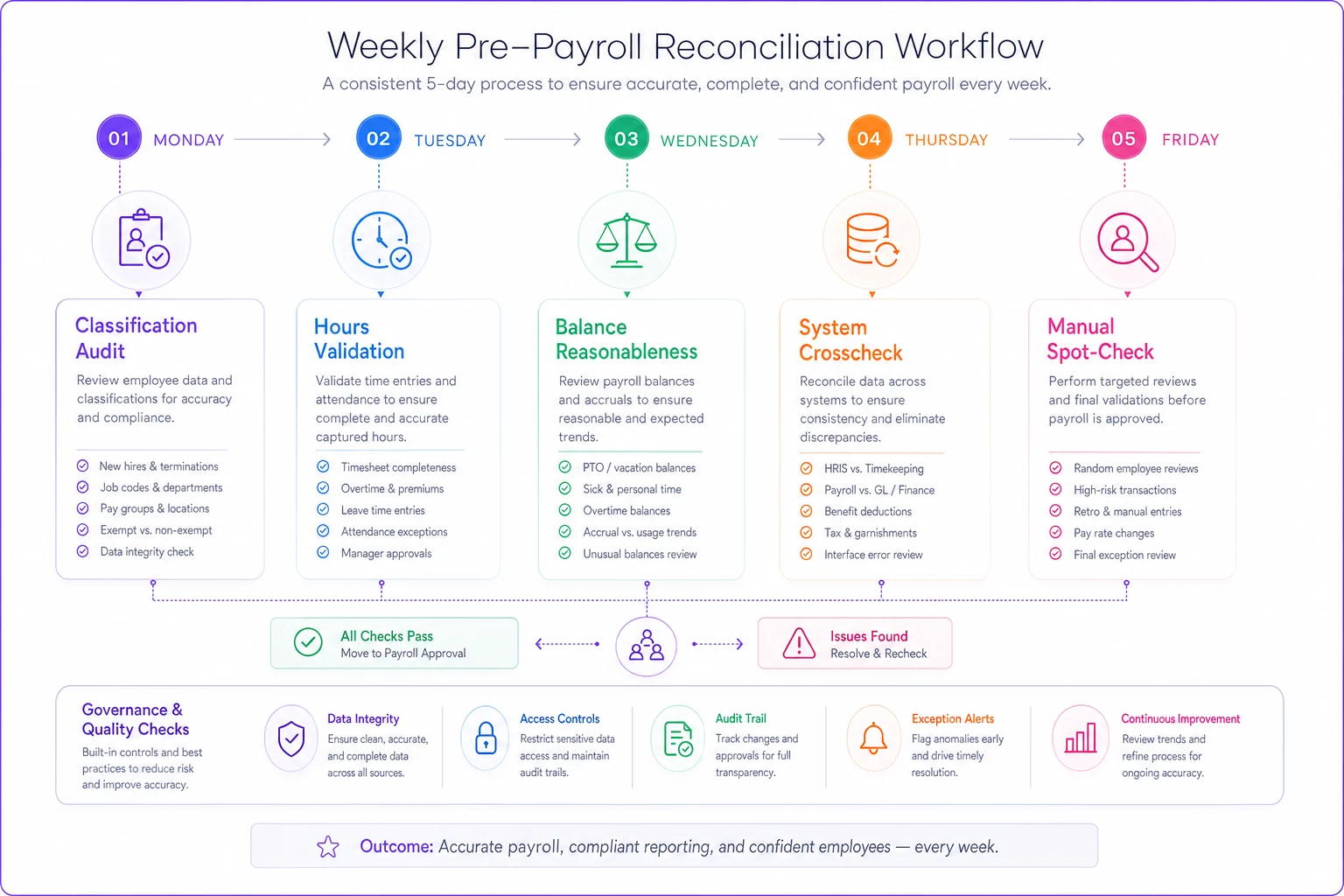
A simple visual of the weekly checkpoints helps payroll and HR coordinate the checks quickly.
The compliance landmines hiding in your calculations
Beyond the financial hit, calculation errors trigger compliance problems that hurt worse than overpayments.
California requires different accrual methods for different types of leave. Sick leave accrues at one hour per 30 hours worked, but vacation can follow company policy. Mix those up and you're facing penalties plus required corrections going back two years. A 50-person company recently got hit with $45,000 in penalties because they were calculating both types the same way.
Multi-state operations compound the complexity. An employee living in Oregon but working remotely for a Texas company follows Oregon's leave laws, not Texas. If they fly to Texas for a week of on-site work though, that week might follow different rules. Most systems can't handle this split automatically.
Union contracts often specify exact accrual formulas that override standard calculations. One manufacturing client had three different unions, each with unique PTO rules. Their payroll system could only handle one formula per employee class, so they were manually adjusting hundreds of calculations every pay period until they built custom calculation logic.
Compliance errors usually get discovered during investigations triggered by other issues. An employee files a wage complaint about overtime, the investigator audits everything, and suddenly you're explaining why your PTO calculations have been wrong for three years.
When to stop patching and rebuild your calculation framework
Manual reconciliation and spreadsheet patches work until they don't. Usually around 30-40 employees, the complexity overwhelms whatever system you've cobbled together.
The breaking point comes when you're spending more time fixing calculations than improving operations. If your HR team devotes every Monday to PTO corrections, or if you're maintaining separate spreadsheets for each employee type, you've already passed the threshold where manual systems make sense.
Operational software becomes critical here — not as a magic solution, but as a framework for handling complexity consistently. Modern AI-powered operational platforms can maintain multiple accrual formulas simultaneously, automatically switch employees between classifications, and flag anomalies before they become errors. The key is choosing software that understands mixed employment types from the ground up, not trying to force complex scenarios into simple templates.
The investment typically pays back within six months through error reduction alone. But the real value comes from freeing your HR team to focus on strategic work instead of mathematical debugging. One client calculated they were spending $3,200 monthly on manual PTO management across salary and time costs. After implementing workflow automation, that dropped to about 4 hours monthly for oversight and exceptions.
Building your mixed-team accrual strategy
Getting this right starts with accepting that your workforce doesn't fit the standard formulas. Instead of forcing everyone into preset categories, build calculations that match how you actually operate.
Document every employment scenario in your company. Not just hourly versus salary, but all the variations: part-time salary, hourly with guaranteed minimums, salary with hourly overtime, contractors converting to employees. Each needs its own calculation logic.
Document every employment scenario in your company.
Create clear policies for edge cases before they happen. What happens when someone takes unpaid leave? How do you handle mid-pay-period classification changes? When does overtime count toward accrual? Writing these rules when you're not trying to fix a specific problem leads to better decisions.
Test calculations with real scenarios. Take last year's actual employment changes and run them through your proposed formulas. You'll spot gaps in logic that would otherwise surface during payroll.
Train your team on why calculations work the way they do, not just how to enter data. When people understand the logic, they catch errors before they compound. A payroll clerk who knows why overtime doesn't count toward PTO accrual will flag it when the system calculates incorrectly.
Companies that handle mixed teams well don't have more sophisticated software or bigger HR departments. They've just accepted that leave accrual hourly vs salaried requires different thinking for modern workforces. Once you stop trying to force complex employment into simple formulas, the calculations become manageable, the errors disappear, and your team stops dreading payroll week.
Your PTO calculations might seem like minor technical detail, but they directly impact employee satisfaction, compliance risk, and operational cost. Getting them right the first time beats fixing them after the damage compounds. The framework and formulas above will catch most errors before they hit payroll.
The rest comes down to vigilance and accepting that mixed employment types need mixed calculation approaches.
Ready to optimize your workforce absence management?
Join 2,000+ HR teams using Absencely to reduce administrative burden, improve compliance, and boost employee satisfaction.